
Can BPC-157 Really Heal a Torn Tendon? The Evidence Is More Complicated Than Social Media Suggests
Published on:
People are asking...
Men on TRT getting hair transplants - can they bolster recovery by layering on anything else over TRT? Fin/min is a given....
The peptides GHK-Cu and BPC-157 have shown some benefits in assisting with recovery and regrowth after a hair transplant.... See Full Answer
Are muscle pains (e.g. calf pain) directly related to DVT or are there other possible causes? My bloodwork has been very consistent (never a concern)...
A safe diagnosis isn't possible over Reddit, so we would suggest you go to see your local doctor. Muscle pains can certainly be from overexertion, even TRT can't prevent that. But if the pain is that ... See Full Answer
Same with men on TRT getting cosmetic surgery like a jaw surgery, can anything else added to TRT speed recovery?...
outside of TRT, the main medicine shown in studies to assist with recovery after a cosmetic surgery would be sermorelin.... See Full Answer
Have a question? Ask us.
At AlphaMD, we're here to help. Feel free to ask us any question you would like about TRT, medical weightloss, ED, or other topics related to men's health. Or take a moment to browse through our past questions.
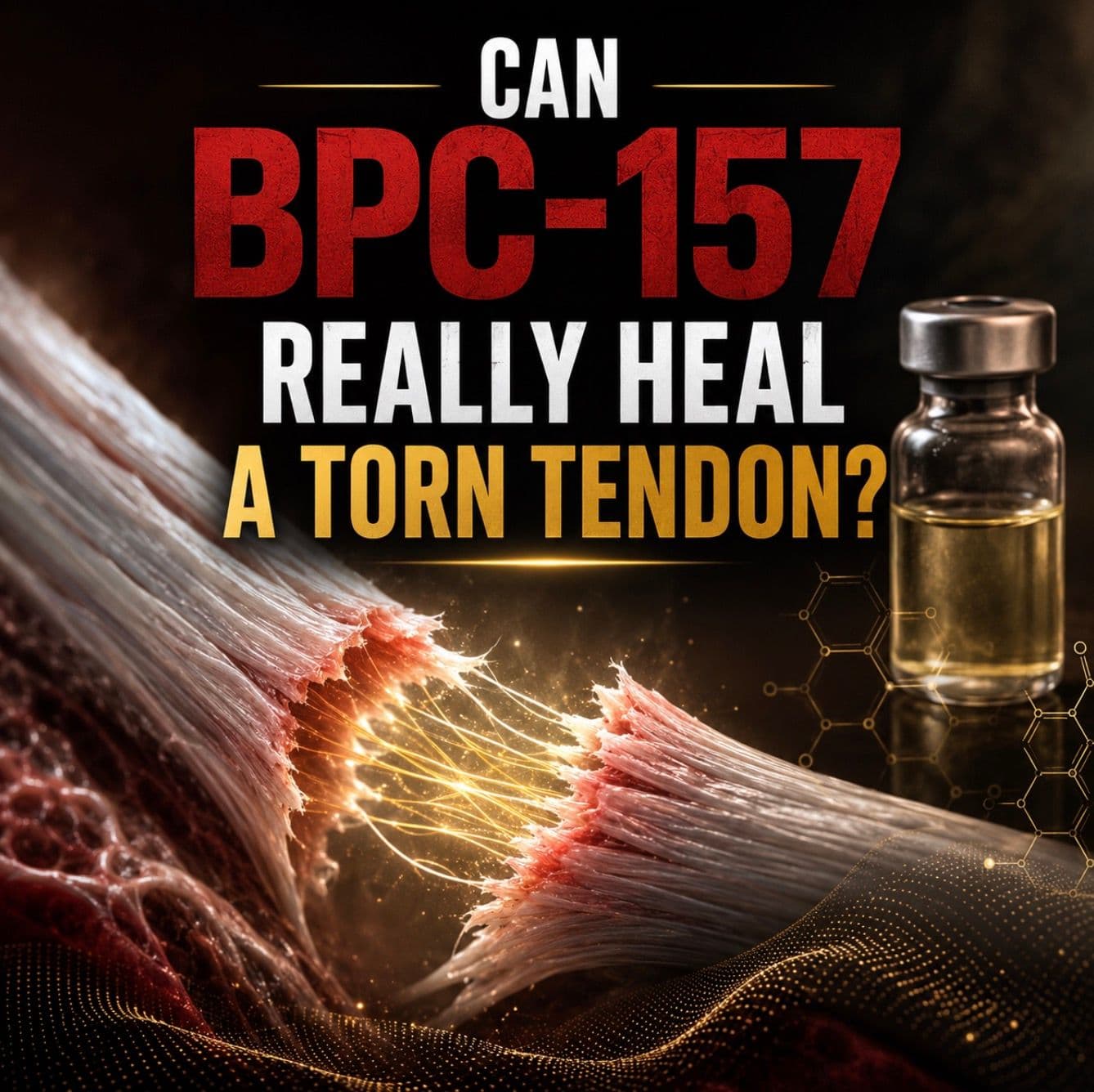
BPC-157 has not been shown in controlled human trials to heal a torn tendon. Animal work on transected rat Achilles tendons and tendon-cell migration is the actual evidence base. Social media skips the species gap, the difference between tendinopathy and rupture, and the fact that many “tears” on MRI are degenerative and managed without a peptide.
If a tendon injury is why you searched this, read AlphaMD’s BPC-157 peptide page for sourcing context - and see an appropriate clinician for the injury itself. A waitlist is not urgent orthopedic care. BPC-157 is not currently for sale through AlphaMD.
What do the famous rat studies show?
Transected Achilles models reported better biomechanics and function with BPC-157 versus controls (PubMed). Fibroblast studies described faster outgrowth and FAK-paxillin signaling (PubMed). Those papers justify laboratory follow-up. They do not justify skipping MRI, ignoring a retracted biceps tendon, or injecting a mystery vial into a shoulder.
A 2019 Cell and Tissue Research review collects preclinical musculoskeletal themes. Reviews of animal data are not human rupture trials. The broader tendon article is BPC-157 for tendon and muscle injuries.
Why are human tendons more complicated?
- Partial versus complete; mid-substance versus insertion.
- Age, diabetes, smoking, and fluoroquinolone history change healing.
- Load: a tendon that still does hill sprints will not behave like a caged rat.
- Surgery versus conservative care is an orthopedic decision, not a peptide decision.
- Degenerative “tears” on MRI can be incidental in middle-aged shoulders.
Pain reduction, MRI improvement, return-to-sport, and re-tear rates are different endpoints. Anecdotes usually report pain. They rarely report standardized imaging or two-year re-injury rates. Demand those endpoints before believing a before-and-after post.
What did FDA say about tendonitis?
Tendonitis was listed among nominated uses. FDA stated the nomination lacked sufficient information to evaluate that use and that clinical studies in that population were not identified. Compounding policy debate around ulcerative colitis does not secretly approve sports-medicine tendon repair.
Read the FDA briefing. Staff recommended against 503A listing. The committee later voted 8–6–1 to recommend inclusion. That is not a rotator-cuff label. See the compounding-vote explainer.
How should you talk about “healing” without marketing language?
A complete Achilles rupture with retraction is a different disease than insertional tendinopathy. A small articular-sided partial cuff tear is a different disease than a massive irreparable tear. Collapsing them into “BPC heals tears” is how people delay surgery they needed or skip rehab they still need.
If you are postoperative, “healing the tendon” is the surgeon’s reconstruction plus biology plus loading. An experimental angiogenic peptide can theoretically change timing in unhelpful ways. See why faster healing is not always better and five questions after surgery.
Product quality still decides whether you even injected BPC-157. See mislabeled vials and acetate vs. free base.
Who should not treat a tear with a research vial?
Anyone with a suspected complete rupture who has not seen an appropriate clinician. Tested athletes: WADA prohibits BPC-157 at all times (Prohibited List). It will not be prescribed through AlphaMD for that use case. Cancer history, pregnancy, and under-18 remain stops.
What does a “tear” on MRI actually mean?
Radiologists use tear language for a spectrum: interstitial signal, partial-thickness, full-thickness with or without retraction, and degenerative splitting. A 5 mm articular-sided partial cuff tear in a 50-year-old overhead athlete is not a transected rat Achilles. Many partial tears are managed with load modification and rehab. Some complete tears with retraction need urgent surgical discussion. The report cannot be treated as a peptide indication.
Ultrasound and MRI also disagree sometimes. Operator skill, magnet strength, and positioning change what you see. A second read by a musculoskeletal radiologist can matter more than a vial. If you already had surgery, postoperative imaging has its own artifacts. Do not inject an experimental peptide because a six-week MRI still “looks angry.” Inflammation and remodeling can look loud.
Functional loss is the clinical compass: cannot plantarflex, cannot lift the arm, obvious gap, or a positive special-test cluster after trauma. Those stories belong in an orthopedic or sports-medicine visit this week, not in a peptide cart.
What endpoints would make a human tendon-tear claim believable?
Define the tear. Randomize or otherwise control loading and rehab, because those are effective confounders. Use a characterized product (sequence, salt, potency, sterility). Measure pain with a validated scale, function with a sport- or joint-specific score, and structure with standardized imaging — then follow re-injury long enough that a two-week miracle cannot hide a six-month retear.
That is a high bar. It is also the bar patients think “heals torn tendons” already cleared. It has not. Animal biomechanics after transection are a reason to keep researching. They are not a reason to skip a surgeon for a retracted biceps or to peri-tendinously inject a Telegram cake.
If a lawful compounded product ever exists through AlphaMD, it would still sit after diagnosis. Nominated UC capsules and 2,000 μg/mL subcutaneous strengths are not tear-size dosing. See dosing: what is studied.
Frequently asked questions
I have a 5 mm partial tear. Will BPC-157 fix it?
No clinical trial answers that by tear size. Many partial tears improve with rehab alone.
Should I inject into the tendon?
Intralesional injection of an unapproved, untested product adds risk without proven benefit.
Is surgery failure a reason to try it?
Failed repairs need surgical reassessment. An experimental peptide is not a default salvage protocol.
How soon after a tear should I start?
There is no evidence-based hour mark. Diagnosis and loading first.
Is this the same as PRP or stem cells?
No. Different products, different evidence, still not a reason to skip an orthopedic exam.
How should you use rehab while you wait for better peptide data?
Tendinopathy programs work by loading the tendon enough to remodel and not so much that you keep the nociceptive fire going. That window is personal. A peptide that theoretically reduces pain could push you out of the window. Stay with the therapist’s progression. Pain charts and strength tests beat forum checkmarks.
After a repair, the graft or suture is the structure. Biology fills in around it on a schedule the surgeon chose. Skipping a sling or a boot because a vial “should have accelerated collagen” is how repairs fail. If you want reading on timing risk, use faster healing is not always better.
Complete ruptures with retraction need a time-sensitive surgical discussion. Do not spend that window sourcing a research chemical. Degenerative partial tears often need patience more than novelty. MRI souvenirs without function loss are a reason for a second opinion, not a peri-tendinous experiment.
What product problems mimic “the peptide didn’t heal my tear”?
Wrong identity, under-potency, and short courses of a drug that was never shown to work. People then double the dose. Doubling a mystery is not pharmacology. Infection can also end a rehab plan. Gray-market injectables add that risk without adding a proven structural benefit.
Salt-form confusion means two people “on BPC” were not on the same API. Comparing their MRI stories is theater. See acetate vs. free base and mislabeled vials.
If a lawful product ever exists through AlphaMD, it would still not be a stapler. Diagnosis, loading, and surgical judgment remain the evidence-based core. Tested athletes remain excluded from prescription through AlphaMD.
A timeline people actually live through — without a peptide
Week one after a strain: protect, avoid complete rest that stiffens everything, see a clinician if function is lost. Weeks two to six: progressive loading if it is tendinopathy. Months: remodeling. A complete rupture timeline is set by surgery or by a documented conservative plan, not by a two-week vial. Social media compresses those calendars because compression sells.
MRI follow-up, when used, should answer a clinical question: new retraction, unexpected fluid, failed repair. It should not be a trophy hunt for “proof the peptide worked.” If you changed loading at the same time, you cannot attribute signal change to a molecule.
People who train through pain will not get a fair test of anything. The tendon needs a different input than another set of hill sprints. That is true whether or not BPC-157 ever becomes a compounded option. See tendon and muscle research for the animal-data version of this caution.
If your job or sport pressure is the reason you want a stapler, say that out loud to the clinician. Return-to-play pressure is a known risk factor for bad decisions. An experimental peptide will not ethically carry that pressure.
Bring prior imaging to the visit. Dates, magnet strength, and the exact words “partial,” “full-thickness,” and “retraction” change the plan. A peptide conversation that starts without those words is not a tendon plan. It is a shopping conversation. Keep it medical, and keep unregulated injectables out of the tendon until a lawful, tested product and a clear diagnosis exist. Social media is not that diagnosis. Neither is a research-chemical CoA. A licensed clinician plus imaging when indicated still is. That pairing beats a vial every time you check.
Related reading
- BPC-157 for joint pain
- BPC-157 dosing
- BPC-157 safety
- Seven unproven claims
- AlphaMD peptides hub
- BPC-157 benefits and FDA review
Bottom line
The tendon story is the most viral BPC-157 story and one of the least clinically proven in humans. Complicated anatomy deserves complicated care — diagnosis, loading, and, when indicated, a surgeon — not a simplified peptide miracle.
Medical disclaimer: This article is for informational purposes only and does not constitute medical advice. BPC-157 is not an FDA-approved drug and is not currently available for sale or prescription through AlphaMD. Speak with a licensed medical provider before using any medication, peptide, supplement, or injectable product.
Have a question? Ask us.
At AlphaMD, we're here to help. Feel free to ask us any question you would like about TRT, medical weightloss, ED, or other topics related to men's health. Or take a moment to browse through our past questions.
People are asking...
Men on TRT getting hair transplants - can they bolster recovery by layering on anything else over TRT? Fin/min is a given....
The peptides GHK-Cu and BPC-157 have shown some benefits in assisting with recovery and regrowth after a hair transplant.... See Full Answer
Are muscle pains (e.g. calf pain) directly related to DVT or are there other possible causes? My bloodwork has been very consistent (never a concern)...
A safe diagnosis isn't possible over Reddit, so we would suggest you go to see your local doctor. Muscle pains can certainly be from overexertion, even TRT can't prevent that. But if the pain is that ... See Full Answer
Same with men on TRT getting cosmetic surgery like a jaw surgery, can anything else added to TRT speed recovery?...
outside of TRT, the main medicine shown in studies to assist with recovery after a cosmetic surgery would be sermorelin.... See Full Answer
Get $30 off your first month’s order
Enter your email address now to receive $30 off your first month’s cost, other discounts, and additional information about TRT.
Legal Disclaimer
This website is a repository of publicly available information and is not intended to form a physician-patient relationship with any individual. The content of this website is for informational purposes only. The information presented on this website is not intended to take the place of your personal physician's advice and is not intended to diagnose, treat, cure, or prevent any disease. Discuss this information with your own physician or healthcare provider to determine what is right for you. All information is intended for your general knowledge only and is not a substitute for medical advice or treatment for specific medical conditions. The information contained herein is presented in summary form only and intended to provide broad consumer understanding and knowledge. The information should not be considered complete and should not be used in place of a visit, phone or telemedicine call, consultation or advice of your physician or other healthcare provider. Only a qualified physician in your state can determine if you qualify for and should undertake treatment.