
Fish Oil Reached the Muscle but Did Not Add More Muscle
Published on:
Updated on:
People are asking...
What happens to the test carrier / ester oil in your body when you inject into the muscle. How is it metabolised/ where does the oil go?...
Testosterone in its true form, like most drugs, comes in a powder. Most drugs are hydrophilic, so if they need to be injected, they are mixed with saline, bacteriostatic water, or sterile water and th... See Full Answer
So I've been on TRT for 6 months, my clinic doubled my dose when I was at 615 with normal E2 levels then 3 months later. I'm only at like 718 and my E...
You already paid for it, there is no harm in trying it. It’s true, gonadorelin is a poor substitute for hCG, and has little benefit for this purpose, though there may be some while you wait on your ne... See Full Answer
I can’t seem to find the right protocol I want muscle gains but my shgb is really low at 16 currently doing 40mg eod but I feel like it’s not enough f...
As a general rule, higher androgens (ie. Higher TRT doses) will lead to more muscle gains. While we can’t speak to your individual response to that specific dose of 120mg/wk, we can say that dose is n... See Full Answer
Have a question? Ask us.
At AlphaMD, we're here to help. Feel free to ask us any question you would like about TRT, medical weightloss, ED, or other topics related to men's health. Or take a moment to browse through our past questions.
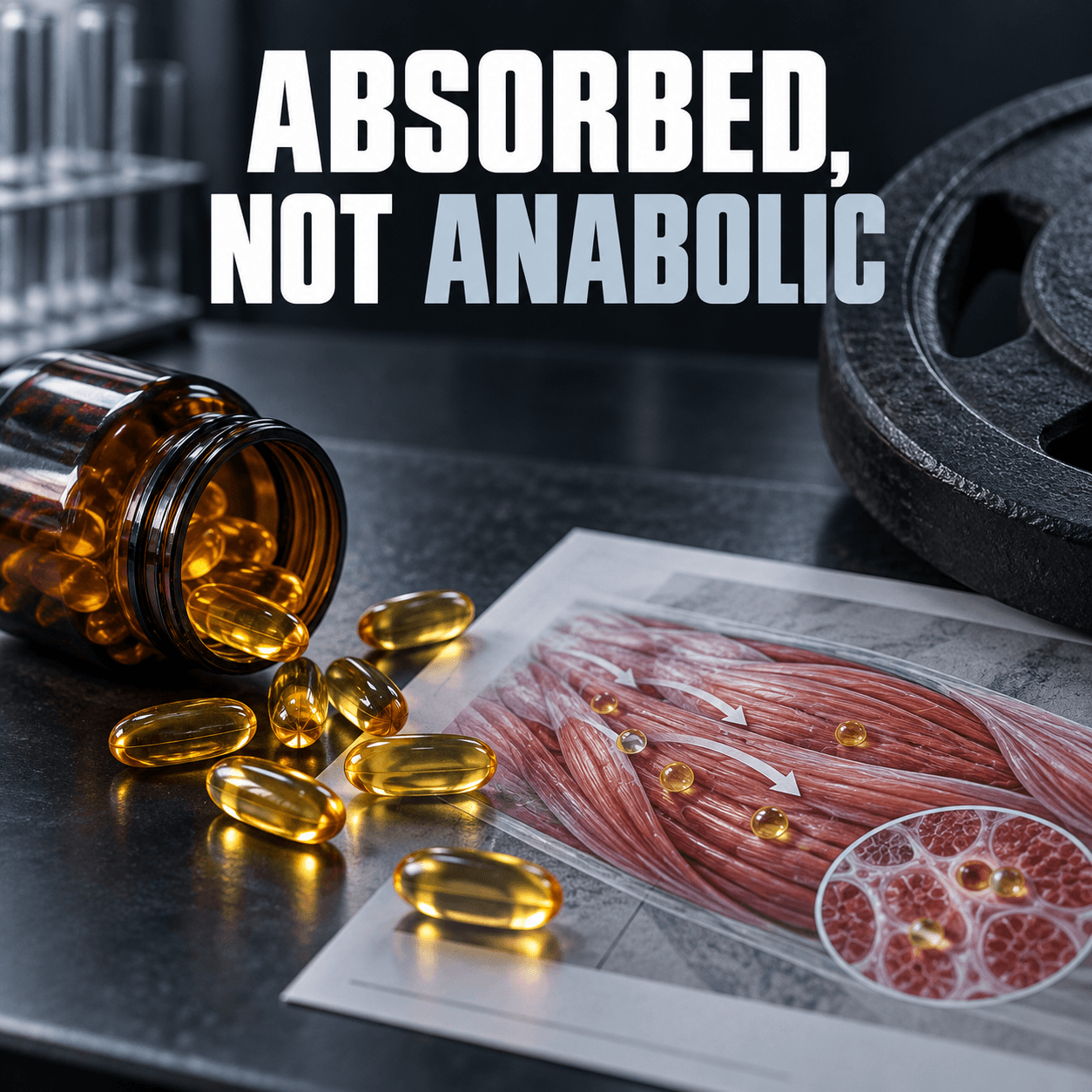
Fish oil did exactly what researchers expected at the biochemical level. Omega-3 fatty acids accumulated in muscle tissue. They just did not produce more muscle.
In a 2026 randomized trial of omega-3 supplementation during resistance training, 46 resistance-trained men completed 14 weeks of supervised lower-body training. They already consumed at least 1.6 grams of protein per kilogram of body weight per day. One group received 6.3 grams per day of omega-3 fatty acids, while the other received placebo.
Both groups gained strength and muscle size. The omega-3 group did not gain more than placebo.
The Study Tested a Difficult Question Well
The researchers did more than measure body weight. They assessed lean mass, muscle cross-sectional area, muscle-fiber size, maximal strength, tissue fatty-acid composition, and key proteins involved in anabolic signaling.
Adherence was high. Training attendance exceeded 96 percent, and supplement adherence exceeded 94 percent. Omega-3 incorporation into muscle tissue confirmed that the supplement reached its intended biological compartment.
Yet there was no added improvement in hypertrophy, strength, or the measured anabolic-signaling response.
That is a useful negative result. It shows that biological uptake is not the same thing as a meaningful performance outcome.
Why Earlier Research Could Still Look Promising
Omega-3 fatty acids have been studied for effects on inflammation, muscle-protein metabolism, recovery, and anabolic sensitivity. Benefits may be more plausible in populations with impaired anabolic responses, lower dietary protein, aging-related resistance, immobilization, illness, or calorie restriction.
This trial enrolled relatively young, healthy, resistance-trained men who were already eating enough protein and following supervised training. Their major muscle-building inputs were in place. A supplement may have had little room to add a detectable effect over 14 weeks.
That does not prove omega-3s can never influence muscle outcomes. It defines a population in which a large daily amount did not add measurable gains.
What This Means for Men on TRT
TRT does not convert every supplement into an anabolic tool. Men sometimes assemble a stack by collecting ingredients with plausible mechanisms, then assume the combined effect must be larger. Trials like this one show why outcome data matter.
If a man uses omega-3s for a clinician-guided cardiovascular or triglyceride-related reason, the absence of extra hypertrophy does not erase that separate rationale. If he takes fish oil primarily because he expects it to add muscle beyond adequate protein and progressive training, this trial weakens that expectation.
The study also does not establish a universally appropriate dose. The amount tested was high, and supplement decisions should account for diet, product quality, bleeding risk, medications, medical history, and the goal being targeted.
The Hierarchy Still Wins
For hypertrophy, the priorities remain familiar:
- Progressive training with enough recoverable volume
- Adequate protein and total energy
- Sleep and recovery
- Consistency over months and years
- Supplements selected for a defined goal, not a mechanistic story
The Bottom Line
In trained men with adequate protein intake, omega-3 supplementation changed muscle fatty-acid composition but did not improve muscle growth, strength, or anabolic signaling beyond training alone. Fish oil may still have other legitimate uses. “More muscle” was not demonstrated here.
This article is for educational purposes and is not medical advice. Discuss high-dose omega-3 supplementation with a licensed clinician, particularly if you use anticoagulant or antiplatelet medication or have a bleeding disorder.
Have a question? Ask us.
At AlphaMD, we're here to help. Feel free to ask us any question you would like about TRT, medical weightloss, ED, or other topics related to men's health. Or take a moment to browse through our past questions.
People are asking...
What happens to the test carrier / ester oil in your body when you inject into the muscle. How is it metabolised/ where does the oil go?...
Testosterone in its true form, like most drugs, comes in a powder. Most drugs are hydrophilic, so if they need to be injected, they are mixed with saline, bacteriostatic water, or sterile water and th... See Full Answer
So I've been on TRT for 6 months, my clinic doubled my dose when I was at 615 with normal E2 levels then 3 months later. I'm only at like 718 and my E...
You already paid for it, there is no harm in trying it. It’s true, gonadorelin is a poor substitute for hCG, and has little benefit for this purpose, though there may be some while you wait on your ne... See Full Answer
I can’t seem to find the right protocol I want muscle gains but my shgb is really low at 16 currently doing 40mg eod but I feel like it’s not enough f...
As a general rule, higher androgens (ie. Higher TRT doses) will lead to more muscle gains. While we can’t speak to your individual response to that specific dose of 120mg/wk, we can say that dose is n... See Full Answer
Get $30 off your first month’s order
Enter your email address now to receive $30 off your first month’s cost, other discounts, and additional information about TRT.
Legal Disclaimer
This website is a repository of publicly available information and is not intended to form a physician-patient relationship with any individual. The content of this website is for informational purposes only. The information presented on this website is not intended to take the place of your personal physician's advice and is not intended to diagnose, treat, cure, or prevent any disease. Discuss this information with your own physician or healthcare provider to determine what is right for you. All information is intended for your general knowledge only and is not a substitute for medical advice or treatment for specific medical conditions. The information contained herein is presented in summary form only and intended to provide broad consumer understanding and knowledge. The information should not be considered complete and should not be used in place of a visit, phone or telemedicine call, consultation or advice of your physician or other healthcare provider. Only a qualified physician in your state can determine if you qualify for and should undertake treatment.