
How Does Ipamorelin Work? Ghrelin and Growth Hormone Explained
Published on:
Updated on:
People are asking...
Thoughts on Kisspeptin and how it compares to hCG?...
Kisspeptin works in a different pathway. Kisspeptin is produced in the hypothalamus and acts upon KISS1 and GPR54 receptors to stimulate the release of several other hormones. It initiates the release... See Full Answer
How about stacking TRT with peptide therapy. Are Sermorelin, Tesamorelin, or CJC w/ Ipamorelin actually safe to use with TRT? What are the real benef...
These are perfectly reasonable options. Currently, licensed providers can prescribe Sermorelin, though not long ago it was permissible to work with the other peptides you mentioned as well. Many men h... See Full Answer
What are the best peptides to pair with TRT for getting lean?...
In terms of current official pharmacy offerings, providers often recommend Sermorelin as a good boost. Anecdotally, Ipamorelin / CJC with or without dac is often described as a solid peptide for fitne... See Full Answer
Have a question? Ask us.
At AlphaMD, we're here to help. Feel free to ask us any question you would like about TRT, medical weightloss, ED, or other topics related to men's health. Or take a moment to browse through our past questions.
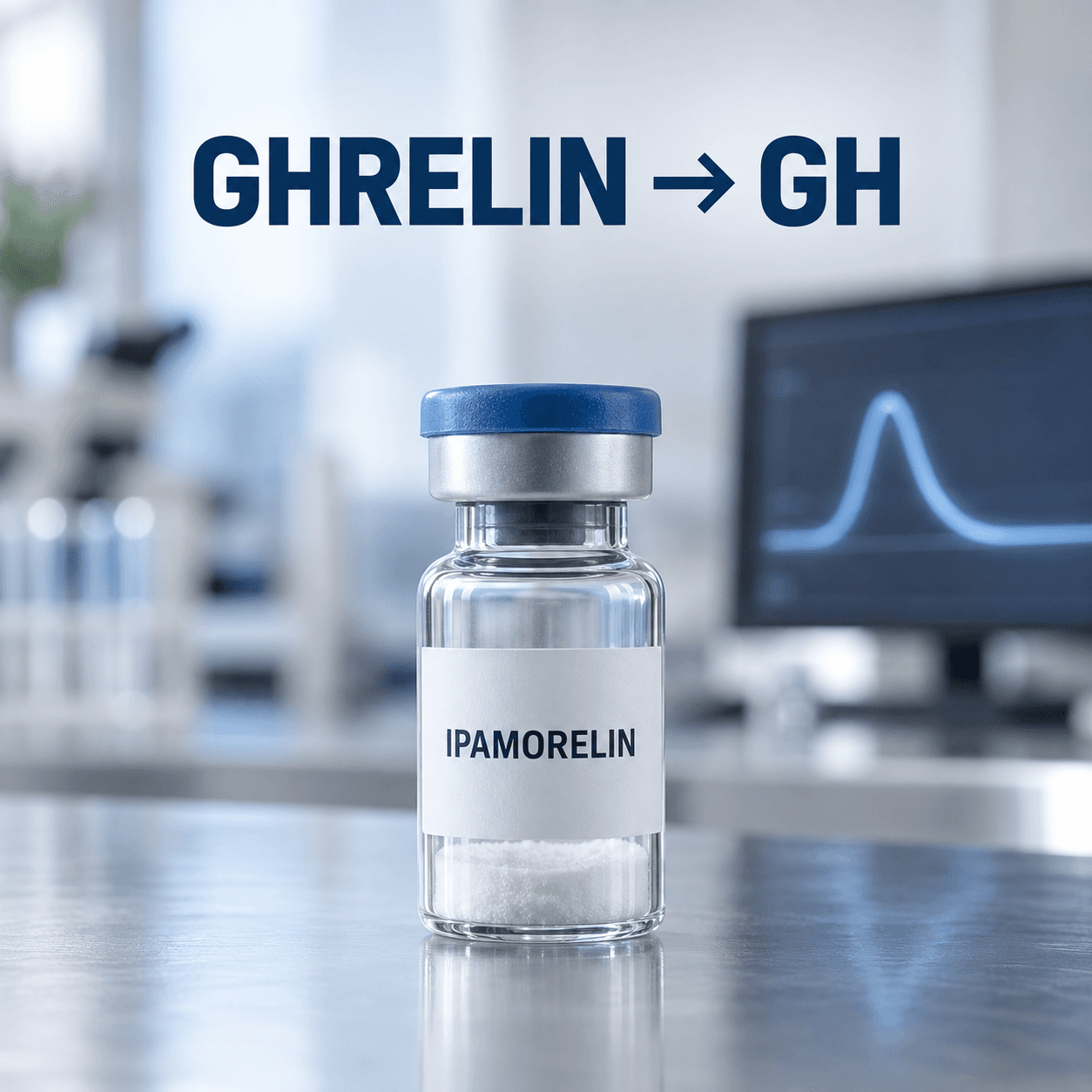
Ipamorelin is a synthetic peptide that activates the growth hormone secretagogue receptor,better known as the ghrelin receptor. That signal can prompt the pituitary gland to release a short pulse of growth hormone (GH). Ipamorelin is not growth hormone itself, and activating this pathway does not prove that it builds muscle, reduces fat, improves sleep, accelerates recovery, or slows aging.
The simplest version of the proposed pathway is: Ipamorelin activates the ghrelin receptor → the pituitary releases GH → GH can signal tissues directly and may influence the wider GH/IGF-1 axis. Human research confirms an acute GH response after intravenous Ipamorelin, but it has not established the long-term wellness and performance outcomes commonly attached to that mechanism.
How Does Ipamorelin Work in One Sentence?
Ipamorelin acts as an agonist at the growth hormone secretagogue receptor type 1a (GHS-R1a), initiating a signal that can cause pituitary somatotroph cells to release stored growth hormone.
“Agonist” means that a substance activates a receptor. “Secretagogue” means that it promotes the release of something the body already makes. In this case, the released hormone is GH.
That distinction is important: Ipamorelin stimulates endogenous GH release; it does not supply recombinant human growth hormone from outside the body.
What Is the Ghrelin Receptor?
The ghrelin receptor is a G-protein-coupled receptor found in the pituitary, hypothalamus, and other tissues. Researchers originally called it the growth hormone secretagogue receptor because synthetic GH-releasing compounds activated it before its natural ligand was known.
The original receptor-cloning study identified this receptor in the pituitary and hypothalamus and showed that growth hormone secretagogues could use it to stimulate and amplify pulsatile GH release. Three years later, researchers identified ghrelin as the receptor's natural ligand.
Ghrelin is often called the “hunger hormone,” but its biology is broader than appetite. It participates in GH release, energy balance, gastrointestinal function, and other signaling systems. Ipamorelin is a synthetic ghrelin-receptor agonist, sometimes described as a ghrelin mimetic because it activates the same named receptor. It is not ghrelin, and it should not be assumed to reproduce every effect of natural ghrelin.
The Ipamorelin Pathway, Step by Step
1. Ipamorelin reaches the ghrelin receptor
Ipamorelin binds to and activates GHS-R1a. The receptor is coupled to intracellular signaling pathways that can increase calcium inside pituitary somatotroph cells.
2. Pituitary cells release stored growth hormone
The receptor signal promotes the release of GH already stored in the anterior pituitary. This differs from injecting growth hormone directly. Ipamorelin relies on a functioning hypothalamic-pituitary system and the body's capacity to produce and release GH.
3. Growth hormone rises as a pulse
In a human pharmacology study of intravenous Ipamorelin, healthy male volunteers received one of five infusion rates. GH rose as a single episode, peaked at approximately 0.67 hours, and then declined toward negligible concentrations. The study estimated Ipamorelin's terminal half-life at about two hours.
Those results demonstrate a short-term pharmacologic response under controlled conditions. They do not establish what happens with different formulations, subcutaneous use, repeated dosing, or long-term exposure.
4. GH can act directly and influence the GH/IGF-1 axis
Growth hormone has direct effects in multiple tissues and can stimulate the liver and other tissues to produce insulin-like growth factor 1 (IGF-1). This is why discussions of Ipamorelin often move from GH release to IGF-1, muscle, fat metabolism, or recovery.
But each arrow in that chain needs evidence. The acute Ipamorelin study measured GH, not sustained IGF-1 changes, body composition, exercise recovery, sleep, or quality of life. A plausible downstream pathway is not the same as a demonstrated clinical outcome.
Is Ipamorelin the Same as Sermorelin or HGH?
No. These substances enter the GH pathway at different points.
Substance | Primary target | What it does conceptually |
Ipamorelin | Ghrelin receptor, GHS-R1a | Signals the pituitary to release endogenous GH through the ghrelin-receptor pathway. |
Sermorelin | GHRH receptor | Mimics part of growth hormone-releasing hormone signaling to encourage endogenous GH release. |
Recombinant human growth hormone | GH receptor | Supplies growth hormone directly rather than asking the pituitary to release it. |
Sermorelin works through the GHRH receptor, while Ipamorelin works through the ghrelin receptor. Those pathways can interact within normal GH regulation, but the substances are not interchangeable. A mechanism-level difference also does not establish that combining secretagogues is more effective or safer; that requires direct human study of the actual combination.
Why Is Ipamorelin Called a “Selective” GH Secretagogue?
The label comes largely from early laboratory and animal research. In the original Ipamorelin characterization, the peptide stimulated GH release in rat pituitary cells, rats, and swine. In swine, it did not increase ACTH or cortisol beyond levels observed with GHRH, even at high experimental doses. The investigators therefore described it as selective for GH release compared with older secretagogues studied in the same experiments.
“Selective” does not mean side-effect-free, precisely targeted in every human tissue, or proven safe for long-term use. The underlying experiments were predominantly preclinical, and the finding should not be converted into a blanket human-safety claim.
Does Activating the Ghrelin Receptor Make You Hungry?
Natural ghrelin can increase appetite, and the ghrelin receptor participates in feeding and energy-balance pathways. That makes the question biologically reasonable.
However, there is not enough controlled human Ipamorelin research to quantify whether it reliably increases hunger, how large that effect might be, or whether it depends on dose, route, timing, or population. Receptor overlap alone cannot establish that Ipamorelin reproduces every effect of natural ghrelin.
The same caution applies in the opposite direction: Ipamorelin should not be described as “appetite-neutral” unless that claim is supported by direct human evidence.
What Have Human Ipamorelin Studies Actually Shown?
The human evidence is narrow.
The healthy-volunteer pharmacology study included five dose groups with eight men in each group. Intravenous Ipamorelin produced a GH pulse at every tested infusion rate. The study answered a mechanism question: can Ipamorelin trigger GH release in people under these conditions? It did not test long-term health, body-composition, sleep, athletic, or anti-aging outcomes.
The main published clinical outcome study asked a different question. In a randomized phase 2 trial after bowel surgery, 117 adults received intravenous Ipamorelin or placebo to test recovery from postoperative ileus. The trial did not show a statistically significant benefit for its primary or secondary efficacy outcomes. That negative gastrointestinal result does not erase the acute GH response; it shows that receptor activity did not produce the tested clinical benefit in that setting.
These studies also used intravenous administration. They cannot automatically validate the pharmacology, safety, or outcomes of subcutaneous products promoted for wellness or performance.
What Does the Mechanism Not Prove?
Understanding the mechanism can explain why a compound was studied. It cannot substitute for outcome trials.
- A GH pulse does not prove increased muscle mass or strength.
- GH signaling does not prove clinically meaningful fat loss.
- Possible influence on the GH/IGF-1 axis does not prove a sustained rise in IGF-1.
- Receptor activity does not prove improved sleep or recovery.
- Preclinical selectivity does not prove long-term human safety.
- A short plasma half-life does not prove that repeated use is safe.
- A plausible combination mechanism does not prove that Ipamorelin stacks work.
Those claims require controlled human studies measuring the specific outcome, in the relevant population, using the same formulation, route, dosing pattern, and duration being discussed.
Is Ipamorelin FDA Approved?
No FDA-approved drug product contains Ipamorelin free base or Ipamorelin acetate.
FDA's review of Ipamorelin-related bulk drug substances found inadequate evidence supporting the proposed uses it evaluated and raised gaps involving human safety, subcutaneous administration, and product characterization. FDA also lists Ipamorelin acetate among bulk substances that may present significant safety risks in compounding, citing concerns that include aggregation, peptide-related impurities, and immunogenicity.
In October 2024, the Pharmacy Compounding Advisory Committee considered Ipamorelin free base and Ipamorelin acetate for the Section 503A Bulks List. The committee summary minutes record a 0 to 12 vote with one abstention against adding each substance. That was an advisory recommendation against inclusion,not FDA approval and not, by itself, a final agency rule.
Regulatory status can change. FDA sources should be checked again immediately before publication.
Frequently Asked Questions
Does Ipamorelin make the pituitary release growth hormone?
Yes, an intravenous human pharmacology study demonstrated an acute GH pulse. That measured response does not prove long-term health, performance, or body-composition benefits.
Is Ipamorelin a form of HGH?
No. Ipamorelin is a growth hormone secretagogue. It signals the body to release endogenous GH; recombinant human growth hormone supplies GH directly.
Does Ipamorelin increase IGF-1?
GH can stimulate IGF-1 production, so the pathway is plausible. But the key human Ipamorelin pharmacology study measured an acute GH response, not a demonstrated long-term IGF-1 benefit. Direct human outcome evidence remains insufficient.
Does Ipamorelin work through GHRH?
Not primarily. Ipamorelin activates the ghrelin receptor, GHS-R1a. GHRH and Sermorelin act through the GHRH receptor. Both pathways can influence pituitary GH release, but they are distinct.
Does Ipamorelin increase hunger?
It is biologically possible because Ipamorelin activates the ghrelin receptor, but controlled human research has not established a reliable appetite effect or its size.
Is Ipamorelin FDA approved?
No. There is no FDA-approved drug product containing Ipamorelin free base or Ipamorelin acetate.
Key Takeaway
Ipamorelin works by activating the ghrelin receptor and prompting the pituitary to release a short pulse of growth hormone. Human research supports that acute pharmacologic effect after intravenous administration.
The evidence does not establish that the mechanism produces muscle gain, fat loss, better sleep, faster recovery, anti-aging effects, sustained IGF-1 improvement, or reliable appetite changes. Ipamorelin is not an FDA-approved drug, and its mechanism should be explained separately from claims about clinical benefit or long-term safety.
This article is for educational purposes and is not medical advice. Medical decisions should be made with an appropriately licensed clinician.
Have a question? Ask us.
At AlphaMD, we're here to help. Feel free to ask us any question you would like about TRT, medical weightloss, ED, or other topics related to men's health. Or take a moment to browse through our past questions.
People are asking...
Thoughts on Kisspeptin and how it compares to hCG?...
Kisspeptin works in a different pathway. Kisspeptin is produced in the hypothalamus and acts upon KISS1 and GPR54 receptors to stimulate the release of several other hormones. It initiates the release... See Full Answer
How about stacking TRT with peptide therapy. Are Sermorelin, Tesamorelin, or CJC w/ Ipamorelin actually safe to use with TRT? What are the real benef...
These are perfectly reasonable options. Currently, licensed providers can prescribe Sermorelin, though not long ago it was permissible to work with the other peptides you mentioned as well. Many men h... See Full Answer
What are the best peptides to pair with TRT for getting lean?...
In terms of current official pharmacy offerings, providers often recommend Sermorelin as a good boost. Anecdotally, Ipamorelin / CJC with or without dac is often described as a solid peptide for fitne... See Full Answer
Get $30 off your first month’s order
Enter your email address now to receive $30 off your first month’s cost, other discounts, and additional information about TRT.
Legal Disclaimer
This website is a repository of publicly available information and is not intended to form a physician-patient relationship with any individual. The content of this website is for informational purposes only. The information presented on this website is not intended to take the place of your personal physician's advice and is not intended to diagnose, treat, cure, or prevent any disease. Discuss this information with your own physician or healthcare provider to determine what is right for you. All information is intended for your general knowledge only and is not a substitute for medical advice or treatment for specific medical conditions. The information contained herein is presented in summary form only and intended to provide broad consumer understanding and knowledge. The information should not be considered complete and should not be used in place of a visit, phone or telemedicine call, consultation or advice of your physician or other healthcare provider. Only a qualified physician in your state can determine if you qualify for and should undertake treatment.