
Will Telehealth TRT Require an In-Person Visit in 2027?
Published on:
Updated on:
People are asking...
I want to start with a telemedicine clinic but I’m worried about what I’ve read on the rules changing in November with the dea requiring A in doctor v...
I'm going to copy another recent reply we made to this comment, if you don't mind, and expand on it. The main issue with the TRT telemedicine concerns is focused on other controlled substances & tele... See Full Answer
My provider won’t continue my TRT without yearly face-to-face visit which they say is law. Are you similar or does it vary by state?...
That's not the law yet, per the DEA's temporary rule. https://www.dea.gov/press-releases/2023/05/09/dea-samhsa-extend-covid-19-telemedicine-flexibilities-prescribing [1]. But to be fair to the provi... See Full Answer
Do you foresee patients currently dependent on TRT to sort of be “screwed” at any point due to increased regulations that make it so they can no longe...
I don’t have a crystal ball, but I don’t see that being a problem. Treatment is becoming more prevalent because providers are better at recognizing the symptoms, more open about talking about it, and ... See Full Answer
Have a question? Ask us.
At AlphaMD, we're here to help. Feel free to ask us any question you would like about TRT, medical weightloss, ED, or other topics related to men's health. Or take a moment to browse through our past questions.
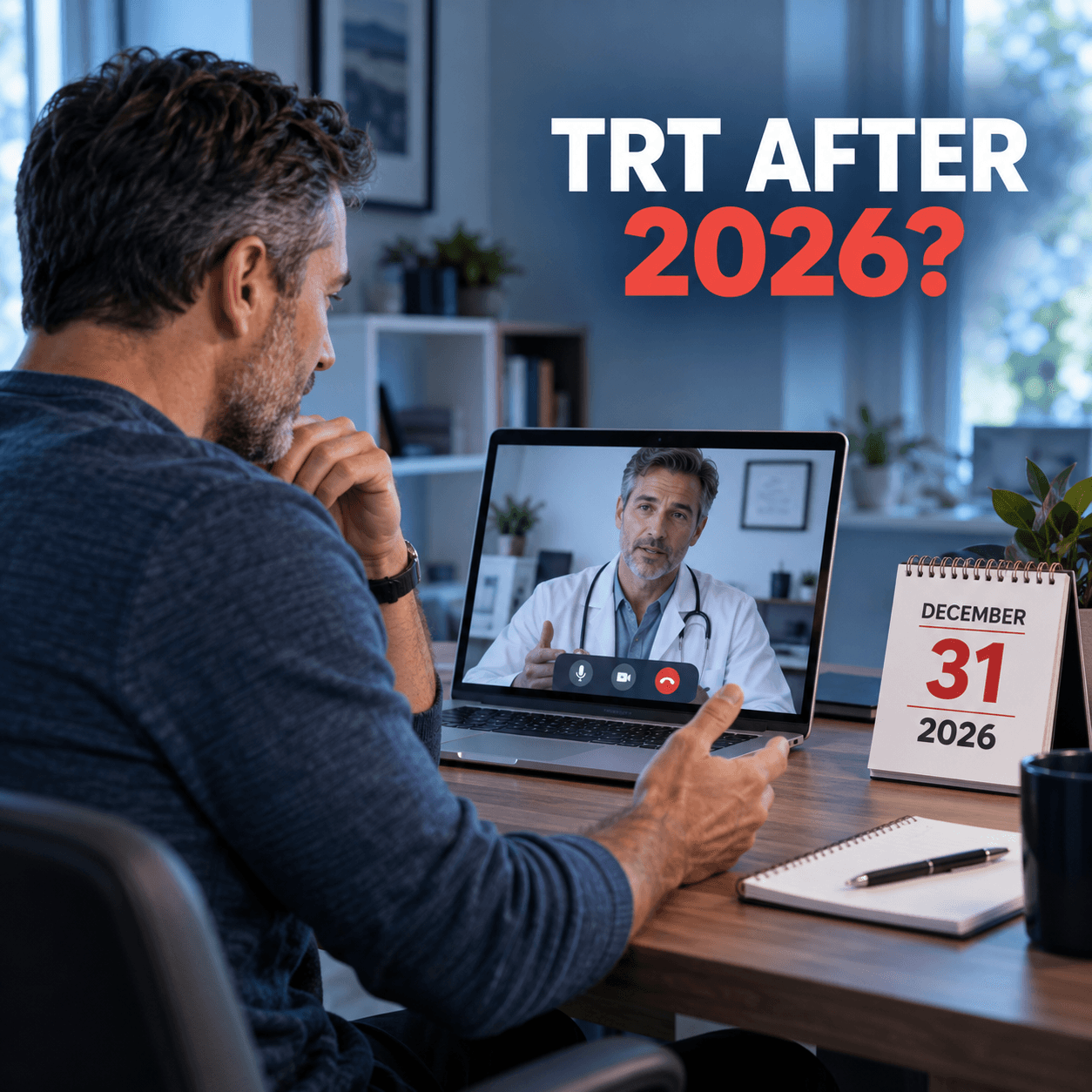
No final federal rule currently says that every telehealth testosterone patient must complete an in-person visit in 2027. The temporary federal flexibility that permits eligible clinicians to prescribe controlled medications through telemedicine without a prior in-person examination currently runs through December 31, 2026. What replaces it remains unsettled.
That deadline matters because testosterone replacement therapy involves a Schedule III controlled substance. Federal rules, state law, professional licensing requirements, and the facts of each patient-clinician relationship can all affect how care is delivered.
What Is the Current Federal Rule?
The Drug Enforcement Administration and Department of Health and Human Services extended the pandemic-era telemedicine flexibilities through December 31, 2026. Under the extension, a DEA-registered practitioner may prescribe Schedule II through V controlled substances through telemedicine without a previous in-person medical evaluation when all applicable conditions are satisfied.
The current federal telehealth policy does not remove the ordinary requirements for a legitimate medical purpose, practitioner licensing, DEA registration, documentation, or compliance with state law.
The extension is temporary. It gives federal agencies more time to develop a durable framework, including a possible special-registration pathway for some telemedicine prescribing.
Does the Extension Apply to Testosterone?
Testosterone is federally classified as a Schedule III controlled substance. It falls within the controlled-medication categories covered by the temporary federal telemedicine policy when the required conditions are met.
That does not mean an online questionnaire is enough for diagnosis or prescribing. A licensed clinician still needs an appropriate clinical basis for treatment. Evaluation commonly involves symptoms, health history, examination when necessary, properly timed laboratory testing, repeat confirmation of low testosterone when indicated, and review of contraindications and monitoring needs.
What Could Change in 2027?
Several outcomes remain possible. Federal agencies could finalize a special-registration system, extend temporary flexibility again, adopt a new in-person requirement for some circumstances, or create different rules for different medications and clinical situations.
Patients should be cautious with headlines that describe any proposal as final. A proposed rule, policy under federal review, or public comment period does not change the current requirement by itself.
State requirements add another layer. A federal policy may permit a form of telemedicine prescribing while a state imposes stricter licensing, evaluation, documentation, or prescribing rules. The clinician must follow the requirements that apply where the patient is physically located during the visit.
Could Existing Patients Be Treated Differently From New Patients?
Future rules could distinguish between an established patient and someone seeking an initial prescription, but no universal 2027 distinction should be assumed until the final policy is published.
Continuity of care may depend on when the relationship began, whether the clinician has previously examined the patient in person, the clinician's registrations and licenses, and the wording of the eventual federal rule. Patients should ask their care team about operational plans instead of relying on social media predictions.
What Should Telehealth TRT Patients Do Now?
There is no reason to panic or arrange an unnecessary visit solely because the temporary rule has an expiration date. A practical approach is to:
- Keep routine follow-up appointments and laboratory monitoring current.
- Confirm that the clinician overseeing care is licensed for the state where you receive care.
- Keep contact and location information accurate.
- Ask how the practice will communicate if federal or state requirements change.
- Avoid stockpiling medication, changing doses, or moving prescriptions without clinician guidance.
A legitimate care relationship should be able to explain how prescriptions, follow-up, laboratory review, and urgent concerns are handled. Regulatory uncertainty is another reason to choose care built around continuing clinical oversight rather than a one-time transaction.
Will AlphaMD Patients Need an In-Person Visit?
The answer depends on the final federal policy, applicable state requirements, and the individual clinical situation. Medical services accessed through AlphaMD are provided by independent licensed clinicians, who determine whether evaluation or treatment is clinically appropriate.
AlphaMD can communicate operational changes when the governing requirements are clear. It cannot guarantee that the current telemedicine rules will remain unchanged after December 31, 2026.
Frequently Asked Questions
Is telehealth TRT legal through the end of 2026?
Federal temporary flexibility remains in effect through December 31, 2026, when its conditions are met. State law and licensing requirements also apply.
Has DEA already required an in-person visit for every TRT patient in 2027?
No final universal requirement has been established as of October 8, 2026. The policy should be checked again before publication and as the deadline approaches.
Can a provider prescribe testosterone based only on symptoms?
Symptoms alone are not sufficient for a responsible diagnosis. Licensed clinicians generally consider symptoms, medical history, properly collected laboratory results, and relevant safety factors.
Should patients stop TRT before the rule expires?
Patients should not stop prescribed medication because of speculation about a future rule. Questions about treatment changes belong with the clinician overseeing care.
Key Takeaway
Telehealth prescribing flexibility for controlled medications currently extends through December 31, 2026. The federal framework for 2027 is still developing. Patients can prepare by maintaining current labs, follow-up, and contact information while watching for final guidance from DEA, HHS, and their care team.
This article is educational and does not provide medical or legal advice. Federal and state requirements can change. Current primary sources and appropriately licensed healthcare counsel should be consulted before publication or operational implementation.
Have a question? Ask us.
At AlphaMD, we're here to help. Feel free to ask us any question you would like about TRT, medical weightloss, ED, or other topics related to men's health. Or take a moment to browse through our past questions.
People are asking...
I want to start with a telemedicine clinic but I’m worried about what I’ve read on the rules changing in November with the dea requiring A in doctor v...
I'm going to copy another recent reply we made to this comment, if you don't mind, and expand on it. The main issue with the TRT telemedicine concerns is focused on other controlled substances & tele... See Full Answer
My provider won’t continue my TRT without yearly face-to-face visit which they say is law. Are you similar or does it vary by state?...
That's not the law yet, per the DEA's temporary rule. https://www.dea.gov/press-releases/2023/05/09/dea-samhsa-extend-covid-19-telemedicine-flexibilities-prescribing [1]. But to be fair to the provi... See Full Answer
Do you foresee patients currently dependent on TRT to sort of be “screwed” at any point due to increased regulations that make it so they can no longe...
I don’t have a crystal ball, but I don’t see that being a problem. Treatment is becoming more prevalent because providers are better at recognizing the symptoms, more open about talking about it, and ... See Full Answer
Get $30 off your first month’s order
Enter your email address now to receive $30 off your first month’s cost, other discounts, and additional information about TRT.
Legal Disclaimer
This website is a repository of publicly available information and is not intended to form a physician-patient relationship with any individual. The content of this website is for informational purposes only. The information presented on this website is not intended to take the place of your personal physician's advice and is not intended to diagnose, treat, cure, or prevent any disease. Discuss this information with your own physician or healthcare provider to determine what is right for you. All information is intended for your general knowledge only and is not a substitute for medical advice or treatment for specific medical conditions. The information contained herein is presented in summary form only and intended to provide broad consumer understanding and knowledge. The information should not be considered complete and should not be used in place of a visit, phone or telemedicine call, consultation or advice of your physician or other healthcare provider. Only a qualified physician in your state can determine if you qualify for and should undertake treatment.