
The Essential Alpha 5 TRT Stack: Five Supplements That Make Sense Alongside TRT
Published on:
Updated on:
People are asking...
TRT Providers should work on making the following available: Anastrozole, exemestane in dosing specifically for men like 0.1 and 5 mg. A way to get...
Yes, these would be nice to have available. When it comes to TRT, there are many medications we wish were available on the platform, but in some cases supply is limited. The pharmacies which can ship... See Full Answer
How do people know they need an AI with TRT? My pcp didnt prescribe one, I guess that is ok??...
Like any medicine, ideally you should be able to take TRT without any side effects. However, some men have a higher amount of aromatase than others, and may need an AI even on more conservative TRT do... See Full Answer
Do you treat women? And would admitting I've been taking small amounts [10-20mgs/week IM] of my bf's Test (and getting great results) be a barrier to...
Providers on the AlphaMD platform currently care for female patients on similar low doses to optimize their hormones. They typically need a bit of Estrogen to keep everything in balance as well as the... See Full Answer
Have a question? Ask us.
At AlphaMD, we're here to help. Feel free to ask us any question you would like about TRT, medical weightloss, ED, or other topics related to men's health. Or take a moment to browse through our past questions.
Testosterone replacement therapy can address clinically low testosterone. It does not automatically optimize your nutrition, cardiovascular health, training performance, recovery or micronutrient status.
That is where a smart supplement strategy can make sense.
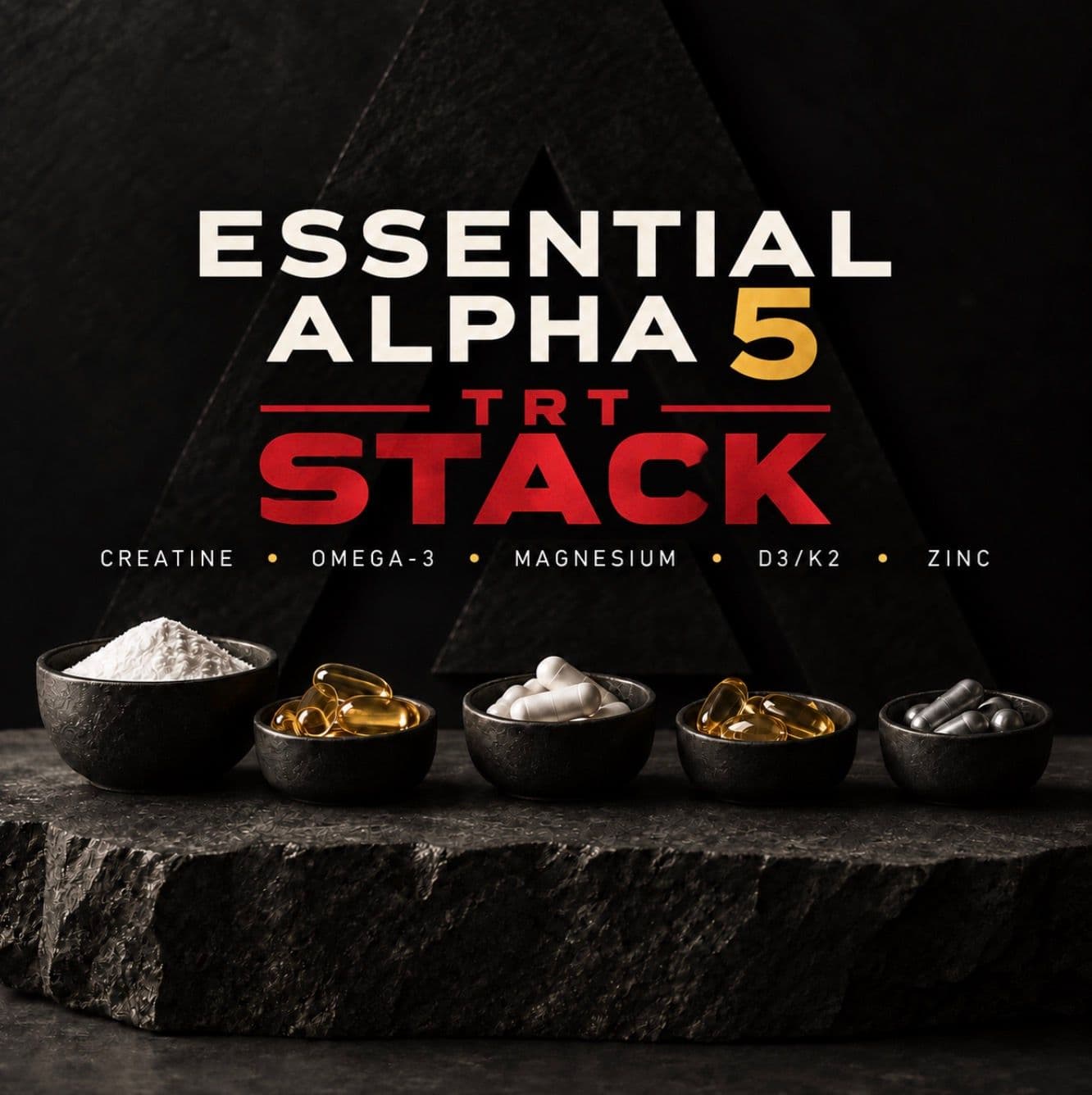
We call ours the Essential Alpha 5 TRT Stack: five evidence-based supplements that address common nutritional and performance priorities for men on TRT without loading the cabinet with questionable testosterone boosters and proprietary blends.
The Essential Alpha 5 is:
- Creatine monohydrate
- Omega-3 fatty acids
- Magnesium
- Vitamin D3 + K2
- Zinc
None of these supplements replaces TRT, and none should be viewed as a treatment for low testosterone.
They are five well-studied nutritional tools that may complement a broader health plan when they are appropriate for the individual.
What Are the Best Supplements to Take With TRT?
For men looking for a simple supplement foundation alongside TRT, creatine, omega-3 fatty acids, magnesium, vitamin D and zinc are five practical options to consider.
Each serves a different purpose.
Creatine primarily supports training performance and cellular energy. Omega-3s can support cardiovascular health and help lower triglycerides. Magnesium is involved in muscle, nerve and energy function. Vitamin D and vitamin K contribute to important physiological processes including bone health, while zinc is an essential mineral involved in hundreds of biological reactions.
The important word is support.
These supplements do not make TRT "work better" by artificially increasing testosterone.
Instead, they address other pieces of health and performance that testosterone therapy does not replace.
Why Build a Supplement Stack Around TRT at All?
TRT is designed to treat testosterone deficiency in appropriately diagnosed patients. It is not a substitute for sleep, resistance training, adequate protein, cardiovascular fitness, good nutrition or regular medical monitoring.
Current Endocrine Society guidance continues to emphasize accurate diagnosis and ongoing monitoring when testosterone therapy is prescribed.
Endocrine Society: Testosterone Replacement Therapy
Think of TRT as one part of the foundation.
We have covered this principle in more detail in TRT Is Part of the Plan, Not the Whole Plan. Testosterone therapy can address a hormonal deficiency, but nutrition, movement, sleep, stress and recovery still matter.
If your testosterone is being appropriately managed but your diet is poor, your sleep is inconsistent and your training has no structure, another capsule is unlikely to solve the problem.
The Essential Alpha 5 is therefore deliberately simple.
No exotic herbs.
No "testosterone booster."
No mystery proprietary blend.
Just five supplements with clear biological roles and enough research behind them to justify a closer look.
1. Creatine Monohydrate: The Performance Foundation
If there is one supplement on this list with an unusually large research base, it is creatine.
Creatine helps replenish phosphocreatine, which cells use to regenerate ATP during periods of high energy demand.
That makes it particularly useful during repeated high-intensity efforts such as resistance training and sprinting.
For men who train while on TRT, that matters.
Research supports creatine monohydrate for improvements in strength and high-intensity exercise performance, particularly when supplementation is combined with resistance training. Creatine monohydrate also remains the most extensively studied form.
Journal of the International Society of Sports Nutrition: Creatine Supplementation
How Much Creatine Should You Take?
A simple approach is:
3 to 5 grams of creatine monohydrate daily.
A loading phase is not required. Taking creatine consistently will gradually increase muscle creatine stores without one.
There is also growing interest in creatine outside the weight room, including its role in cellular energy availability and cognition.
We cover that research separately in Creatine Is a Brain Supplement: TRT Men Are Just Now Figuring This Out.
Alpha 5 takeaway: Creatine is not included because it increases testosterone. It is included because it can help support training performance and adaptation.
2. Omega-3s: The Cardiovascular Piece
TRT should not make cardiovascular health an afterthought.
EPA and DHA are the two long-chain omega-3 fatty acids most commonly found in fatty fish and fish-oil supplements.
The evidence is strongest for their ability to lower triglycerides. Eating fish and seafood as part of a healthy diet is also associated with cardiovascular benefits, although that does not mean everyone automatically needs a fish-oil supplement.
NIH Office of Dietary Supplements: Omega-3 Fatty Acids
What Should You Look for in an Omega-3 Supplement?
Do not look only at the number on the front that says "1,000 mg fish oil."
Look at the actual amounts of:
- EPA
- DHA
Two products containing the same amount of total fish oil can provide very different amounts of EPA and DHA.
Your ideal intake depends on your diet, cardiovascular risk factors, triglycerides and other health considerations.
High-dose omega-3 therapy used to treat elevated triglycerides is a medical intervention and is not the same thing as taking an ordinary fish-oil supplement.
Alpha 5 takeaway: Think EPA and DHA, not simply "fish oil."
3. Magnesium: The Mineral Involved in Almost Everything
Magnesium does not have the marketing appeal of a new peptide or exotic herbal extract.
Biologically, however, it is involved in more than 300 enzyme systems.
Magnesium contributes to muscle and nerve function, energy production, protein synthesis, blood glucose regulation and normal heart rhythm.
NIH Office of Dietary Supplements: Magnesium
Adult men generally need around 400 to 420 mg of magnesium per day from all sources, depending on age.
That includes magnesium from food.
Good dietary sources include nuts, seeds, legumes, whole grains and leafy green vegetables.
How Much Supplemental Magnesium Should You Take?
Supplementation should fill a gap rather than automatically provide your entire daily requirement.
The NIH lists 350 mg per day as the adult upper limit specifically for magnesium from supplements and medications, not magnesium naturally present in food.
Higher supplemental amounts commonly cause diarrhea, nausea or abdominal cramping.
Magnesium glycinate is a popular option when gastrointestinal tolerance is a priority, but the most important factors are how much elemental magnesium you are actually getting and whether supplementation is appropriate for you.
Alpha 5 takeaway: Get magnesium from food first and use supplementation to fill the remaining gap when needed.
4. Vitamin D3 + K2: Two Fat-Soluble Vitamins Worth Understanding
Vitamin D gets mentioned constantly in conversations about testosterone, but it is important not to turn that association into something the evidence does not support.
Vitamin D is important whether you use TRT or not.
It plays major roles in bone health, calcium metabolism and other physiological processes.
People with limited sunlight exposure, inadequate dietary intake, certain digestive disorders and other risk factors can develop low vitamin D levels.
NIH Office of Dietary Supplements: Vitamin D
The best approach is not:
"I am on TRT, so I need a huge dose of vitamin D."
It is:
"Do I have enough vitamin D, and if not, how much do I actually need?"
A 25-hydroxyvitamin D blood test can help answer that question.
For adults taking vitamin D without medical supervision, the NIH lists a tolerable upper intake level of 4,000 IU per day from all sources.
Higher doses may be appropriate in specific situations but should be clinician-directed.
NIH Office of Dietary Supplements: Vitamin D FAQs
What About Vitamin K2?
Vitamin K is required for proteins involved in normal blood clotting and bone metabolism.
K2 refers to a group of compounds called menaquinones, including MK-4 and MK-7.
NIH Office of Dietary Supplements: Vitamin K
K2 is frequently sold alongside vitamin D3, but that does not mean every person taking vitamin D automatically requires a K2 supplement.
There is another important consideration: vitamin K can interact significantly with warfarin and similar anticoagulant medications.
Anyone taking those medications should discuss vitamin K supplementation with a licensed medical provider before making changes.
Alpha 5 takeaway: Treat vitamin D as a nutrient to measure and manage, not something to megadose blindly.
5. Zinc: Essential, but More Is Definitely Not Better
Zinc deserves a spot on the list for one simple reason: your body needs it.
Adult men have a recommended dietary allowance of approximately 11 mg of zinc per day.
Zinc is available from foods including meat, seafood, dairy, eggs, beans, nuts and whole grains.
NIH Office of Dietary Supplements: Zinc
Where things go wrong is when "important for testosterone" gets interpreted as "take as much zinc as possible."
That is not how micronutrients work.
The adult upper intake level for zinc is 40 mg per day from all sources.
Consistently taking 50 mg or more can interfere with copper absorption and may produce other unwanted effects.
For someone who already gets adequate zinc from food, another large dose is unlikely to provide some hidden TRT advantage.
Alpha 5 takeaway: Correct inadequate intake. Do not turn zinc into a megadose testosterone supplement.
What Is NOT in the Essential Alpha 5?
This is just as important as what made the list.
You will notice there is no:
- Tongkat ali
- Fenugreek
- "Testosterone booster"
- DHEA
- DIM
- Tribulus
- Mystery hormone-support blend
There may be circumstances where individual supplements outside the Alpha 5 have a role.
That is different from saying every man on TRT should take them.
For a broader breakdown of which supplements may and may not deserve a place in your cabinet, see The Best and Worst Supplements to Stack With TRT.
The basic premise behind many testosterone boosters also becomes particularly strange once someone is already receiving prescribed testosterone.
The goal should not be to assemble the largest supplement stack possible.
The goal is to identify the smallest number of things that have a legitimate reason to be there.
Can Supplements Prevent TRT Side Effects?
This deserves a clear answer:
The Essential Alpha 5 should not be used as a substitute for proper TRT monitoring or as a way to self-treat changes in hematocrit, estradiol, blood pressure, PSA or other clinical markers.
Taking fish oil does not eliminate the need to monitor cardiovascular risk factors.
Taking magnesium does not fix an inappropriate testosterone dose.
Taking zinc does not prevent elevated estradiol.
TRT requires medical follow-up.
Regular bloodwork is one of the most important parts of responsible testosterone therapy.
AlphaMD's guide to The Complete TRT Blood Panel: 11 Markers Your Clinic Should Be Running explains why markers beyond total testosterone, including hematocrit and other health indicators, deserve attention during treatment.
The Endocrine Society also recommends evaluating men after treatment begins to assess their response, potential adverse effects and treatment regimen.
Endocrine Society Clinical Practice Guideline: Testosterone Therapy
Supplements sit beside that process.
They do not replace it.
The Essential Alpha 5 TRT Stack
If you want the entire concept in one place, it is remarkably simple:
Creatine Monohydrate
For cellular energy, strength and training performance.
Omega-3 EPA + DHA
For cardiovascular and triglyceride support when additional omega-3 intake is appropriate.
Magnesium
For muscle, nerve, energy and numerous other physiological functions.
Vitamin D3 + K2
For maintaining adequate vitamin D status, bone-related functions and other nutrient-dependent processes, with dosing based on individual needs.
Zinc
For maintaining adequate intake of an essential trace mineral without unnecessary megadosing.
That is the Essential Alpha 5.
Not five ways to raise testosterone.
Five ways to support the rest of the system while TRT handles the job it was actually prescribed to do.
Frequently Asked Questions About Supplements and TRT
Can I Take Creatine While on TRT?
For most healthy adults, creatine monohydrate and testosterone therapy perform completely different functions.
Creatine does not need to be cycled simply because someone is receiving TRT.
Creatine is commonly studied at approximately 3 to 5 grams per day.
People with kidney disease or other relevant medical conditions should discuss supplementation with a licensed medical provider.
Do Supplements Make TRT More Effective?
These supplements should not be thought of as TRT enhancers.
Their purpose is to support areas such as nutrition, exercise performance and cardiovascular health that remain important regardless of testosterone status.
Do I Need All Five Supplements?
No.
Someone who eats fatty fish several times per week may not need additional omega-3 supplementation.
Someone with excellent dietary magnesium intake may not need magnesium.
Vitamin D supplementation should reflect vitamin D status and individual risk factors.
A stack is a framework, not a requirement.
Will Zinc or Vitamin D Raise My Testosterone While I Am on TRT?
Correcting a nutrient deficiency can matter for overall health, but taking extra zinc or vitamin D beyond what your body needs should not be treated as a strategy for pushing testosterone higher.
If you are on TRT, testosterone dosing should be determined through your treatment plan and laboratory monitoring, not through nutritional megadosing.
Should I Take All Five at the Same Time?
They do not all have to be swallowed together.
Consistency, appropriate dosing, your diet, medication interactions and individual tolerability matter more than creating one giant morning handful of capsules.
What Is the Best Supplement to Take With TRT?
There is no single supplement that every person on TRT needs.
Creatine is particularly useful for men focused on strength and training performance. Omega-3 supplementation may make sense when dietary intake is low or triglyceride management is a concern. Magnesium, vitamin D and zinc are most useful when intake or status is inadequate.
The best stack depends on your diet, health history, medications, laboratory results and goals.
TRT Is the Therapy. The Foundation Still Matters.
There is a temptation after starting testosterone therapy to optimize everything at once.
More supplements.
More compounds.
More hacks.
More numbers to chase.
Usually, the better approach is simpler.
Use TRT appropriately when clinically indicated.
Monitor it properly.
Lift weights.
Do cardiovascular exercise.
Eat enough protein and nutrient-dense food.
Sleep.
Keep body fat under control.
Pay attention to blood pressure and laboratory markers.
Then use supplements selectively to fill legitimate gaps.
That is the idea behind the Essential Alpha 5 TRT Stack.
Five evidence-based fundamentals.
No mystery ingredients.
No fake testosterone boosters.
Just a smarter foundation to build around.
If you are currently on TRT or considering treatment, AlphaMD can connect you with a licensed medical provider to discuss your symptoms, laboratory results and treatment options.
Supplement use should also be reviewed when relevant, particularly if you take prescription medications or have existing medical conditions.
This article is for educational purposes only and is not a substitute for individualized medical advice.
Have a question? Ask us.
At AlphaMD, we're here to help. Feel free to ask us any question you would like about TRT, medical weightloss, ED, or other topics related to men's health. Or take a moment to browse through our past questions.
People are asking...
TRT Providers should work on making the following available: Anastrozole, exemestane in dosing specifically for men like 0.1 and 5 mg. A way to get...
Yes, these would be nice to have available. When it comes to TRT, there are many medications we wish were available on the platform, but in some cases supply is limited. The pharmacies which can ship... See Full Answer
How do people know they need an AI with TRT? My pcp didnt prescribe one, I guess that is ok??...
Like any medicine, ideally you should be able to take TRT without any side effects. However, some men have a higher amount of aromatase than others, and may need an AI even on more conservative TRT do... See Full Answer
Do you treat women? And would admitting I've been taking small amounts [10-20mgs/week IM] of my bf's Test (and getting great results) be a barrier to...
Providers on the AlphaMD platform currently care for female patients on similar low doses to optimize their hormones. They typically need a bit of Estrogen to keep everything in balance as well as the... See Full Answer
Get $30 off your first month’s order
Enter your email address now to receive $30 off your first month’s cost, other discounts, and additional information about TRT.
Legal Disclaimer
This website is a repository of publicly available information and is not intended to form a physician-patient relationship with any individual. The content of this website is for informational purposes only. The information presented on this website is not intended to take the place of your personal physician's advice and is not intended to diagnose, treat, cure, or prevent any disease. Discuss this information with your own physician or healthcare provider to determine what is right for you. All information is intended for your general knowledge only and is not a substitute for medical advice or treatment for specific medical conditions. The information contained herein is presented in summary form only and intended to provide broad consumer understanding and knowledge. The information should not be considered complete and should not be used in place of a visit, phone or telemedicine call, consultation or advice of your physician or other healthcare provider. Only a qualified physician in your state can determine if you qualify for and should undertake treatment.