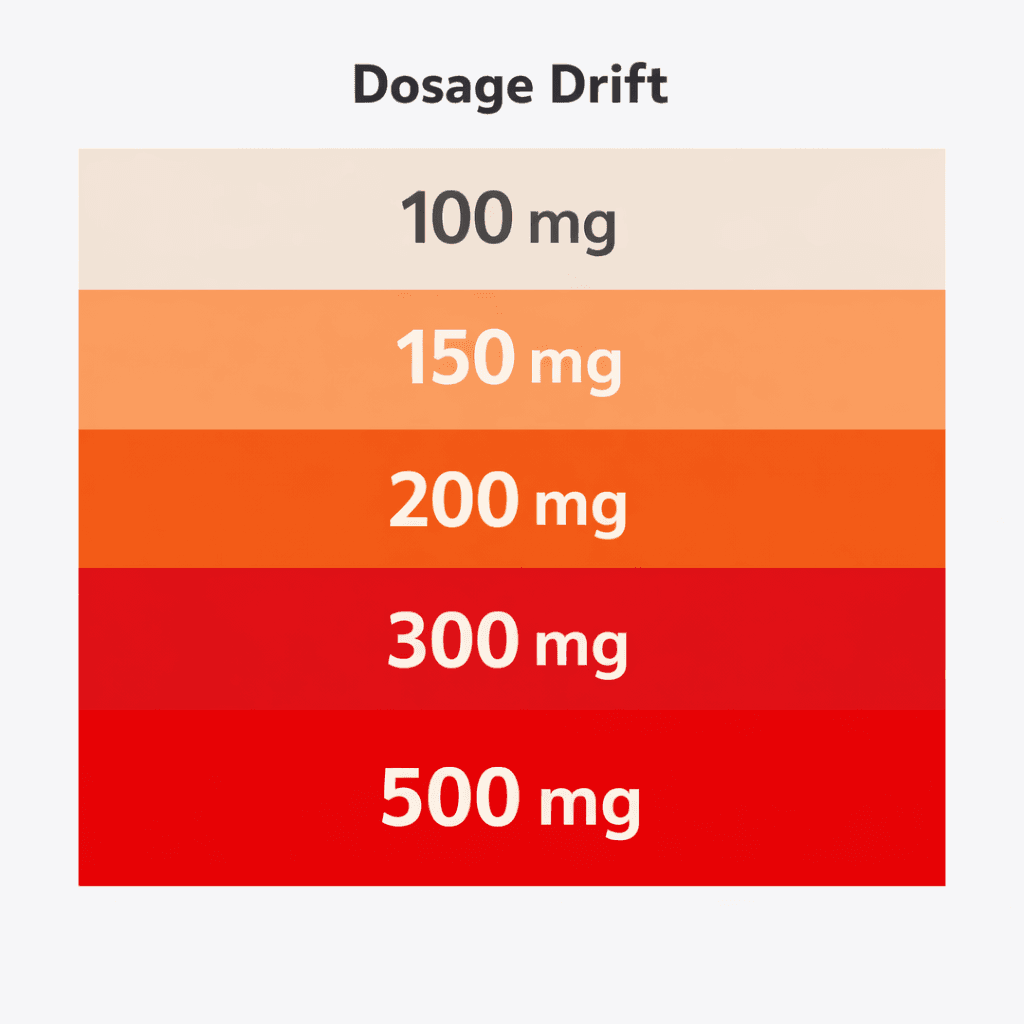
500 mg of testosterone a week is not replacement therapy. Labeled testosterone cypionate replacement is 50-400 mg every two to four weeks (DEPO-Testosterone label), and the AUA lists injectable cypionate and enanthate at 50-200 mg every 7-14 days (AUA Table 2). Calling a 500 mg weekly protocol TRT blurs replacement with a supraphysiologic cycle, and that changes the risks you take on. The prescriber sets the dose.
What TRT was designed to do
Testosterone replacement therapy exists to restore hormone levels in men who are deficient and have symptoms from that deficiency. The diagnosis needs both: symptoms or signs, and a total testosterone below 300 ng/dL on two separate early-morning tests (AUA 2018). The Endocrine Society uses the same pair of requirements: signs or symptoms plus unequivocally and consistently low morning testosterone, confirmed on a repeat fasting test (Endocrine Society 2018).
The treatment target is the middle tertile of the lab's normal range (AUA 2018). In healthy nonobese men aged 19-39, a harmonized normal range is 264-916 ng/dL (Travison 2017).
Guideline-supported benefits are limited. The AUA says testosterone therapy may improve erectile function, sex drive, anemia, bone density, lean mass, and depressive symptoms, and that evidence is inconclusive for energy, fatigue, cognition, lipids, diabetes measures, and quality of life (AUA 2018). In the Testosterone Trials (790 men aged 65 and older with testosterone under 275 ng/dL), a year of gel brought a moderate benefit for sexual function, some benefit for mood, and no benefit for vitality or walking distance (Snyder 2016).
Using testosterone as a performance-enhancing drug is a different goal.
When "TRT" starts looking like a cycle
The molecule is the same whether it is prescribed or obtained another way. Dose, intent, and the resulting levels change.
Cycle-style protocols push testosterone above what replacement regimens use. The DEPO-Testosterone label gives 50-400 mg every two to four weeks as replacement in hypogonadal men (DEPO-Testosterone label). A 500 mg weekly injection is above that labeled range and above the AUA injectable schedule (AUA Table 2). Pope and colleagues studied testosterone cypionate rising to 600 mg a week in healthy men as a supraphysiologic research dose (Pope 2000).
There is nothing wrong with being honest about an enhancement goal. Calling it TRT still muddies the water. When people with exceptional physiques say they are "just on TRT," it sets unrealistic expectations for men seeking medical treatment, and it downplays the risks that come with levels well above the physiologic range.
Year-round use does not make a protocol replacement therapy. The labeled indication is replacement for deficiency or absence of endogenous testosterone (DEPO-Testosterone label).
Why high doses are not just "more TRT"
The cardiovascular system responds to the hormone levels in the blood, not to the name on the protocol.
Testosterone raises red-cell production. The AUA says to measure hemoglobin and hematocrit before starting, to withhold treatment if baseline hematocrit is above 50% until the cause is explained, and that an on-treatment hematocrit of 54% or higher warrants intervention, with dose adjustment first (AUA 2018). The DEPO-Testosterone label also says to check hemoglobin and hematocrit periodically during long-term use to detect polycythemia (DEPO-Testosterone label). For how that monitoring works in practice, see why high hematocrit on testosterone matters.
Heart-risk claims need the trial next to them. TRAVERSE (5,246 men aged 45-80 with cardiovascular disease or high risk, symptoms, and two fasting testosterone levels under 300 ng/dL) found testosterone gel noninferior to placebo for major cardiac events: 7.0% vs 7.3%. Atrial fibrillation, acute kidney injury, and pulmonary embolism were more frequent on testosterone (TRAVERSE, NEJM 2023). Noninferiority is not the same finding as protection. The AUA, written before TRAVERSE, said it cannot be stated definitively whether testosterone therapy increases or decreases cardiovascular events (AUA 2018).
In 2025 the FDA added an increased blood-pressure warning to every testosterone product after ambulatory blood-pressure studies, added TRAVERSE to the labels, and removed the older cardiovascular Boxed Warning language (FDA 2025). Testosterone does not lower blood pressure.
Mood change at high doses showed up in a minority of men in one trial. In a randomized crossover study, testosterone cypionate rising to 600 mg a week produced minimal psychiatric effects in 84% of men, mild hypomania in 12%, and marked hypomania in 4%, and those reactions were not predictable from baseline (Pope 2000). The DEPO-Testosterone label lists anxiety, depression, and increased or decreased libido among nervous-system effects (DEPO-Testosterone label).
What testosterone does to fertility
Any exogenous testosterone can suppress the body's own production. The label describes the mechanism: circulating androgen feeds back on pituitary LH, and at large doses FSH falls enough to suppress spermatogenesis. Oligospermia can follow prolonged administration or excessive dosage (DEPO-Testosterone label).
That is not limited to 500 mg weeks. In a WHO contraception study, testosterone enanthate 200 mg weekly made 65% of 271 healthy fertile men azoospermic by six months (WHO 1990). After hormonal male-contraception regimens, sperm recovered to 20 million/mL in 67% of men by six months and 90% by 12 months in an analysis of 1,549 healthy men (Liu 2006). Those figures come from healthy men on time-limited protocols. They are not a recovery guarantee after years at a high dose.
Exogenous testosterone should not be prescribed to men who are currently trying to conceive (AUA Strong, Grade A) (AUA 2018). The infertility guideline says the same for men interested in current or future fertility (AUA/ASRM 2020). The Endocrine Society recommends against starting testosterone in men planning fertility in the near term (Endocrine Society 2018). Discuss long-term effects on sperm with anyone who may want children later (AUA 2018). Aromatase inhibitors, hCG, or SERMs may be used to maintain fertility (Conditional, Grade C); they do not cancel the rule against prescribing testosterone while trying to conceive (AUA 2018). More on how testosterone therapy affects sperm production.
Why more is not automatically better
A persistent idea in online testosterone talk is that a higher dose automatically means a better result. Higher studied doses change mood in some men (Pope 2000), and higher on-treatment levels are the setting where the AUA tries dose reduction first for hematocrit at or above 54% (AUA 2018). Extra milligrams buy more of that management, not a guarantee of better results.
No guideline recommends a routine aromatase inhibitor on testosterone therapy. The AUA mentions those drugs for fertility, not as standard estrogen control (AUA 2018). If a dose already above replacement leads to blood-pressure treatment, sleep aids, or an estrogen blocker, that is a reason to revisit the dose with the prescribing clinician.
The men who stay well on long-term replacement are usually the ones who stop climbing once symptoms are treated and safety labs are stable.
What replacement therapy looks like
Legitimate replacement starts with more than one testosterone value. A clinician reviews symptoms, history, cardiovascular risk, baseline hematocrit, and, in men over 40, PSA before treatment (AUA 2018). Do not start testosterone within three to six months of a cardiovascular event (AUA 2018). The Endocrine Society also recommends against starting testosterone in men with breast or prostate cancer or a palpable prostate nodule or induration (Endocrine Society 2018).
Once treatment begins, testosterone is checked every 6-12 months, and hematocrit is part of ongoing safety labs (AUA 2018). Adjustments follow response and labs, not a dose posted online. If you feel well and labs are in range, there is no guideline reason to increase. If hematocrit is high, the first move the AUA names is a dose adjustment (AUA 2018).
Testosterone does not replace the rest of health work. In a meta-analysis, weight loss raised total testosterone, more so with greater weight loss (Corona 2013). Sleep, training, and nutrition still matter for how you feel. They do not cancel a confirmed deficiency.
The psychology of chasing numbers
A common trap, especially in communities that compare doses and lab printouts, is to feel better and then wonder whether a higher number would feel better still.
If the aim is health, function, and quality of life, feeling well on a replacement regimen is the endpoint. If the aim is a physique or a performance mark that sits above that, the protocol has moved into enhancement. That choice is yours to name. The risk is telling yourself it is still TRT after the dose and the goal have left the definition, and then accepting risks you did not mean to take because the label sounds medical.
Bottom line
500 mg of testosterone a week is above labeled and guideline replacement regimens. Replacement is for confirmed deficiency plus symptoms, aimed at the mid-normal range, with hematocrit, blood pressure, and fertility on the safety checklist. If a protocol looks like a cycle, naming it honestly is the first useful step. AlphaMD providers review labs before prescribing testosterone and use follow-up labs to adjust treatment; see testosterone replacement therapy.