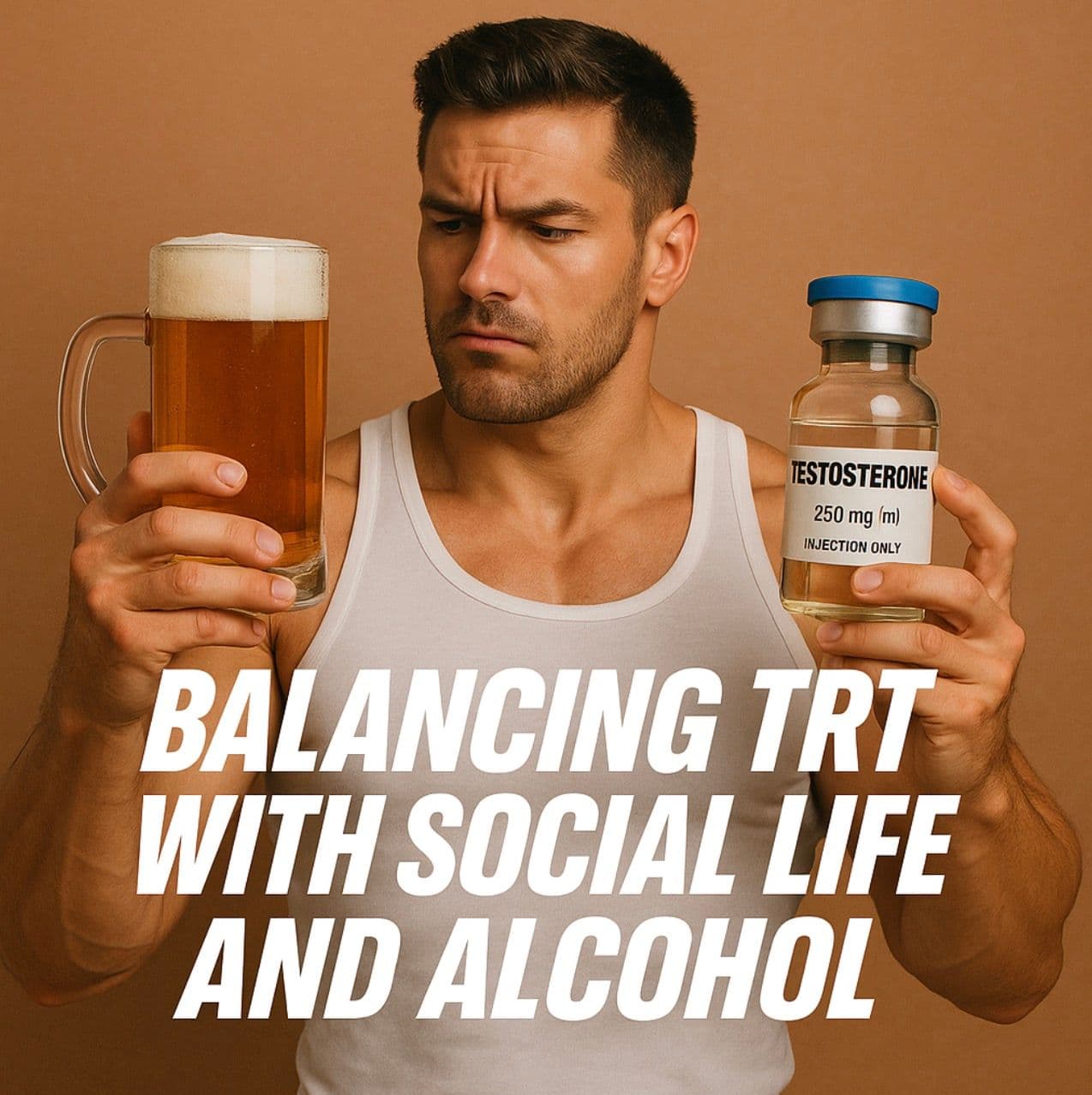
Yes, alcohol can lower testosterone. How much depends on the dose and how often you drink. A low dose can raise testosterone for a few hours. A large single dose can cut it by about a fifth overnight, and the drop is still there the next morning. Men who drink heavily for months to years have lower circulating testosterone and poorer semen quality.
Testosterone helps maintain muscle, bone, sex drive, and fat distribution. In the Testosterone Trials, raising low levels in older men improved sexual function and had a smaller effect on mood, with no benefit for vitality or walking distance (Snyder 2016). Sleep and body weight also change testosterone.
Does one night of drinking lower testosterone?
A low dose and a binge are not the same thing. In a double-blind crossover study of 13 men, 0.5 g of alcohol per kilogram of body weight raised plasma testosterone from 13.5 to 16.0 nmol/L for a few hours, likely because of a change in liver redox state (Sarkola 2003). A 2023 review reports the same pattern: acute low-to-moderate intake tends to raise testosterone; a large volume tends to lower it (Smith 2023).
A large single dose does lower it, and recovery is not a matter of a few hours. Eight healthy men aged 20-26 who drank 1.5 g of ethanol per kilogram over three hours had a 23% drop in serum testosterone between 10 and 16 hours after they started, with no change in LH or FSH pulses (Välimäki 1990). In an earlier study from the same group, 1.75 g/kg (peak blood alcohol about 1.51 g/L) produced a testosterone drop at 12 hours that was still present at 24 hours, even after LH and FSH had risen (Välimäki 1984). Those were one-night experiments in young men, not a recovery timeline for regular drinkers.
Daily "moderate" drinking is a different question. Ten middle-aged men who drank 40 g of alcohol per day with dinner for three weeks (about three standard drinks) had a 6.8% drop in morning testosterone compared with alcohol-free beer (Sierksma 2004). That is a small change over a short study. It is not proof that a nightly drink is harmless for testosterone.
What does chronic heavy drinking do?
The clearer reductions show up with sustained heavy use. A 2024 meta-analysis of 21 studies (10,199 men) found lower circulating total and free testosterone, lower SHBG, and higher estradiol in healthy men with chronic alcohol intake. The same analysis did not find that pattern after a single drink, or in men already diagnosed with alcohol use disorder (Santi 2024).
In a clinic comparison, 66 men who drank at least 180 mL of whiskey or brandy a day, five days a week, for a year or more had lower testosterone and progesterone, higher FSH, LH, and estradiol, and lower semen volume, sperm count, motility, and normal morphology than 30 non-drinking controls (Muthusami 2005). A 1998 NIAAA review describes the same pattern: heavy alcohol use can interfere with the hypothalamus, pituitary, and testes and can cause impotence, infertility, and reduced secondary sexual characteristics (Emanuele 1998).
Low testosterone itself is diagnosed only when symptoms or signs sit with two early-morning total testosterone results below 300 ng/dL (AUA 2018). Therapy may improve erectile function, sex drive, and lean mass in men who meet that definition. Heavy drinking also lowers semen quality, so fertility trouble can appear for reasons besides testosterone.
If testosterone is low and a clinician is considering treatment, that workup is testosterone replacement therapy. Men already on treatment who still drink will want a separate look at alcohol alongside TRT.
How does alcohol change testosterone production?
Alcohol can act at more than one point on the hypothalamic-pituitary-gonadal axis. The 2023 review points to higher hypothalamic-pituitary-adrenal activity, inflammation, and oxidative stress when a large dose lowers testosterone, and to liver detoxification enzymes when a small dose raises it (Smith 2023). The NIAAA review describes direct effects on Leydig cells (the testicular cells that make testosterone) and on LH and FSH from the pituitary (Emanuele 1998). In the one-night studies above, testosterone fell before gonadotropins changed, which fits a testicular effect rather than a pituitary one (Välimäki 1990).
Liver disease is part of the picture in some men, not the only path. In one older series, 87% of men with advanced alcoholic cirrhosis had less axillary hair, a testosterone-dependent trait. Later work found Leydig-cell and Sertoli-cell damage even without liver disease or malnutrition (Emanuele 1998).
How much drinking counts as moderate?
The 2025-2030 Dietary Guidelines no longer give a numeric drink cap. Two practical definitions still do. The American Heart Association tells men who drink to stay at no more than two drinks a day (AHA). NIAAA calls five or more drinks in about two hours a binge for men, and five or more on any day or 15 or more per week heavy drinking. A U.S. standard drink is 0.6 fl oz (14 g) of pure alcohol (NIAAA).
Those limits were written for blood pressure, injury, and alcohol use disorder, not as a testosterone target. The testosterone drops in the studies above are largest around binge and heavy-drinking amounts.
What else moves testosterone besides alcohol?
Sleep and weight change the number on their own. One week of 5-hour nights cut daytime testosterone by 10-15% in young healthy men (Leproult 2011). In a meta-analysis, weight loss raised total testosterone, more so with greater weight loss (Corona 2013). Sleep and weight do not cancel a drinking pattern. They are among other reasons men's testosterone has been trending lower.
If you have symptoms that sound like low testosterone (low sex drive, erectile trouble, less energy or muscle) and you drink heavily, the next step is a clinician, not a single lab drawn after a night out. The Endocrine Society also wants symptoms plus two fasting morning tests before a diagnosis (Endocrine Society 2018).
Bottom line
Alcohol can lower testosterone. A small drink can raise it briefly. A large dose can drop it overnight, and that drop is still measurable the next morning. Weeks of daily drinking produced a small decline in one controlled study. Chronic heavy use shows lower testosterone and poorer semen quality. If symptoms and repeat morning labs point to testosterone deficiency, treatment is a separate decision from cutting back on alcohol.