
Don't Panic: 5 Common TRT Side Effects and When They Need Attention
People are asking...
What are the most common side effects and symptoms you see in patients, that may eventually lead them to stop?...
The primary reasons men stop TRT, which providers on the platform rarely see (less than 5%), are desire to maximize chances of fertility, weight gain (TRT increases hunger because of anabolism), and w... See Full Answer
Just started 200 mg split in 2 doses a week. Felt great first few week with high sex drive, full erections, morning wood, and strength in the gym. Wee...
There is a very common phenomenon around the 6 week mark of TRT, where some of the benefits seem to diminish. No one knows why that is, though we believe it is because that is the usual time window wh... See Full Answer
Is any symptom considered more relevant for TRT than others? I.e. low libido versus ED versus muscular issues...
Some symptoms are more directly treated by TRT than others, and that makes them more relevant to diagnose it. Low energy, low libido, difficulty losing fat, difficulty gaining muscle, ED, body aches, ... See Full Answer
Have a question? Ask us.
At AlphaMD, we're here to help. Feel free to ask us any question you would like about TRT, medical weightloss, ED, or other topics related to men's health. Or take a moment to browse through our past questions.
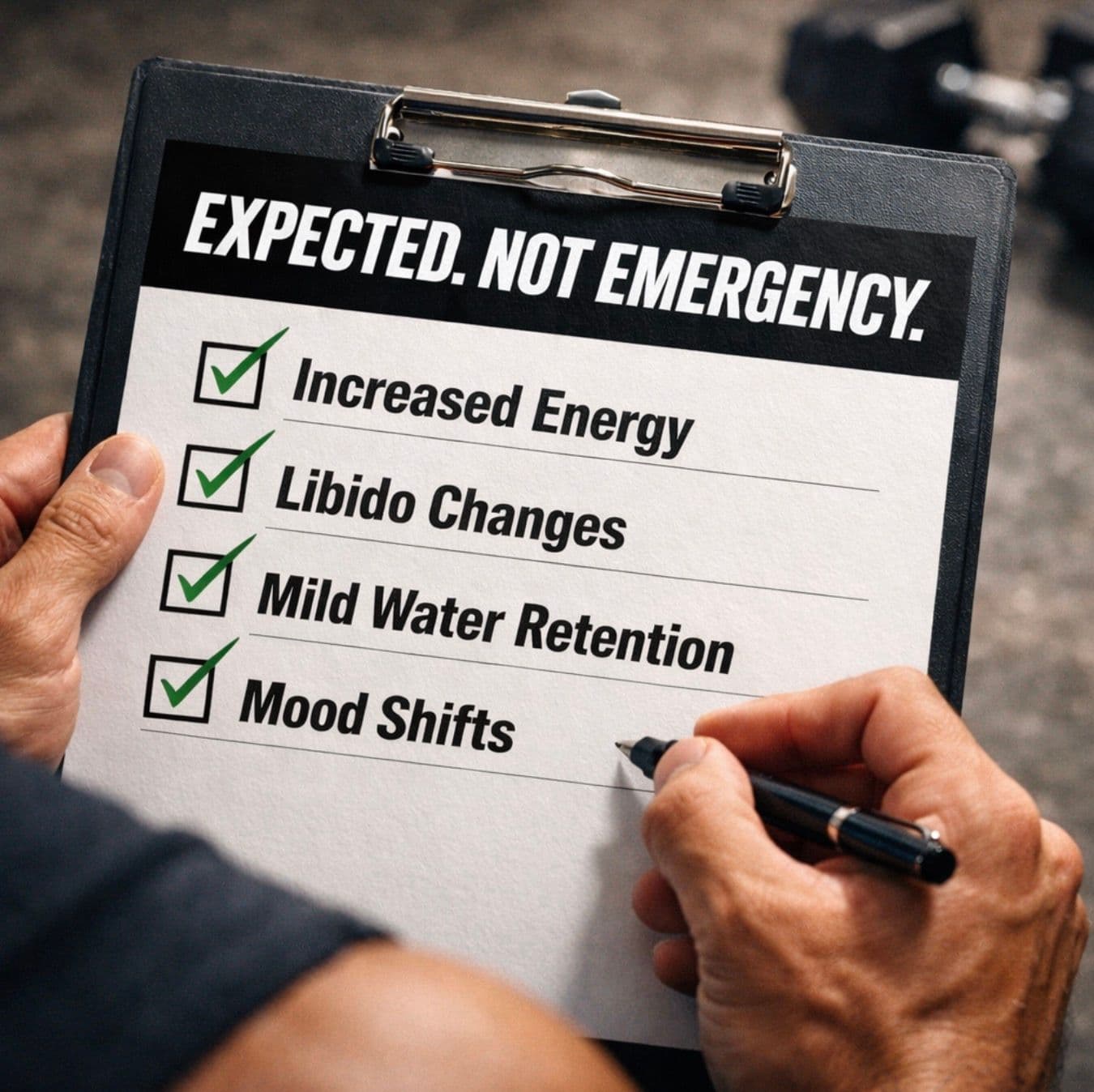
Five changes are common in the first months of testosterone replacement therapy (TRT): uneven energy, shifting libido, mild water retention, a rising red blood cell count, and acne. Most are manageable with regular labs and follow-up, but one has a firm limit: a hematocrit of 54% or higher on treatment needs action from your prescriber.
Online forums tend to amplify worst-case stories, though some of the fears posted there are real. Fertility is one: the AUA says testosterone "should not be prescribed to men who are currently trying to conceive" (AUA 2018). Others are overstated, and the sections below sort them out.
TRT is a treatment for testosterone deficiency. Under the AUA guideline, that diagnosis is made only when a man has symptoms or signs and a total testosterone below 300 ng/dL on two separate early-morning tests (AUA 2018). The symptoms that lead men to it include fatigue, low sex drive, loss of muscle mass, and mood changes.
Even when TRT is prescribed and monitored properly, your body needs time to adjust, and some adjustment effects get mistaken for dangerous side effects. Telling a normal response from a real problem depends on knowing what is happening in your body and having a clinician watching your labs.
Here are five commonly feared side effects, what is behind each one, and when each one needs attention.
Why does my energy go up and down in the first weeks?
One of the most frustrating experiences men report in the first weeks of TRT is unpredictable energy. You might feel fantastic for a few days, then exhausted, then wired at bedtime. After hearing TRT would fix your fatigue, this can feel like the treatment is making things worse.
Part of this is timing. With injections, levels rise after each dose and then fall gradually; testosterone cypionate injected into muscle has a half-life of about eight days (DEPO-Testosterone label). Your sleep, stress, and activity are also changing around a new hormone level.
Benefits take weeks to appear. A review of published trials found effects on quality of life within 3 to 4 weeks and on depressive mood after 3 to 6 weeks (Saad et al., 2011). No study has measured how long early energy swings last, so there is no fixed window to wait out. Track the pattern with your provider: are the good days becoming more frequent, and is the overall trend moving in the right direction?
What is not normal is feeling steadily worse over time, developing new symptoms, or fatigue severe enough to interfere with daily life. Those call for a conversation with your clinician about your treatment plan, not a decision to quit on your own.
Why hasn't my libido come back yet, or why is it swinging?
You started TRT partly because your sex drive had disappeared. Then your libido doesn't come back right away, or it spikes for a week before dropping, or it changes in ways you didn't expect.
Libido depends on testosterone, but also on estrogen (which your body makes from testosterone), sleep, stress, your relationship, and mood. The DEPO-Testosterone label lists both "increased or decreased libido" among reported reactions (DEPO-Testosterone label). In the review of trial data, effects on sexual interest appeared at about 3 weeks and plateaued at about 6 (Saad et al., 2011).
Estrogen matters here too. In a randomized trial of 400 healthy men aged 20 to 50 whose own hormones were suppressed for 16 weeks, low estrogen mainly accounted for gains in body fat, and both low testosterone and low estrogen contributed to the drop in sexual function (Finkelstein et al., NEJM 2013).
What matters is the trend over several weeks and months, along with how you feel overall. If sexual function keeps declining or new problems appear, raise it with your provider.
Why do I look puffy, and is it fat?
A few weeks into TRT, the scale may show a few extra pounds, your rings feel tighter, and your face looks slightly fuller. This is a common worry for men starting treatment.
Testosterone can cause the body to hold fluid. The DEPO-Testosterone label lists "retention of sodium, chloride, water, potassium, calcium, and inorganic phosphates" among its reactions (DEPO-Testosterone label). Fluid weight is not fat, but no study has timed how quickly it settles, so tell your provider if it doesn't.
Swelling in one leg is different. The same label says pain, swelling, warmth, or redness in a leg should be checked for a deep vein thrombosis (a blood clot), and sudden shortness of breath should be checked for a pulmonary embolism (a clot in the lung) (DEPO-Testosterone label). Seek care the same day for either.
Persistent or worsening swelling in both legs or the face also needs an exam. Your provider can decide whether your treatment plan needs a change or whether something else is going on.
Is a higher red blood cell count on my labs a problem?
Testosterone raises red blood cell production. Every form of TRT raises hemoglobin and hematocrit (the share of your blood made of red cells), and injections tend to raise them the most (Jones et al., 2015). The rise usually shows by about 3 months and peaks at 9 to 12 months (Saad et al., 2011).
For a small group, the rise helps. In the Testosterone Trials, men 65 and older with low testosterone and unexplained anemia saw hemoglobin rise by at least 1.0 g/dL in 54% on testosterone versus 15% on placebo, though the authors noted the overall health benefit "remains to be established" (Roy et al., JAMA Intern Med 2017). For men who were not anemic, a higher count is a side effect to watch, not a benefit.
The AUA sets clear limits. Hemoglobin and hematocrit are checked before starting. If baseline hematocrit is above 50%, testosterone is withheld until the cause is explained. On treatment, a hematocrit of 54% or higher "warrants intervention," and dose adjustment is the first step (AUA 2018). Whether a high hematocrit on TRT raises clot risk is still unsettled in the research (Jones et al., 2015) so the 54% threshold is acted on when it is reached.
Blood donation or therapeutic phlebotomy is sometimes used, but a 2024 review found that evidence for its benefit and safety in TRT-related high hematocrit is lacking, and repeated phlebotomy depletes iron stores (Endocr Connect 2024). It is a decision for you and your prescriber, not a routine fix. For more on the numbers, see how high hematocrit becomes dangerous on TRT.
Skipping follow-up labs is where the danger lies, because a count nobody measures can't be acted on.
Why am I breaking out like a teenager?
You're well past adolescence, and suddenly you're dealing with oily skin and breakouts. For some men, this is frustrating enough to consider stopping treatment.
Androgens such as testosterone directly stimulate the skin's oil glands and increase sebum (skin oil), which feeds the bacteria involved in acne (Expert Opin Pharmacother 2021). Acne and seborrhea (oily, flaky skin) are listed reactions on the DEPO-Testosterone label (DEPO-Testosterone label). It is the same mechanism behind teenage acne.
For mild oiliness and occasional breakouts, a simple cleansing routine and non-comedogenic (non-pore-clogging) products are the usual starting point. If acne persists, becomes painful and cystic, or scars, talk with your provider, who may review your treatment plan or refer you to a dermatologist. The guide to managing acne on TRT covers treatment options in more detail.
How do I sort real risks from internet panic?
Online forums make it easier to research a treatment, but the most extreme experiences get repeated while uneventful ones fade. A man with a smooth, gradual course rarely posts daily updates. A man with a bad experience, especially one who was self-medicating, often does.
Some risks are real and worth knowing. In TRAVERSE (NEJM 2023), 5,246 men aged 45 to 80 with or at high risk of heart disease had major cardiac events at 7.0% on testosterone gel versus 7.3% on placebo, but atrial fibrillation, acute kidney injury, and pulmonary embolism were more frequent with testosterone (Lincoff et al., NEJM 2023). In 2025 the FDA added a warning about increased blood pressure to all testosterone products (FDA 2025).
Regular monitoring is how these risks get caught early. The AUA recommends measuring testosterone every 6 to 12 months on therapy (AUA 2018), and the Endocrine Society recommends checking symptoms, side effects, testosterone, and hematocrit during the first year (Endocrine Society 2018). The DEPO-Testosterone label also says to monitor blood pressure periodically (DEPO-Testosterone label). Monitoring lowers these risks without removing them.
How do I tell normal adjustment from a real problem?
The first weeks to months of TRT involve real physiological changes as your body adapts to a new hormone level.
Adjustment effects are usually mild to moderate, improve gradually even with day-to-day variation, and are changes you can function through, even when they're annoying.
Problems that need prompt review are different. They get steadily worse rather than better, interfere with daily life, or are new symptoms that weren't there before. Get urgent care for chest pain, sudden shortness of breath, or pain and swelling in one leg; the DEPO-Testosterone label lists heart attack, stroke, and blood clots among reported events (DEPO-Testosterone label).
This is why the relationship with your provider matters. You need someone who listens, helps you tell normal from concerning, and adjusts your treatment based on your labs and how you respond. Don't change your dose yourself; bring the question to the clinician managing your care.
Who shouldn't start TRT?
TRT isn't right for everyone, and some situations rule it out under the guidelines:
- You are trying to conceive now (AUA statement 23, Strong, Grade A) (AUA 2018).
- Your hematocrit is above 50% before treatment and the cause hasn't been explained (AUA 2018).
- You had a heart attack, stroke, or other cardiovascular event in the past 3 to 6 months (AUA 2018).
- You have untreated severe obstructive sleep apnea, uncontrolled heart failure, breast or prostate cancer, or a clotting disorder (Endocrine Society 2018).
Others find the benefits don't outweigh the inconvenience or risks in their situation. That decision belongs to you and a clinician after a full evaluation.
Bottom line
Energy swings, libido changes, fluid retention, a rising red cell count, and acne are common early on TRT, and most are manageable with monitoring. A hematocrit of 54% or higher, leg pain and swelling, sudden shortness of breath, chest pain, or rising blood pressure are not adjustment effects and need your prescriber. Keep your follow-up labs, and bring changes to your provider instead of to a forum. AlphaMD's testosterone replacement therapy program includes provider review of labs before prescribing and follow-up labs during treatment.
Have a question? Ask us.
At AlphaMD, we're here to help. Feel free to ask us any question you would like about TRT, medical weightloss, ED, or other topics related to men's health. Or take a moment to browse through our past questions.
People are asking...
What are the most common side effects and symptoms you see in patients, that may eventually lead them to stop?...
The primary reasons men stop TRT, which providers on the platform rarely see (less than 5%), are desire to maximize chances of fertility, weight gain (TRT increases hunger because of anabolism), and w... See Full Answer
Just started 200 mg split in 2 doses a week. Felt great first few week with high sex drive, full erections, morning wood, and strength in the gym. Wee...
There is a very common phenomenon around the 6 week mark of TRT, where some of the benefits seem to diminish. No one knows why that is, though we believe it is because that is the usual time window wh... See Full Answer
Is any symptom considered more relevant for TRT than others? I.e. low libido versus ED versus muscular issues...
Some symptoms are more directly treated by TRT than others, and that makes them more relevant to diagnose it. Low energy, low libido, difficulty losing fat, difficulty gaining muscle, ED, body aches, ... See Full Answer
Get $30 off your first month’s order
Enter your email address now to receive $30 off your first month’s cost, other discounts, and additional information about TRT.
Legal Disclaimer
This website is a repository of publicly available information and is not intended to form a physician-patient relationship with any individual. The content of this website is for informational purposes only. The information presented on this website is not intended to take the place of your personal physician's advice and is not intended to diagnose, treat, cure, or prevent any disease. Discuss this information with your own physician or healthcare provider to determine what is right for you. All information is intended for your general knowledge only and is not a substitute for medical advice or treatment for specific medical conditions. The information contained herein is presented in summary form only and intended to provide broad consumer understanding and knowledge. The information should not be considered complete and should not be used in place of a visit, phone or telemedicine call, consultation or advice of your physician or other healthcare provider. Only a qualified physician in your state can determine if you qualify for and should undertake treatment.