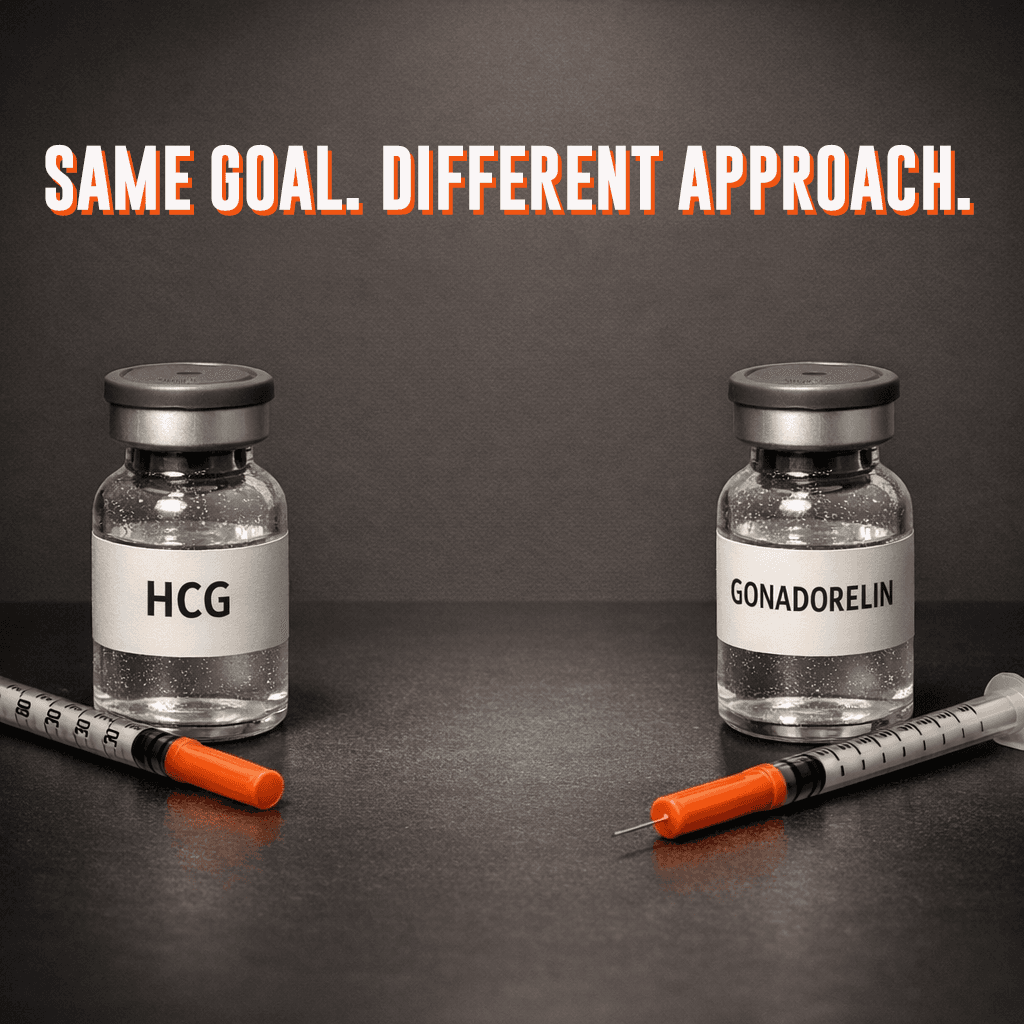
hCG has more evidence than gonadorelin for keeping the testes working on TRT, and even hCG's evidence comes from small studies. Gonadorelin is often described as an upgrade because it acts higher in the hormone chain. The mechanism is real, but no published trial has shown that intermittent gonadorelin injections preserve testicular function in men on testosterone. Neither drug is the guideline answer for a man who is trying to conceive now.
Why TRT affects the testes at all
Your testes take their orders from the brain. The hypothalamus releases gonadotropin-releasing hormone (GnRH) in pulses. GnRH tells the pituitary to release luteinizing hormone (LH), which drives testosterone production in the testes, and follicle-stimulating hormone (FSH), which supports sperm production. Together this loop is the hypothalamic-pituitary-gonadal (HPG) axis.
Testosterone from an injection or gel feeds back on the loop and turns those signals down. In a randomized trial of 29 healthy men given testosterone enanthate 200 mg weekly for 3 weeks, LH fell to 5% of baseline and FSH to 3%. Testosterone inside the testes (intratesticular testosterone, which sperm production depends on) fell by 94% (Coviello et al., JCEM 2005). That is how TRT impairs sperm production (Hsieh et al., J Urol 2013).
hCG and gonadorelin are two ways of keeping the testes stimulated anyway, and they enter the loop at different points.
How hCG works
Human chorionic gonadotropin (hCG) acts on the testes directly. Its label says its action "is virtually identical to that of pituitary LH, although HCG appears to have a small degree of FSH activity as well" (Novarel label, DailyMed). It bypasses the hypothalamus and pituitary and stimulates the testosterone-producing cells of the testes.
In the Coviello trial, men were randomized to placebo or to hCG at 125, 250, or 500 IU every other day alongside the testosterone. Intratesticular testosterone rose with the hCG dose. It ended 25% below baseline at 125 IU, 7% below at 250 IU, and 26% above at 500 IU. The trial lasted 3 weeks and measured hormone levels, not sperm or pregnancies.
The semen data come from a retrospective review of 26 men (mean age 35.9) on TRT plus hCG 500 IU every other day, followed for a mean of 6.2 months. None became azoospermic (no sperm in the ejaculate), semen parameters did not change, and 9 of the 26 contributed to a pregnancy (Hsieh et al., J Urol 2013). The study had no comparison group.
Those doses are what the studies used, not a recommendation. Your prescriber sets the dose.
How gonadorelin works
Gonadorelin is synthetic GnRH, the hypothalamic signal at the top of the loop. It acts on the pituitary, which then releases LH and FSH. That is the basis for the claim that it keeps more of the natural system running than hCG does.
Two facts about GnRH limit how it can be used. It is short-lived: GnRH "has a short half-life of 2–4 minutes and is secreted in frequent pulse waves" (Saleh and Taylor, F&S Reports 2023). And the pituitary responds to the pattern of exposure, not only the amount. In monkeys whose own GnRH release had been abolished, a constant GnRH infusion failed to restore LH and FSH, a pulse once an hour restored them, and switching back to continuous delivery could cause "desensitization" of the pituitary (Belchetz et al., Science 1978). Long-acting GnRH agonists used in medicine shut the pituitary down the same way: after 1 to 3 weeks of sustained exposure, the receptor is "desensitized and becomes down-regulated" (Saleh and Taylor).
The human evidence that gonadorelin can drive sperm production comes from men with congenital hypogonadotropic hypogonadism (CHH, a condition in which the brain does not make enough GnRH), treated with a pump that delivers it in pulses.
In a nonrandomized study of 28 azoospermic men with CHH, sperm appeared in 90% of the 10 men on a gonadorelin pump and 83.3% of the 18 men on hCG plus hMG injections, a difference that was not statistically significant. Sperm appeared sooner on the pump, at a median of 6 months versus 14 (Am J Mens Health 2019). In a retrospective study of 54 adult men with CHH on a GnRH pump, 27 of the 34 who gave a semen sample after 6 months or more of treatment had sperm (Transl Androl Urol 2025).
These men were not on testosterone, and they used a pump rather than a few injections a week. No published trial has given men on TRT intermittent subcutaneous gonadorelin and measured testicular size, intratesticular testosterone, or sperm. Whether that use keeps the testes working is not known.
Gonadorelin and hCG side by side
- Where it acts. Gonadorelin acts on the pituitary, which then releases LH and FSH. hCG acts on the testes directly, mostly like LH, with a small degree of FSH activity.
- How it has to be given. Gonadorelin lasts 2 to 4 minutes in the blood and works only in pulses; continuous exposure shuts the pituitary down. hCG was given as injections every other day in the TRT studies above.
- Evidence in men on TRT. hCG has one 3-week randomized trial of intratesticular testosterone and one retrospective semen study of 26 men. Gonadorelin has no published study; its sperm data come from pump therapy in men with CHH who were not on testosterone.
- Fertility guidance. The AUA guideline names hCG among the drugs clinicians may use to help maintain fertility. It does not name gonadorelin.
- FDA status. hCG is FDA-approved for specific uses, not for use alongside TRT. No FDA-approved gonadorelin product for people is currently marketed.
Some comparisons say gonadorelin carries less risk of "desensitization" than hCG, or suits long-term use better. No trial has compared the two in men on TRT, so neither claim has data behind it, and continuous GnRH exposure is itself the classic cause of pituitary desensitization.
FDA status of each
hCG
Branded hCG such as Novarel is FDA-approved for prepubertal cryptorchidism (undescended testes), for "selected cases of hypogonadotropic hypogonadism (hypogonadism secondary to a pituitary deficiency) in males", and for ovulation induction in women (Novarel label). Using it alongside TRT is off-label.
Gonadorelin
Two gonadorelin products for people were FDA-approved: Factrel (gonadorelin hydrochloride) in 1982 and Lutrepulse (gonadorelin acetate) in 1989. Drugs@FDA lists both as discontinued (Factrel, Lutrepulse). Gonadorelin used with TRT today is prescribed by a licensed clinician, who sets the dose, and filled by a licensed pharmacy.
Side effects
The hCG label lists headache, irritability, restlessness, depression, fatigue, edema (fluid retention), gynecomastia (breast tissue growth), and pain at the injection site, with no rates. In the CHH study above, the hCG-plus-hMG group tended toward higher testosterone, with more facial acne and breast tenderness.
For gonadorelin, the same CHH study reported skin redness at the pump site as a common side effect. No side-effect rates have been published for gonadorelin injections in men on TRT.
If you are trying to conceive
The AUA guideline is direct: "Exogenous testosterone therapy should not be prescribed to men who are currently trying to conceive" (Strong Recommendation, Grade A). Adding hCG or gonadorelin to TRT is not the guideline plan for that situation. The guideline says clinicians "may use aromatase inhibitors, human chorionic gonadotropin, selective estrogen receptor modulators, or a combination thereof in men with testosterone deficiency desiring to maintain fertility" (Conditional Recommendation, Grade C). It also says the long-term effect of testosterone on sperm production should be discussed with any man interested in future fertility (Strong Recommendation, Grade A) (AUA guideline).
If you are trying for a child now, or plan to soon, raise it with your prescriber before starting or continuing testosterone. That conversation covers whether you should be on testosterone at all and which alternatives fit. For more on this, see how TRT affects sperm production.
If children are not in your plans and you still want to keep the testes stimulated, ask your prescriber about it. Both drugs are prescription medications that need lab follow-up, so don't source either one yourself.
Common questions
Is gonadorelin a newer version of hCG?
No. They are different hormones that act at different points in the loop. Gonadorelin is not new either: Factrel was approved in 1982. What is newer is giving it alongside TRT, and no published trial has tested that use.
Does adding hCG to TRT guarantee fertility?
No. The best data come from a 26-man retrospective study with about 6 months of follow-up. Sperm production also depends on your baseline sperm health and how long you have been on testosterone.
Does hCG do anything for FSH?
Only a little. Its label describes "a small degree of FSH activity", but it acts mainly like LH. In the Coviello trial, FSH fell to 3% of baseline on testosterone alone.
Can I switch from hCG to gonadorelin myself?
No. Changing either drug, or its dose, is a decision for the clinician managing your care, based on your goals and labs.
Bottom line
Gonadorelin and hCG keep the testes stimulated in different ways. hCG acts on the testes directly, and small studies show it maintains intratesticular testosterone and semen parameters on TRT. Gonadorelin acts on the pituitary and works only in pulses; its sperm data come from pump therapy in men with CHH, not from men on TRT. Men trying to conceive need a fertility conversation with their prescriber, and the guideline answer is not to be on testosterone.
AlphaMD offers gonadorelin and hCG alongside testosterone replacement therapy, prescribed by a licensed provider after a review of your labs.