
Could Your Sauna Routine Be Working Against Fertility?
Published on:
Updated on:
People are asking...
I still want to have kids and want to avoid anything that could possibly shut me down all together. Which treatment is best for me ?...
It depends on when you want to have children. If your intent is to conceive in the next 12 months, you should choose hCG alone or a SERM like enclomiphene. These will maintain or even likely increase ... See Full Answer
How often do you see HCG doing nothing to preserve fertility? I had to completely quit all TRT for 6+ months to regain my fertility. I was on 250iu t...
Very rarely. Many times, men haven't done a semenalysis prior to starting TRT, so it's not always possible to be sure they were not already infertile prior to starting therapy. So without a baseline, ... See Full Answer
Is there any long term risk associated with hcg use?...
Generally HCG is fairly safe to work with long term, and many men enjoy low doses of it alongside their traditional TRT. However you body does get used to it over time (slightly) so if you were to use... See Full Answer
Have a question? Ask us.
At AlphaMD, we're here to help. Feel free to ask us any question you would like about TRT, medical weightloss, ED, or other topics related to men's health. Or take a moment to browse through our past questions.
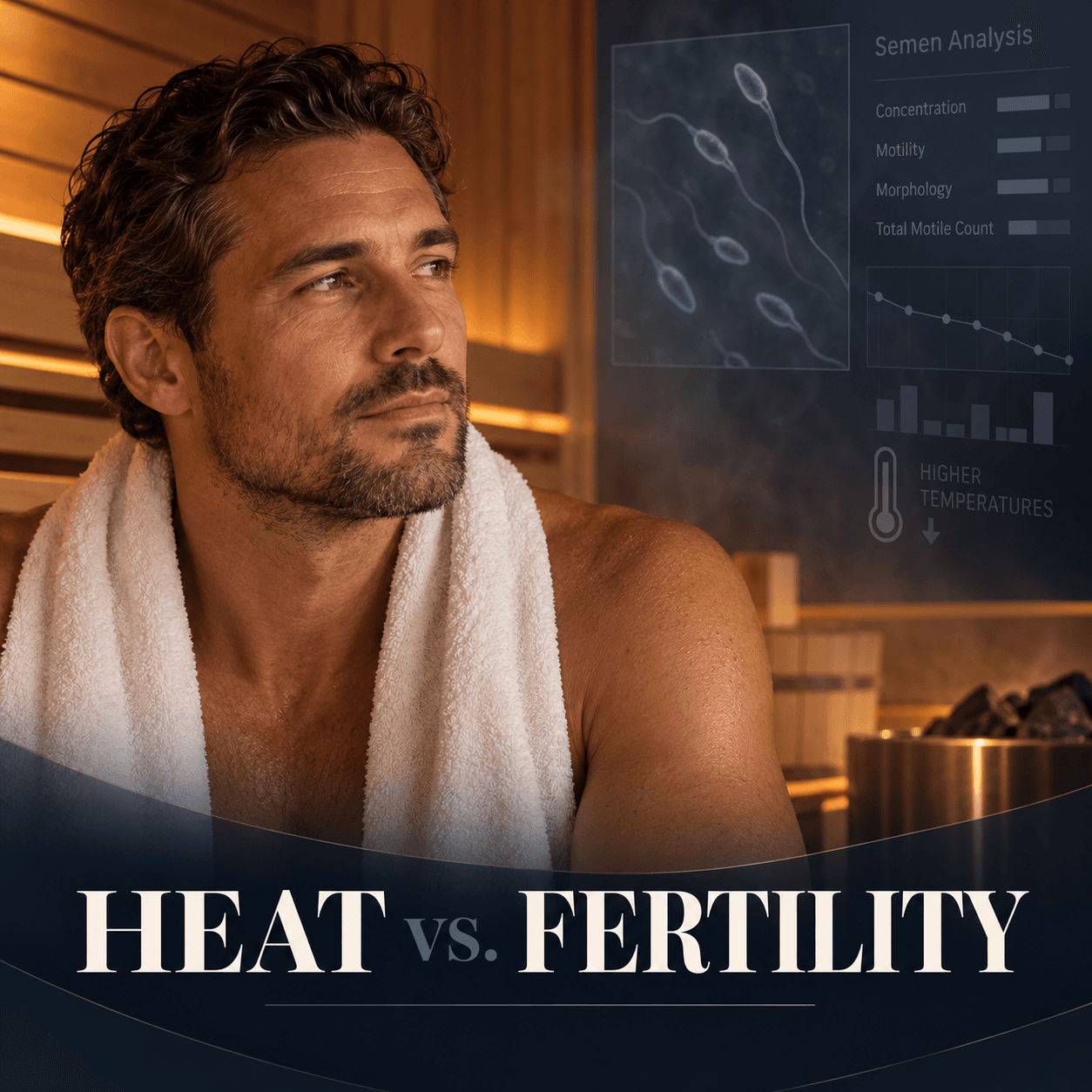
Frequent heat exposure may affect sperm production, but the fertility effect of a typical sauna routine is not settled. A newly registered randomized trial will compare sauna bathing, hot baths, and no deliberate heat exposure over three months.
That makes this a timely question for men who use saunas for recovery, cardiovascular conditioning, or longevity while also trying to conceive. The current evidence supports caution with sustained testicular heat, not a claim that every sauna session causes infertility.
Why Are the Testes Outside the Body?
Sperm production works best at a temperature below core body temperature. The scrotum, blood vessels, and local muscles help regulate that temperature.
Sustained heat can disrupt stages of sperm production and maturation. The timing matters because a semen sample reflects biological processes occurring over weeks, not only what happened the day before the test.
Sources of heat can include febrile illness, occupational exposure, hot baths, heated seats, laptops placed directly on the lap, and sauna use. These exposures differ in temperature, duration, frequency, and how much heat reaches the testes.
What Is the New Sauna Trial Testing?
A September 2026 trial registration describes a randomized study in healthy men interested in sauna or hot-bath use.
The planned sauna group will complete three rounds of 8 to 12 minutes in an 80 to 90 degree Celsius sauna, separated by two minutes of cold-water exposure, twice weekly for three months. A hot-bath group will use water at 42 to 43 degrees Celsius for five minutes, five days per week. A control group will avoid both routines.
Researchers plan to measure sperm concentration, count, motility, DNA fragmentation, and other semen parameters. The target sample is small, and the trial had not reported results as of October 8, 2026.
The registration tells us why the question remains active. It does not tell us which group will do better.
What Does Existing Human Evidence Suggest?
Experimental heat studies have found that repeated testicular warming can worsen some semen parameters. Small sauna studies have also reported reversible changes after frequent exposure.
Observational research is less consistent. Men who use saunas may differ from nonusers in exercise, cardiovascular health, smoking, alcohol use, occupation, and other fertility factors. Self-reported sauna habits also fail to measure the actual temperature reaching the testes.
Semen parameters are surrogate outcomes. Even when count or motility changes, a study may not show whether pregnancy or live-birth rates changed.
Does a Cold Plunge Cancel the Heat?
There is no established evidence that a brief cold plunge after sauna fully reverses testicular heating or protects sperm production. The new trial includes cold-water exposure in the sauna protocol, so it may provide useful information about that common routine.
Cold exposure creates its own physiological response. It should not be treated as an antidote that makes unlimited heat exposure consequence-free.
What About Men on TRT?
Testosterone replacement therapy can suppress luteinizing hormone, follicle-stimulating hormone, intratesticular testosterone, and sperm production. A man using TRT who wants fertility evaluation already has an important hormonal factor to discuss with a licensed clinician.
Adding frequent heat exposure may create another variable, but the effects cannot be calculated from a general sauna schedule. A semen analysis and reproductive history are more informative than assumptions based on heat alone.
Men should discuss fertility goals before starting TRT whenever possible. Treatment changes and fertility-preservation strategies require clinician guidance.
Should Men Trying to Conceive Stop Using Saunas?
There is no universal evidence-based rule for every man. A cautious approach is reasonable for someone with abnormal semen parameters, unexplained infertility, substantial occupational heat exposure, or an intensive sauna and hot-bath routine.
The decision should account for frequency, duration, temperature, fertility timeline, current semen results, and other causes of impaired sperm production. Because spermatogenesis takes time, changing a heat routine will not produce an immediate answer.
Frequently Asked Questions
Does one sauna session lower sperm count?
Evidence does not establish that one ordinary session causes a clinically meaningful fertility change. Repeated heat exposure is the larger concern.
Are sauna-related sperm changes permanent?
Some small studies suggest heat-related semen changes can improve after exposure stops. Recovery varies, and pregnancy outcomes are less well studied.
Does TRT make heat exposure more dangerous for fertility?
TRT can already suppress sperm production. The combined fertility effect of TRT and sauna use has not been established in controlled trials.
Can a semen analysis prove that sauna caused a problem?
No. A semen analysis can identify abnormalities, but it cannot assign the cause without broader evaluation and repeat testing.
Key Takeaway
Testicular heat can influence sperm production, but the fertility effect of common sauna routines remains uncertain. A new randomized trial is testing the question. Men actively trying to conceive should treat repeated heat exposure as one part of a complete fertility review, especially when TRT or abnormal semen results are also involved.
This article is educational and is not medical advice. Fertility concerns and treatment decisions should be reviewed with an appropriately licensed clinician.
Have a question? Ask us.
At AlphaMD, we're here to help. Feel free to ask us any question you would like about TRT, medical weightloss, ED, or other topics related to men's health. Or take a moment to browse through our past questions.
People are asking...
I still want to have kids and want to avoid anything that could possibly shut me down all together. Which treatment is best for me ?...
It depends on when you want to have children. If your intent is to conceive in the next 12 months, you should choose hCG alone or a SERM like enclomiphene. These will maintain or even likely increase ... See Full Answer
How often do you see HCG doing nothing to preserve fertility? I had to completely quit all TRT for 6+ months to regain my fertility. I was on 250iu t...
Very rarely. Many times, men haven't done a semenalysis prior to starting TRT, so it's not always possible to be sure they were not already infertile prior to starting therapy. So without a baseline, ... See Full Answer
Is there any long term risk associated with hcg use?...
Generally HCG is fairly safe to work with long term, and many men enjoy low doses of it alongside their traditional TRT. However you body does get used to it over time (slightly) so if you were to use... See Full Answer
Get $30 off your first month’s order
Enter your email address now to receive $30 off your first month’s cost, other discounts, and additional information about TRT.
Legal Disclaimer
This website is a repository of publicly available information and is not intended to form a physician-patient relationship with any individual. The content of this website is for informational purposes only. The information presented on this website is not intended to take the place of your personal physician's advice and is not intended to diagnose, treat, cure, or prevent any disease. Discuss this information with your own physician or healthcare provider to determine what is right for you. All information is intended for your general knowledge only and is not a substitute for medical advice or treatment for specific medical conditions. The information contained herein is presented in summary form only and intended to provide broad consumer understanding and knowledge. The information should not be considered complete and should not be used in place of a visit, phone or telemedicine call, consultation or advice of your physician or other healthcare provider. Only a qualified physician in your state can determine if you qualify for and should undertake treatment.