
Social Media Is Diagnosing Men With Low T. A Peer-Reviewed Study Just Confirmed the Harm.
Published on:
People are asking...
With T fluctuations being so drastic from any given hour, day, week, how can you really know if someone has a hormonal imbalance?...
That is why symptoms are king, and numbers should be used as a guide post for what treatment is appropriate and how responsive someone is. Your 500 and my 500 will feel completely different to each of... See Full Answer
Thoughts on people under 30 seeking TRT? Seeing as this is a lifetime commitment?...
It sucks if a man has to start TRT before 30. It also sucks that it is unlikely that a man who gets low T in his 30s is able to naturally increase his testosterone. Providers on the AlphaMD platform h... See Full Answer
Have been zeroing on some health issues and I recently got a Testosterone test of 301 ng/dl. As a very healthy male ( train 6x a week, track every cal...
Based on your symptoms, a licensed provider would likely consider you a candidate for TRT. A provider would want to talk with you to dive a bit deeper into them, but at a glance, yes.Men who are very ... See Full Answer
Have a question? Ask us.
At AlphaMD, we're here to help. Feel free to ask us any question you would like about TRT, medical weightloss, ED, or other topics related to men's health. Or take a moment to browse through our past questions.
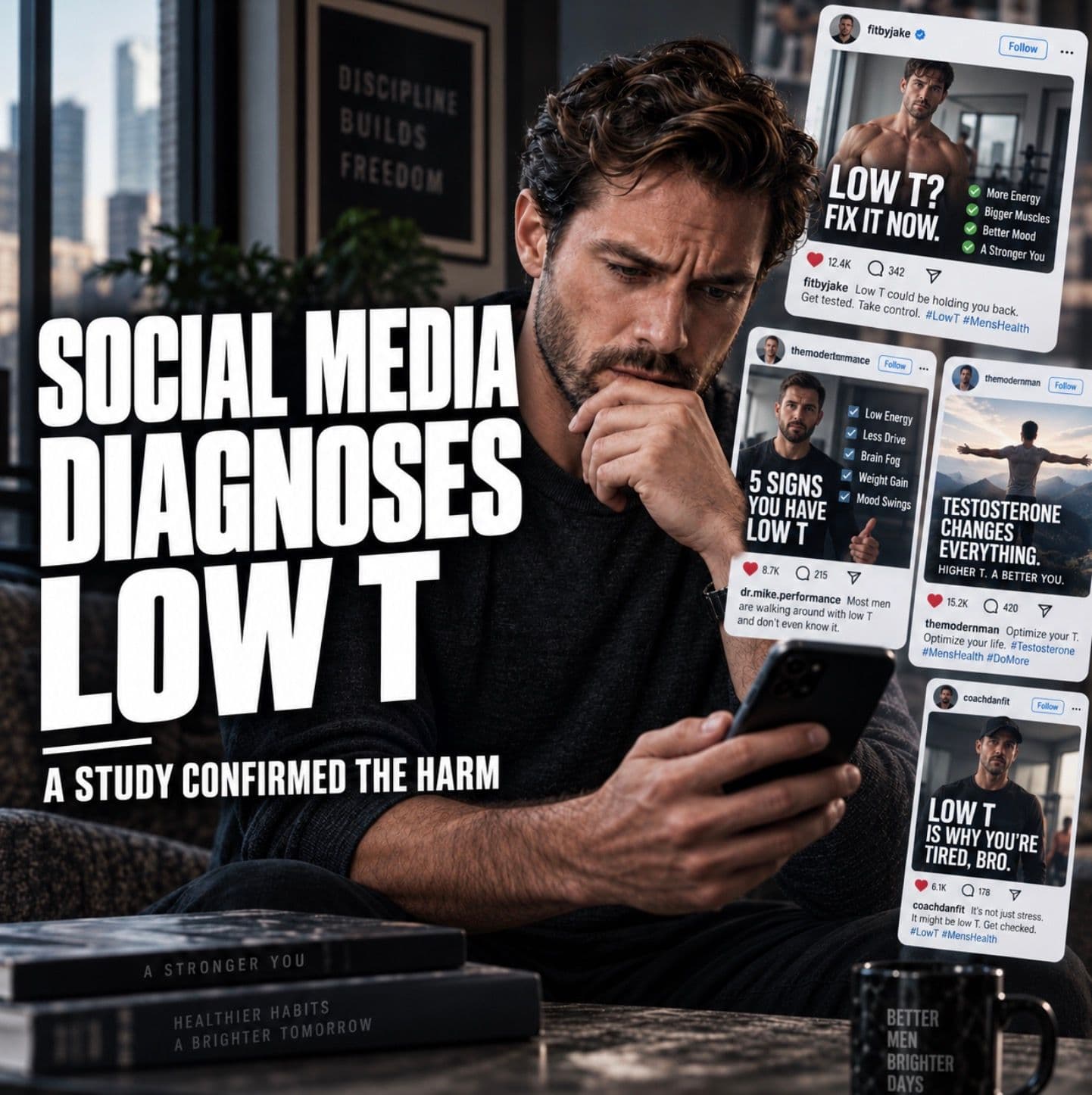
Scroll through any men's health forum, fitness page, or short-form video feed for ten minutes and you will likely encounter content telling you that you are tired, unmotivated, and struggling in the bedroom because of low testosterone. A peer-reviewed study published in the journal PLOS ONE confirmed what many clinicians have suspected for years: the information men are finding online about testosterone is frequently inaccurate, commercially motivated, and potentially harmful.
The Algorithm Rewards Alarm, Not Accuracy
Social media platforms are built to maximize engagement, and health anxiety drives engagement extremely well. A post framing fatigue, low libido, or brain fog as signs of "low T" gets clicks, shares, and comments from men who recognize those feelings in themselves. That engagement signals the algorithm to push the content further, creating a feedback loop that has nothing to do with medical accuracy.
The framing also matters. Low testosterone content is almost always wrapped in the language of masculinity, identity, and performance. It positions a lab number as the difference between being a "high-value man" and being diminished. That emotional charge makes the content sticky in a way that a nuanced clinical explanation never could be.
Supplementing all of this is a massive commercial ecosystem. Testosterone boosters, adaptogens, peptide stacks, and "optimization" programs are billion-dollar markets. The brands behind them fund creators, sponsor podcasts, and design symptom checklists that are engineered to make nearly every adult man feel like a candidate for intervention. Those checklists ask about fatigue. Who is not sometimes fatigued? They ask about mood changes, reduced motivation, difficulty building muscle. Every item resonates with someone.
What Low Testosterone Actually Means Clinically
Hypogonadism, the clinical term for testosterone deficiency, is a real medical condition. It can cause significant symptoms and, in confirmed cases, testosterone replacement therapy is an established and effective treatment. The critical word in that sentence is "confirmed."
A clinical diagnosis of low testosterone is not made by matching your symptoms to a social media checklist. According to guidelines from the Endocrine Society, diagnosis requires both the presence of consistent symptoms and biochemical confirmation through blood testing conducted under appropriate conditions, typically in the morning when testosterone levels are naturally at their peak, and repeated on more than one occasion to account for natural daily and situational variation.
Symptoms alone are not diagnostic. This is one of the most important distinctions that online content routinely collapses, and it is where a significant amount of harm begins.
The Overlap Problem: When Everything Looks Like Low T
The symptoms most commonly attributed to low testosterone are real and often genuinely distressing. Fatigue, reduced sex drive, difficulty concentrating, irritability, low mood, changes in body composition, and disrupted sleep affect millions of men. The problem is that these symptoms are extraordinarily non-specific.
Consider how many other conditions share the same presentation. Chronic sleep deprivation alone can suppress testosterone and produce every symptom on the standard checklist. Clinical depression, generalized anxiety, and burnout can present identically. Overtraining without adequate recovery does the same. Obesity, type 2 diabetes, thyroid disorders, elevated prolactin, and anemia all have overlapping symptom profiles. Alcohol use, certain prescription medications including antidepressants and opioids, and chronic psychological stress can each independently suppress hormone production or produce symptoms that are indistinguishable from true testosterone deficiency.
When a man who is sleeping five hours a night, drinking most evenings, and managing a high-stress job watches a video that says his fatigue and low libido are caused by low T, he is receiving a confident answer to a question that requires careful clinical investigation. That confident answer delays the real one.
What Research Says About the Harm
The peer-reviewed literature on testosterone misinformation has grown substantially in recent years. A study published in PLOS ONE analyzed online testosterone content and found that a significant proportion of videos and posts contained inaccurate information, exaggerated benefits, downplayed risks, and encouraged viewers to seek treatment without proper evaluation. The researchers noted that this content frequently originated from commercially motivated sources rather than medical professionals.
Research has documented several categories of harm associated with this misinformation pattern. Men who self-diagnose based on social media content are more likely to approach clinicians with a predetermined conclusion, which can pressure prescribing decisions. Some men pursue treatment through channels that bypass clinical evaluation entirely, including online pharmacies operating in legal gray areas and black-market sources. This introduces risks of unverified product quality, dosing errors, and complete absence of monitoring.
There are also significant mental health consequences. The constant bombardment of content linking masculinity to hormone levels has contributed to increased body image anxiety among men, a problem that was once discussed almost exclusively in the context of women's health. Men who become preoccupied with optimizing their testosterone report elevated health anxiety, compulsive testing behavior, and distress when results fall in ranges that clinicians consider normal. The pursuit of optimization can become its own source of suffering.
Fertility and Family Planning: A Conversation That Cannot Wait
One of the most underreported harms in online testosterone content is the impact on fertility. Exogenous testosterone, meaning testosterone introduced into the body from an outside source, signals the brain to reduce or halt its own hormonal signals to the testes. This suppresses sperm production, often dramatically, and can in some cases lead to temporary or prolonged infertility.
This effect is rarely mentioned in social media content promoting testosterone use. Men who begin treatment without understanding this risk and without disclosing their family planning intentions to a clinician may discover the fertility consequences only after the fact.
For men who want to preserve fertility while addressing confirmed testosterone deficiency, options exist. Human chorionic gonadotropin is one treatment that can be used to support testicular function and sperm production, sometimes alongside or instead of standard testosterone therapy. The point is not that treatment is unavailable for these men, but that none of these decisions can be made appropriately without a clinician who knows your full situation, including your reproductive goals.
What a Careful Medical Evaluation Actually Involves
A thorough evaluation for possible testosterone deficiency looks nothing like clicking through an online quiz. It begins with a comprehensive history: your symptoms, when they started, how they have changed, what else is going on in your life, your medications, your alcohol and substance use, your sleep, your stress levels, and your family and reproductive history.
It includes a physical examination that can identify signs relevant to hormonal status and rule out other contributing conditions. It involves laboratory testing, which should be conducted at the right time of day and interpreted in the context of your full clinical picture, not against a single number in isolation. If initial results are borderline or ambiguous, good clinical practice calls for repeat testing before drawing conclusions.
Critically, a responsible evaluation does not end at testosterone. It looks at thyroid function, blood sugar regulation, complete blood counts, and other relevant markers that can explain or contribute to your symptoms. The goal is to understand what is actually happening, not to confirm a self-diagnosis arrived at through a video.
What to Do Instead of Trusting a Checklist
If you are experiencing the symptoms commonly associated with low testosterone, the most productive thing you can do is document them carefully and bring that documentation to a qualified clinician. Write down when symptoms started, how often they occur, what makes them better or worse, and what else has been changing in your life.
When evaluating online health content, a few questions are useful. Who is funding this content? Does this creator or brand sell a product or service related to the advice being given? Is the claim backed by peer-reviewed research, or is it built on anecdotal testimonials? Does the content acknowledge nuance and uncertainty, or does it offer certainty where none exists?
Lifestyle factors are not a deflection; they are genuinely meaningful. Consistent, quality sleep is one of the most powerful levers for hormonal health available to any man without a prescription. Regular resistance exercise, reduction in alcohol consumption, stress management, and maintaining a healthy body weight all have documented effects on testosterone levels and on the symptoms that are often attributed to low T. These are not alternatives to medical care for men with confirmed deficiency, but they are legitimate first steps for the many men whose symptoms have a recoverable, non-hormonal cause.
Getting an Honest Evaluation Matters More Than a Quick Answer
Social media is not a diagnosis. It cannot order your labs, review your history, or account for the dozen other explanations for how you are feeling. A confident creator telling you that you have low T based on symptoms you recognized in a sixty-second video is not practicing medicine; they are selling something, even if what they are selling is just attention.
The men most likely to be harmed by online testosterone content are the ones who need the most help, those who are genuinely struggling and are understandably drawn to a clear explanation and a simple solution. Those men deserve a real evaluation.
If you are considering whether your symptoms might have a hormonal cause, seeking care from a clinician who will take a complete history, order appropriate testing, and interpret results in context is the right starting point. AlphaMD offers evidence-based online evaluation and men's health support, connecting you with licensed clinicians who can work through what your symptoms actually mean rather than simply confirming what an algorithm suggested.
Have a question? Ask us.
At AlphaMD, we're here to help. Feel free to ask us any question you would like about TRT, medical weightloss, ED, or other topics related to men's health. Or take a moment to browse through our past questions.
People are asking...
With T fluctuations being so drastic from any given hour, day, week, how can you really know if someone has a hormonal imbalance?...
That is why symptoms are king, and numbers should be used as a guide post for what treatment is appropriate and how responsive someone is. Your 500 and my 500 will feel completely different to each of... See Full Answer
Thoughts on people under 30 seeking TRT? Seeing as this is a lifetime commitment?...
It sucks if a man has to start TRT before 30. It also sucks that it is unlikely that a man who gets low T in his 30s is able to naturally increase his testosterone. Providers on the AlphaMD platform h... See Full Answer
Have been zeroing on some health issues and I recently got a Testosterone test of 301 ng/dl. As a very healthy male ( train 6x a week, track every cal...
Based on your symptoms, a licensed provider would likely consider you a candidate for TRT. A provider would want to talk with you to dive a bit deeper into them, but at a glance, yes.Men who are very ... See Full Answer
Get $30 off your first month’s order
Enter your email address now to receive $30 off your first month’s cost, other discounts, and additional information about TRT.
Legal Disclaimer
This website is a repository of publicly available information and is not intended to form a physician-patient relationship with any individual. The content of this website is for informational purposes only. The information presented on this website is not intended to take the place of your personal physician's advice and is not intended to diagnose, treat, cure, or prevent any disease. Discuss this information with your own physician or healthcare provider to determine what is right for you. All information is intended for your general knowledge only and is not a substitute for medical advice or treatment for specific medical conditions. The information contained herein is presented in summary form only and intended to provide broad consumer understanding and knowledge. The information should not be considered complete and should not be used in place of a visit, phone or telemedicine call, consultation or advice of your physician or other healthcare provider. Only a qualified physician in your state can determine if you qualify for and should undertake treatment.