
Testosterone and Penile Health: The Vascular and Structural Evidence That Goes Beyond Libido
Published on:
Updated on:
People are asking...
Does TRT benefit erection quality?...
Yes, generally the three main reasons people start TRT are: Energy/motivation, fat loss issues/muscle loss, and libido/erectile function.... See Full Answer
Is there an alternative to HCG in respect to keeping the testes from shrinking? Ive also read anecdotal reports from some that HCG has helped them ke...
There are not good alternative for teste size, or at least none as good as HCG with as few negatives as it has other than price. In those reports, it is likely that the person's Estrogen was lower tha... See Full Answer
38 with hormonal issues and it's attendant symptoms and effect since adolescence. Completely bald by 23, finger nails and pubic hair takes a very long...
Fatigue, confidence, libido, motivation, and erectile function are all things that improve on TRT. Head hair & likely nail growth speed is typically not improved with TRT. Body hair for most men tends... See Full Answer
Have a question? Ask us.
At AlphaMD, we're here to help. Feel free to ask us any question you would like about TRT, medical weightloss, ED, or other topics related to men's health. Or take a moment to browse through our past questions.
Most men think about penile health in terms of desire, but the mechanics that actually produce and sustain an erection are almost entirely vascular and structural. Understanding that distinction changes how you think about sexual function, long-term tissue health, and what warning signs are worth paying attention to.
Erections Are a Vascular Event, Not Just a Feeling
An erection begins not in the brain but in the blood vessels. When arousal signals travel down the nervous system, the penile arteries dilate, arterial blood rushes into two chambers called the corpora cavernosa, and the expanding tissue compresses the veins that would otherwise drain that blood away. The result is rigidity. Strip away the psychology and what you have is a hydraulic system that depends on healthy arteries, responsive smooth muscle, and intact veno-occlusive mechanics.
This matters because libido, the desire to have sex, and the physical capacity to achieve an erection are controlled by different pathways. A man can have high desire and poor erectile function. He can also have low desire and still achieve firm erections. These two dimensions diverge more often than most men realize, and conflating them leads to misdiagnosis and missed opportunities for proper evaluation.
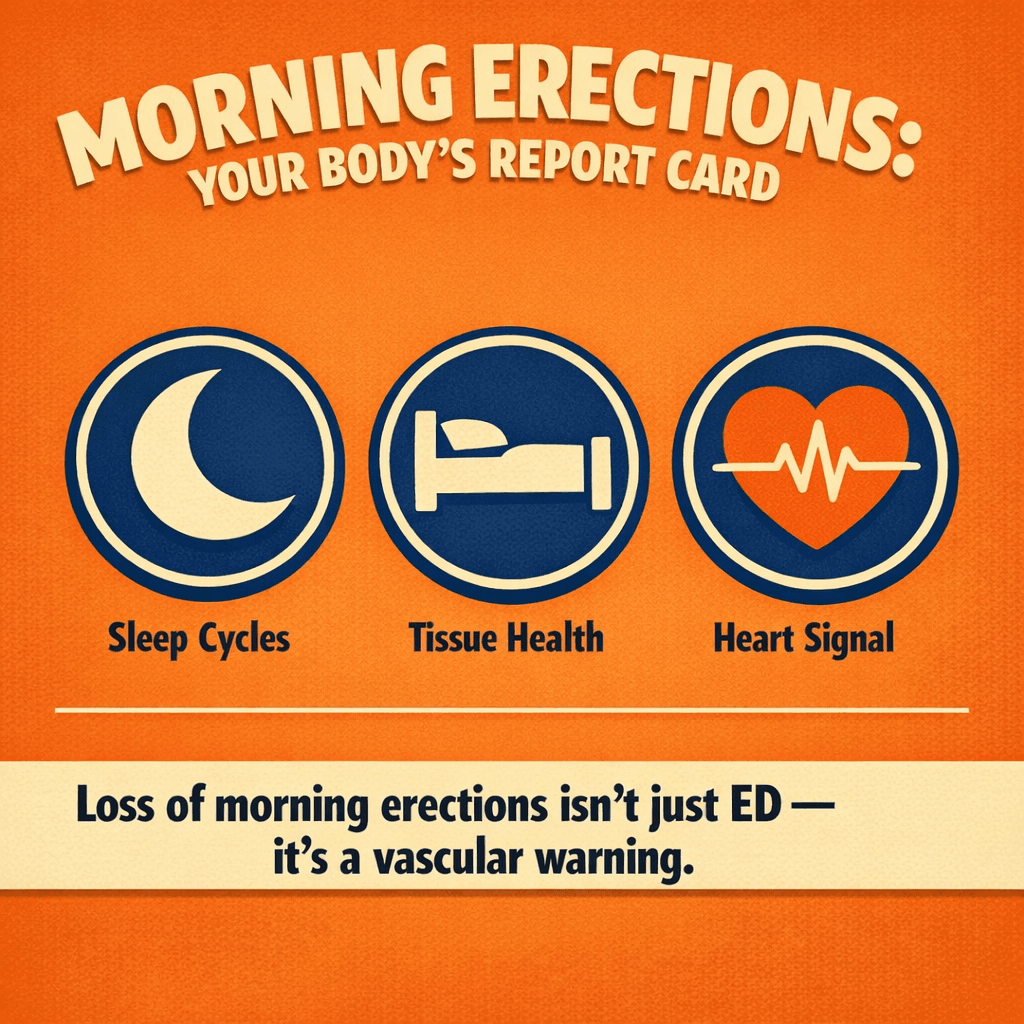
Nocturnal erections, the automatic erections that occur during REM sleep, illustrate this point well. They happen without any conscious sexual thought and serve a genuine physiological purpose: delivering oxygenated blood to penile tissue, preventing local hypoxia, and maintaining the health of smooth muscle and connective tissue. Their absence is clinically meaningful and can point toward vascular or neurological disruption rather than psychological cause.
The Nitric Oxide Pathway: The Biochemistry Behind Arterial Inflow
The central molecule in penile vascular function is nitric oxide (NO). When the endothelium, the thin cellular lining of blood vessels, receives the right signals, it releases nitric oxide, which relaxes smooth muscle in the arterial walls and allows blood to flow in. The enzyme responsible for producing nitric oxide in this context is endothelial nitric oxide synthase (eNOS), and its activity is sensitive to a surprisingly wide range of factors: blood pressure, blood sugar, oxidative stress, inflammation, and yes, androgen levels.
Endothelial dysfunction, meaning the impaired ability of vessel walls to produce or respond to nitric oxide, is one of the earliest measurable signs of cardiovascular disease. The penile arteries are small-diameter vessels, and small arteries tend to show dysfunction earlier than large ones. This is part of why erectile dysfunction (ED) in otherwise healthy men under 50 has been identified in peer-reviewed research as a potential early marker of systemic cardiovascular risk, sometimes preceding a cardiac event by years. Research published by the American Heart Association has highlighted this connection, underscoring that penile vascular health is not a niche concern but a window into systemic arterial function.
Smooth Muscle, Collagen, and the Structural Side of Penile Tissue
Beyond the blood vessels themselves, the internal architecture of the penis plays a defining role in erectile function. The corpora cavernosa are largely composed of smooth muscle cells embedded in a collagen matrix. When this smooth muscle is healthy and responsive, it relaxes to allow engorgement and contracts to allow detumescence. When smooth muscle is lost and replaced by collagen, the tissue becomes fibrotic, less elastic, and less capable of the pressure changes needed for a full erection.
Fibrosis in penile tissue is a real and underappreciated problem. It can develop gradually from chronic tissue hypoxia (reduced oxygenation during periods of poor erectile function), from aging, from metabolic disease, or from injury. Peyronie's disease, a condition where localized scar tissue forms in the tunica albuginea, the dense fibrous sheath surrounding the corpora cavernosa, is one of the more visible consequences of this process. It is not rare, affecting an estimated 3 to 9 percent of adult men, and it exists on a spectrum from mild plaque formation to significant curvature and functional impairment. Understanding Peyronie's disease as a structural and fibrotic condition, rather than a mysterious or shameful one, helps frame it correctly in the context of penile tissue biology.
The veno-occlusive mechanism also depends on tissue structure. If the tunica albuginea or the surrounding smooth muscle loses tone, the veins may not be compressed properly during erection, allowing blood to drain out prematurely. This is referred to as a venous leak and can result in erections that are difficult to achieve or impossible to maintain, even when arterial inflow is adequate.
How Androgens Shape the Tissue, Not Just the Drive
Androgens, particularly testosterone, have direct effects on penile tissue that extend well beyond their influence on sexual desire. Androgen receptors are expressed in the smooth muscle cells of the corpora cavernosa, in the endothelium of the penile vasculature, and in the cells of the tunica albuginea. This distribution matters because it means testosterone is not just a hormone that signals the brain to want sex; it is a molecule that physically maintains the tissue architecture of the penis.
Research has shown that testosterone promotes the expression of eNOS in penile tissue, supporting the nitric oxide pathway described earlier. In low-androgen states, eNOS expression tends to decline, contributing to endothelial dysfunction and impaired arterial response. Animal model studies and some human data suggest that prolonged hypogonadism is associated with increased collagen deposition and smooth muscle atrophy in the corpora cavernosa, a fibrotic shift that could, over time, reduce erectile capacity in ways that are not fully reversible. The National Institutes of Health has published research on androgen effects in erectile tissue, supporting the idea that hormonal environment actively regulates penile structural health.
Testosterone also appears to have anti-fibrotic signaling roles, inhibiting certain pathways that promote collagen accumulation. While this area of research is still evolving, it suggests that maintaining adequate androgen levels may be relevant not just for desire but for preserving the cellular composition and mechanical function of erectile tissue. What remains less settled is the precise threshold below which these tissue-level effects become clinically significant, and whether testosterone replacement therapy consistently reverses established fibrotic changes or primarily prevents further progression.
When Libido Is Fine but Function Is Not: Separating Two Different Systems
One of the most important clinical distinctions in men's sexual health is the separation between desire and mechanics. Testosterone influences desire substantially; this relationship is well-established. But erectile function also depends on vascular integrity, neurological signaling, and tissue health, none of which testosterone alone controls.
A man with adequate testosterone levels can still have significant ED driven by atherosclerosis, diabetes-related nerve damage, medication side effects, or pelvic floor dysfunction. Conversely, a man with low testosterone may notice reduced desire long before he notices any change in morning erections or erectile quality. Recognizing this divergence is clinically important because it means evaluating ED requires looking at multiple systems, not just hormone panels.
Some men also experience what is sometimes called psychogenic ED, where anxiety, performance pressure, relationship conflict, or the use of pornography creates a conditioned response that impairs erection despite normal vascular and hormonal function. This is real, it is common, and it does not mean the problem is "all in your head" in a dismissive sense. It means the psychological and vascular systems interact, and addressing one without the other often falls short.
The Lifestyle Variables That Quietly Reshape Penile Vasculature
Penile vascular health does not exist in a vacuum. The same factors that damage coronary arteries damage penile arteries, often earlier and more visibly in terms of symptoms. Smoking is among the most damaging: nicotine and combustion byproducts directly impair endothelial function, reduce nitric oxide availability, and accelerate arterial stiffening. The effect on erectile function is measurable and dose-dependent.
Metabolic health, particularly insulin sensitivity, body fat distribution, and blood pressure, has a direct impact on endothelial function and androgen levels. Visceral obesity is associated with increased aromatization of testosterone to estradiol, elevated inflammation, and suppressed gonadotropin signaling, all of which affect both hormonal and vascular parameters relevant to penile health.
Sleep quality deserves specific mention. Testosterone is predominantly secreted during sleep, particularly during slow-wave and REM sleep stages. Chronic sleep deprivation suppresses testosterone levels, reduces the frequency of nocturnal erections, and impairs tissue oxygenation cycles that help maintain smooth muscle and collagen balance. Resistance exercise, cardiovascular fitness, and maintaining a healthy body composition all support both endocrine and vascular function in ways that are consistently reflected in the literature on men's sexual health.
What a Proper Evaluation Actually Looks Like
For men experiencing ED or noticing changes in erectile quality, morning erections, or sexual desire, a thorough clinical evaluation does more than check a single hormone level. A competent clinician will take a detailed history that separates the timing and nature of the dysfunction, whether it is situational or consistent, whether morning erections are present, and what cardiovascular and metabolic risk factors exist.
Laboratory evaluation typically covers hormonal status, metabolic markers, and cardiovascular risk factors. Physical examination and a review of medications, many of which affect erectile function, are also part of the picture. In some cases, penile duplex ultrasound, which measures arterial inflow velocity and assesses venous leak, provides detailed vascular information that labs alone cannot offer. This imaging is not always necessary but becomes more relevant in cases where the cause is unclear or where the findings might change treatment decisions.
Cardiovascular risk assessment is an important and sometimes overlooked part of any ED evaluation, precisely because of the relationship between penile vascular disease and systemic arterial health discussed earlier.
Treatment Considerations and the Role of Medical Supervision
Treatment decisions in this area depend heavily on identifying the underlying cause. When hypogonadism is a contributing factor, addressing it through testosterone replacement therapy may improve tissue health, libido, and erectile function, though the degree of benefit varies and is not guaranteed to be complete, particularly if structural changes are already established. Treatment should always be supervised by a clinician who can monitor hormone levels, evaluate response, and watch for potential side effects.
Phosphodiesterase-5 inhibitors, the class of medications most men associate with ED treatment, work by amplifying the nitric oxide pathway, which underscores how central that vascular mechanism is. In some cases, these medications and hormonal treatment complement each other. In others, addressing lifestyle factors, metabolic health, or psychological contributors may be the higher-yield intervention.
Platelet-rich plasma therapy, shockwave therapy, and other emerging interventions aimed at vascular regeneration and tissue remodeling are areas of active research. Their evidence base is growing but not yet definitive, and they are best discussed with a clinician who follows the current literature.
Putting It Together: Why Penile Health Is Vascular and Structural, First
Penile health is a story of blood vessels, smooth muscle, collagen architecture, nitric oxide signaling, and androgen-mediated tissue maintenance. Libido is one dimension of sexual health, but it is not the mechanism, and treating desire as a proxy for function leads men and clinicians to miss the real picture.
If you are noticing changes in erectile quality, frequency of morning erections, or penile sensation, those are signals worth evaluating systematically. Platforms like AlphaMD offer online men's health care with clinicians who understand the hormonal, vascular, and structural dimensions of sexual health, and can help evaluate symptoms, order appropriate labs, and discuss whether treatment options are appropriate for your situation. Penile health, properly understood, is a measure of vascular and tissue biology, and it deserves the same evidence-based attention as any other aspect of cardiovascular and hormonal wellness.
Have a question? Ask us.
At AlphaMD, we're here to help. Feel free to ask us any question you would like about TRT, medical weightloss, ED, or other topics related to men's health. Or take a moment to browse through our past questions.
People are asking...
Does TRT benefit erection quality?...
Yes, generally the three main reasons people start TRT are: Energy/motivation, fat loss issues/muscle loss, and libido/erectile function.... See Full Answer
Is there an alternative to HCG in respect to keeping the testes from shrinking? Ive also read anecdotal reports from some that HCG has helped them ke...
There are not good alternative for teste size, or at least none as good as HCG with as few negatives as it has other than price. In those reports, it is likely that the person's Estrogen was lower tha... See Full Answer
38 with hormonal issues and it's attendant symptoms and effect since adolescence. Completely bald by 23, finger nails and pubic hair takes a very long...
Fatigue, confidence, libido, motivation, and erectile function are all things that improve on TRT. Head hair & likely nail growth speed is typically not improved with TRT. Body hair for most men tends... See Full Answer
Get $30 off your first month’s order
Enter your email address now to receive $30 off your first month’s cost, other discounts, and additional information about TRT.
Legal Disclaimer
This website is a repository of publicly available information and is not intended to form a physician-patient relationship with any individual. The content of this website is for informational purposes only. The information presented on this website is not intended to take the place of your personal physician's advice and is not intended to diagnose, treat, cure, or prevent any disease. Discuss this information with your own physician or healthcare provider to determine what is right for you. All information is intended for your general knowledge only and is not a substitute for medical advice or treatment for specific medical conditions. The information contained herein is presented in summary form only and intended to provide broad consumer understanding and knowledge. The information should not be considered complete and should not be used in place of a visit, phone or telemedicine call, consultation or advice of your physician or other healthcare provider. Only a qualified physician in your state can determine if you qualify for and should undertake treatment.