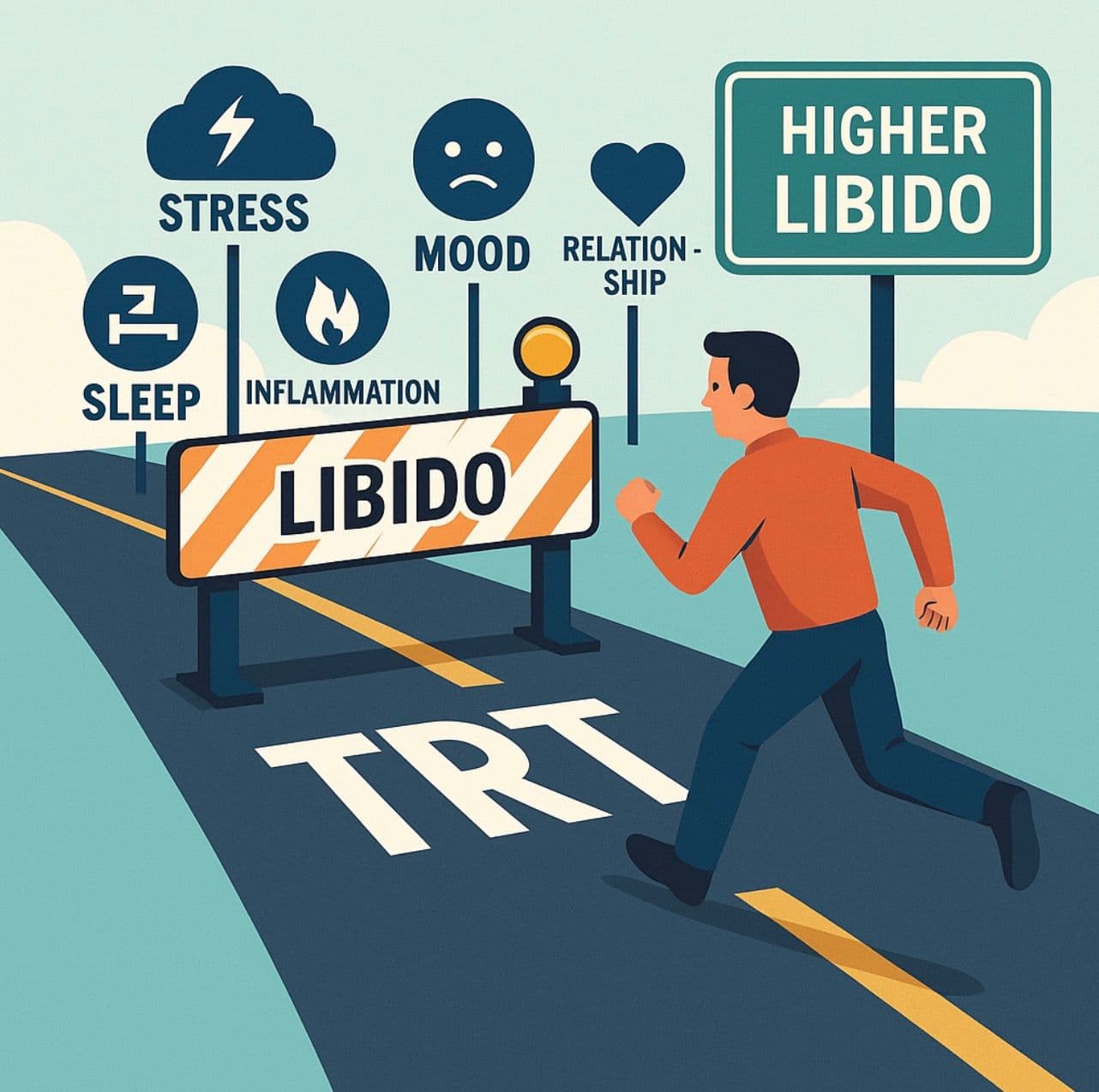
If your testosterone is back in range on TRT but your sex drive is still low, the cause may be something testosterone doesn't treat. A normal level doesn't guarantee normal desire. Medications, depression, the relationship, erection problems, sleep apnea, alcohol, and other hormone problems can each affect sex drive or sexual function, and most of them can be checked.
What TRT does for libido, and how long it takes
The best evidence comes from the Testosterone Trials (TTrials), a set of randomized, placebo-controlled trials in 790 men aged 65 and older with testosterone under 275 ng/dL and symptoms of low T. One year of testosterone gel brought a moderate benefit to sexual function, including sexual desire, and some benefit to mood (Snyder et al., NEJM 2016).
A closer look at the 470 men in the Sexual Function Trial, all of whom had low libido, found that desire and sexual activity improved in step with how much testosterone rose. There was no threshold level above which desire switched on, and none of 27 baseline traits predicted who would respond (Cunningham et al., JCEM 2016). These were older men with clearly low T, so the results say less about younger men or men whose levels were borderline before treatment.
A review of testosterone studies found that effects on sexual interest appear after about 3 weeks and plateau around 6 weeks, with no further gains expected after that. Changes in erections can take up to 6 months (Saad et al., Eur J Endocrinol 2011).
First, check that TRT itself is on target
The AUA guideline says dosing should be adjusted to reach a total testosterone level in the middle third of the normal range, with levels measured every 6 to 12 months on therapy (AUA 2018). If you think your level is off, raise it with the provider managing your care rather than changing the dose yourself.
The same guideline says clinicians should discuss stopping testosterone 3 to 6 months after starting when levels have normalized but symptoms haven't improved. So if your T is in the target range and desire hasn't moved after several months, the guideline's next step is a conversation about whether to continue, and the causes below are worth checking. The TRT treatment page covers how AlphaMD providers review labs before and during treatment.
1. Medications
Antidepressants are the best-studied example. A meta-analysis of studies that asked patients directly about sexual side effects found higher rates of sexual dysfunction than placebo with sertraline, venlafaxine, citalopram, paroxetine, fluoxetine, imipramine, phenelzine, duloxetine, escitalopram, and fluvoxamine, ranging from 25.8% to 80.3% of patients. Bupropion and mirtazapine, among others, were not different from placebo (Serretti and Chiesa, J Clin Psychopharmacol 2009). If an antidepressant may be the cause, the prescriber can weigh the options. Don't stop one on your own.
Finasteride, used for hair loss and prostate enlargement, is another. In the 4-year trial in the PROSCAR label, 6.4% of men on finasteride reported decreased libido in the first year, compared with 3.4% on placebo, and there was no significant difference in years 2 to 4 (PROSCAR label).
2. Depression and anxiety
Depression and sexual problems feed each other. A meta-analysis of prospective cohort studies found that depression raised the risk of later sexual dysfunction (adjusted odds about 1.7 times higher), and sexual dysfunction raised the odds of later depression (about 3.1 times higher). The authors recommend screening for depression in anyone reporting sexual dysfunction (Atlantis and Sullivan, J Sex Med 2012).
An international consensus review lists depression, anxiety, and the medications used to treat them as risk factors for sexual dysfunction in men (McCabe et al., J Sex Med 2016). In the TTrials, men on testosterone reported only slightly better mood and lower depressive symptoms than men on placebo (Snyder et al., NEJM 2016), so TRT isn't a treatment for depression. If low motivation and flat mood came along with low desire, the article on why some men feel flat or lose their drive on TRT covers that overlap. Persistent low mood deserves its own evaluation.
3. The relationship
Desire for a partner is closely tied to how things are going with that partner. In a study of 1,846 adults, including 377 couples, the strongest predictors of desire for a partner were sexual satisfaction and feelings of romantic love toward them, with similar results for men and women (Vowels et al., J Sex Med 2021). The data were cross-sectional, so they show association, not cause.
The 2015 consensus review calls psychosocial factors "clearly risk factors" and recommends that men with sexual dysfunction be offered psychosocial evaluation and treatment alongside medical care (McCabe et al., J Sex Med 2016). Couples or sex therapy is a reasonable step when conflict, resentment, or a mismatch in desire has built up.
4. Erection problems
Low desire and erectile dysfunction (ED) are separate problems. In the Sexual Function Trial, desire rose with testosterone levels, but erectile function did not track the increase (Cunningham et al., JCEM 2016).
The AUA ED guideline says men with ED should be told about oral PDE5 inhibitors such as sildenafil (Viagra) and tadalafil (Cialis) (Strong Recommendation, Grade C), and that in men with testosterone deficiency, a PDE5 inhibitor may work better combined with testosterone therapy (Moderate Recommendation, Grade C). It also recommends that clinicians consider referral to a mental health professional for men being treated for ED, partly to reduce performance anxiety (Moderate Recommendation, Grade C) (AUA ED guideline).
New ED can also be an early sign of heart disease. The consensus review recommends checking for hidden cardiovascular disease in men who develop ED with a physical cause, especially men under 70, and lists diabetes and chronic illness as risk factors for sexual dysfunction (McCabe et al., J Sex Med 2016).
5. Sleep apnea
A meta-analysis of 28 observational studies found that men with obstructive sleep apnea (repeated pauses in breathing during sleep) had a higher risk of ED, though the authors say controlled trials are still needed (Kellesarian et al., Int J Impot Res 2018). In a separate meta-analysis, treating apnea with CPAP improved erectile function scores, and CPAP plus a PDE5 inhibitor did better than CPAP alone (Sleep Med Rev 2019). These studies measured erections, not desire. Loud snoring, gasping at night, or daytime sleepiness are reasons to ask about a sleep study.
6. Alcohol
Heavy drinking is linked to low desire. In a study of 101 men with alcohol dependence and 50 controls, 58.4% of the alcohol-dependent men had sexual dysfunction, and 54.4% had problems with desire (Grover et al., Indian J Med Res 2016). The pattern differs for moderate drinkers: a meta-analysis of 89 population studies found that moderate intake was associated with a lower risk of ED (Allen and Walter, J Sex Med 2018). The evidence of harm comes from heavy, dependent drinking.
7. Prolactin and thyroid problems
A testosterone level won't reveal these two hormonal causes. High prolactin (a pituitary hormone) is associated with low desire, and treating it can correct the problem. The International Consultation on Sexual Medicine calls testing testosterone and prolactin "mandatory" in men with sexual dysfunction (ICSM 2024, Sex Med Rev 2025). Some medications raise prolactin, and the Endocrine Society guideline covers drug-induced cases (Melmed et al., JCEM 2011).
The same consultation notes that thyroid disorders can cause sexual problems that often go unrecognized. In a small study of 48 men, low sexual desire affected 64.3% of the 14 men with an underactive thyroid and 17.6% of the 34 with an overactive one, and most sexual symptoms reversed once thyroid levels were normalized (Carani et al., JCEM 2005).
Questions men ask
Should I raise my testosterone dose?
Not on your own. The AUA target is the middle third of the normal range, and when levels are normal but symptoms persist, the guideline's next step is a conversation about whether to continue. Talk to the clinician managing your TRT about your labs.
How long should I wait before deciding TRT isn't helping my libido?
Effects on sexual interest appear after about 3 weeks and plateau around 6. The AUA guideline sets 3 to 6 months as the point to discuss stopping if testosterone is normal and symptoms haven't improved.
Will Viagra or Cialis fix low desire?
They are treatments for erectile dysfunction, and the AUA guideline recommends them for ED. If the problem is erections and the worry around them, they may help. If desire itself is low, the causes above are worth checking.
What can TRT do for sex when it works?
For men whose testosterone was clearly low, the TTrials showed moderate gains in desire and sexual activity. The article on how TRT can affect orgasm and sexual satisfaction covers that side.
Bottom line
TRT improves libido in men whose testosterone was clearly low, but the gain is moderate and usually shows within about 6 weeks. If your level is in the target range and desire still hasn't returned after a few months, the AUA guideline calls for discussing whether to continue TRT. Medications, depression, the relationship, erection problems, sleep apnea, heavy drinking, and prolactin or thyroid problems are the main causes to check with your provider.