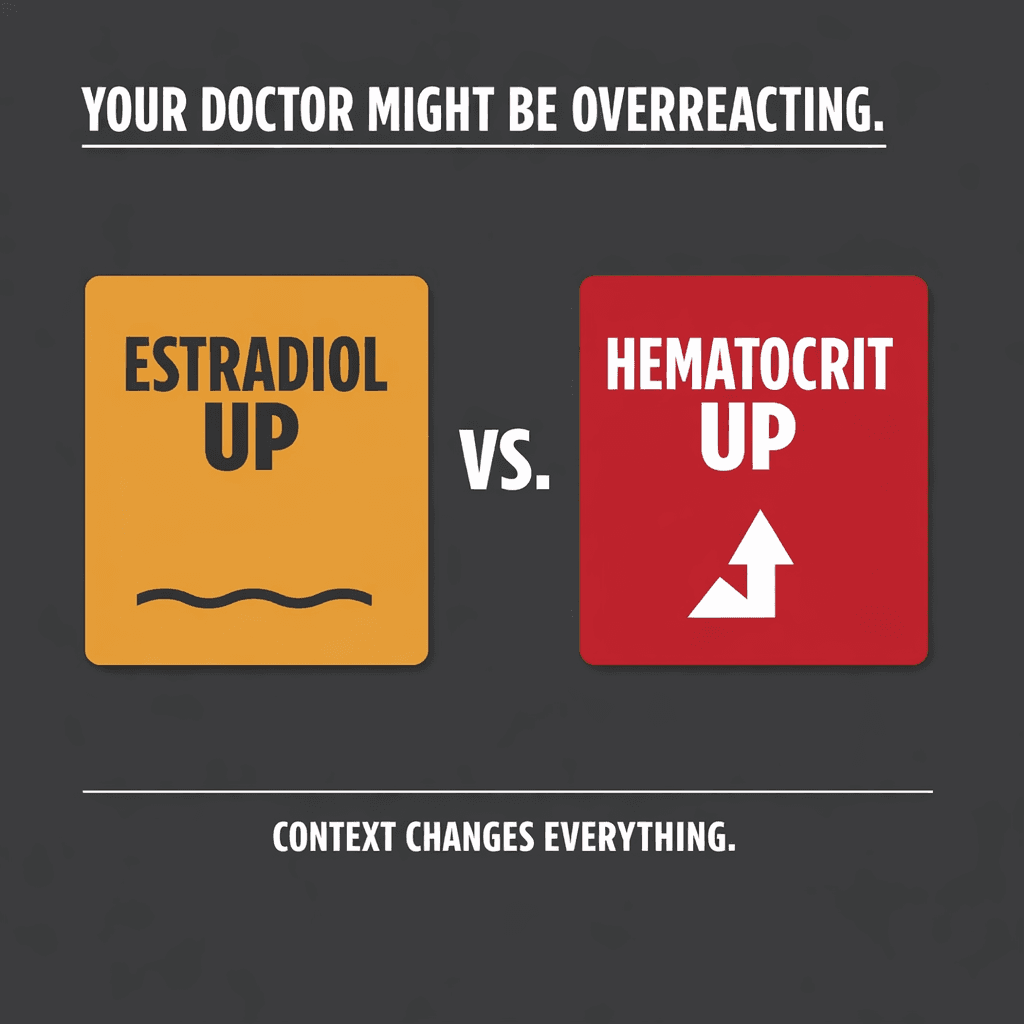
Your blood work came back and something is flagged - now your doctor wants to stop your testosterone therapy immediately. Before anyone makes a hasty decision, it is worth asking a simple but important question: is this result actually dangerous, or does it just look alarming on paper?
TRT monitoring labs are one of the most misread areas in men's health. Clinicians who are unfamiliar with testosterone therapy sometimes treat a mildly elevated marker the same way they would treat a major warning sign. At the same time, there are results that genuinely deserve attention and rarely get it because patients and even some providers do not know what they are looking for. Understanding the difference is not about playing doctor with your own results. It is about being an informed participant in your care.
Why a Single Lab Number Almost Never Tells the Whole Story
Lab reference ranges are built around population averages. They are useful tools, but they are not the final word on whether something is wrong with you specifically. A value that falls outside the standard range might be completely normal for your body, especially after months or years of therapy. A value inside the range might still represent a meaningful shift from your personal baseline.
Context matters enormously. Where were you in your injection or application cycle when blood was drawn? Testosterone levels fluctuate significantly depending on whether you were tested at peak or trough. Did you sleep poorly the night before? Elevated stress hormones from a bad week at work, a viral illness, heavy training, or even a few nights of alcohol use can shift multiple markers temporarily. These are not excuses to dismiss a concerning result. They are reasons to interpret results carefully rather than reactively.
Lab-to-lab variability is also real. Different laboratories use different assays and calibrations, which means a result from one facility may not be directly comparable to a result from another. When you switch labs, what looks like a dramatic change may partly reflect a methodological difference rather than a true physiological shift. Tracking trends over time, using consistent labs when possible, and comparing results to your own baseline carries far more clinical weight than any single snapshot.
The Lab Result That Should Make You Pause
Of all the markers tracked during TRT, the one that warrants the most careful attention when something unexpected changes is hematocrit - the concentration of red blood cells in your blood.
Testosterone stimulates red blood cell production. This is a known and predictable effect of therapy. Moderate increases in hematocrit are common and often clinically acceptable. The concern is not that the number moves at all. The concern is when it climbs consistently and significantly above the upper end of the healthy range, or when it rises sharply in a short period of time.
Excessively elevated hematocrit thickens the blood. Thicker blood moves less efficiently through vessels, and over time, this can increase the risk of cardiovascular complications, including clotting events. These are not hypothetical risks. They are the reason hematocrit is on the standard TRT monitoring panel in the first place.
What makes this marker worth a genuine clinical conversation is the pattern, not a single reading. A one-time mild elevation after starting therapy or adjusting a dose may simply reflect your body adapting. But a value that continues to climb across multiple draws, that reaches consistently high levels, or that is accompanied by symptoms like unusual headaches, flushing, or changes in energy and breathing deserves a thorough evaluation - not a panicked discontinuation, but a real, honest conversation with your provider about what is driving it.
Several factors can push hematocrit higher independent of TRT: dehydration at the time of the draw, sleep apnea (which is remarkably common and often undiagnosed in men on testosterone), living at altitude, or smoking. If your hematocrit is elevated, these variables should be investigated alongside your therapy. Sleep apnea in particular is frequently overlooked. Untreated apnea drives red blood cell production in its own right, and combining it with testosterone can accelerate the effect. Identifying and treating apnea often brings hematocrit back into a safer range without any change to therapy.
If your provider identifies a persistently elevated hematocrit, reasonable next steps might include evaluating your hydration habits, screening for sleep apnea, considering a dose adjustment or change in administration frequency, and in some cases, therapeutic phlebotomy. What is rarely the right first move is abrupt cessation of therapy without a plan.
The Marker That Triggers Unnecessary Panic
Estradiol - the primary estrogen marker monitored in men on TRT - is the source of more unnecessary alarm, more unnecessary treatment, and more unnecessary therapy discontinuations than almost any other lab value in this space.
Testosterone converts to estradiol through a natural process called aromatization. Some degree of this conversion is not just normal - it is necessary. Estradiol in men plays a role in bone density, cardiovascular health, cognitive function, libido, and joint comfort. The idea that all estradiol elevation is bad, and that lower is always better, is not supported by good evidence.
Yet many men are told to suppress their estradiol aggressively at the first sign of an elevated result, often before symptoms are even assessed. The result can be a different set of problems: low estradiol causes its own symptoms, including joint pain, mood instability, poor libido, and bone loss over time. Some men end up chasing their estradiol up and down with interventions that create more instability than the original elevation ever caused.
So when is elevated estradiol actually a concern? The answer is primarily when it is accompanied by specific, persistent symptoms that cannot be explained by other factors - symptoms like significant water retention, gynecomastia, or notable mood and libido disruption. Even then, the next step is usually to investigate why conversion is elevated: body composition, genetics, alcohol use, certain supplements, and some medications can all increase aromatase activity. Addressing the root cause often matters more than suppressing the number.
A mildly elevated estradiol number in a man who feels good, is sleeping well, and has no relevant symptoms is frequently not the crisis it appears to be on a lab printout. The result deserves acknowledgment, not alarm.
The Other Markers Worth Understanding
Beyond hematocrit and estradiol, a standard TRT monitoring panel typically covers several other important categories, each with its own nuance.
Prostate-related markers are standard inclusions in TRT monitoring and are the source of considerable anxiety for patients. The relationship between testosterone therapy and prostate health has been significantly revised in recent years - the old fear that testosterone drives prostate disease has been largely reconsidered in the medical literature. That said, prostate-related markers should still be tracked consistently, and any significant or accelerating changes warrant further evaluation. A gradual increase over years is different from a sudden sharp spike.
Lipid panels reflect cardiovascular risk factors and can shift with TRT, particularly depending on how therapy is administered. These changes are worth monitoring over time and discussing in the context of overall cardiovascular health, diet, and activity level - not reacting to in isolation.
Liver enzymes are commonly checked and frequently misinterpreted. Testosterone injections do not typically stress the liver the way certain oral medications can. If liver enzymes are elevated, the more likely explanations are often heavy training (which elevates certain enzymes through muscle breakdown rather than liver stress), alcohol consumption, or other medications. Context, as always, changes the picture.
Fertility-related markers are worth discussing with your provider before starting TRT if having biological children is part of your plans. Exogenous testosterone suppresses the hormonal signals the body uses to produce sperm. This effect is often reversible, but the timeline and degree vary. This is a conversation to have proactively, not after the fact.
What to Ask When a Lab Comes Back Abnormal
This article is educational and not a substitute for personalized medical guidance. Your specific results need to be interpreted by a clinician who knows your full health history, your symptoms, and your treatment context. What follows is a framework for having a better conversation, not a prescription for what to do.
When a result is flagged, useful questions include: Is this value outside the range for the general population, or outside my personal baseline? Has this marker trended consistently in one direction, or is this a single isolated reading? What other factors in my current lifestyle - sleep, stress, alcohol, training, illness - might be influencing this result? Are there other tests that would help clarify the picture before making any changes to therapy?
If a result is truly unexpected, significantly outside range, or accompanied by new physical symptoms, more urgent evaluation may be appropriate. Symptoms like chest pain, shortness of breath, severe headache, or significant changes in urine output should prompt same-day medical contact, not a wait-and-see approach.
For the vast majority of flagged results, the right response is a calm, thorough conversation rather than an emergency.
Reading the Whole Picture, Not Just the Flag
The goal of TRT monitoring is not to keep every number inside a tidy range at all costs. It is to ensure that therapy is working, that your body is responding well, and that any emerging risks are caught early enough to address thoughtfully. That requires reading labs the way good clinicians do - with attention to trends, timing, symptoms, lifestyle, and individual history.
If you are navigating TRT and want monitoring that goes beyond a reflexive reaction to flagged values, the providers you'll work with through AlphaMD bring exactly that kind of clinical nuance to your care. The markers that matter most are not always the ones that generate the most anxiety, and the ones that generate the most anxiety are not always the ones that matter most. Knowing which is which makes all the difference.