
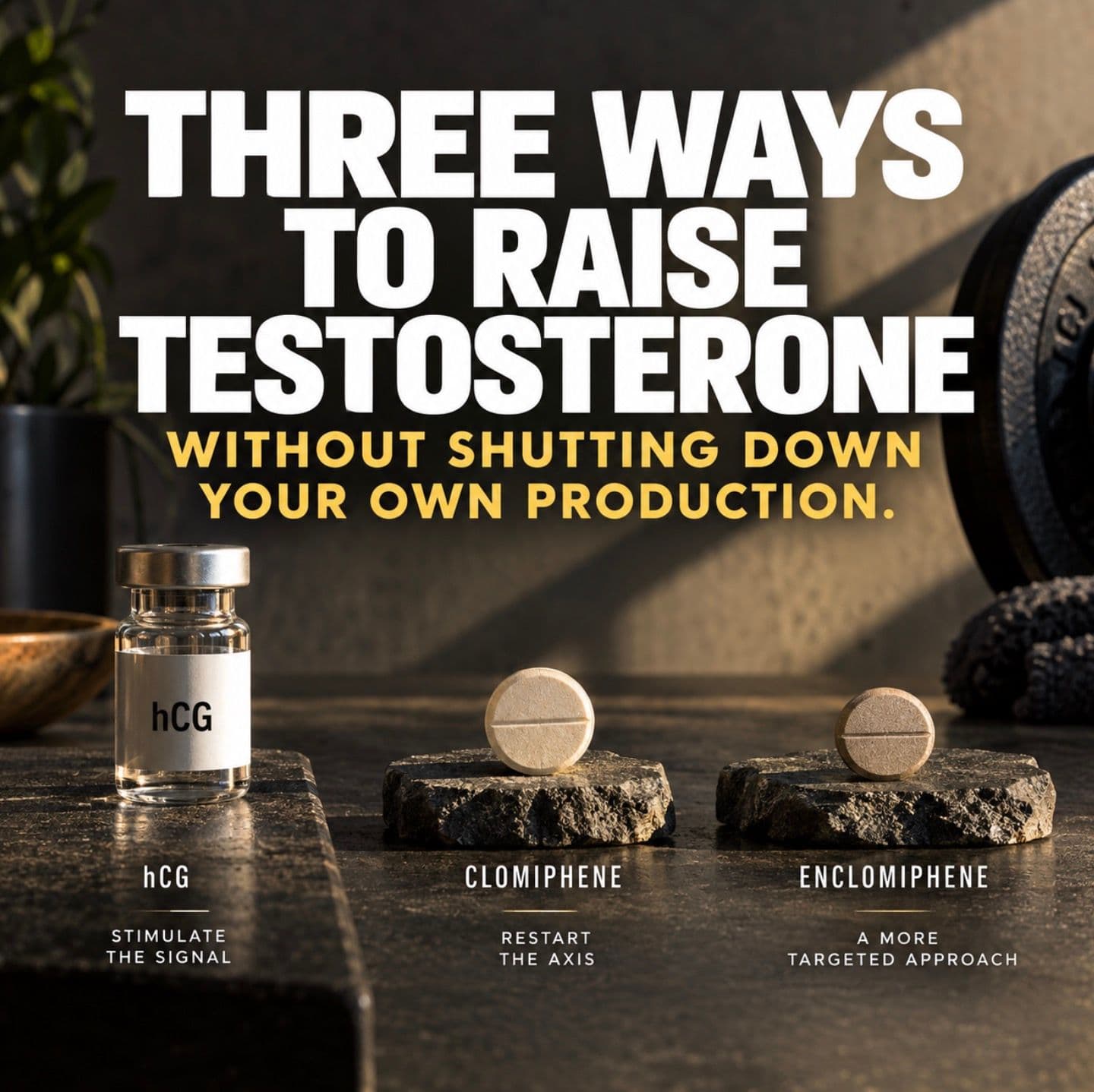
Three Ways to Raise Testosterone Without Shutting Down Your Own Production.
People are asking...
Currently on trt cream, no hcg. Talking about starting family with my wife, wondering what the best way to boost fertility without coming off would be...
Without coming off of TRT, then hCG would be the typical recommendation. This will raise intratesticular testosterone levels and restart sperm production. 75% of men on TRT and hCG can produce enough ... See Full Answer
So. According to you. Taking AI essentially means your body will work harder to produce E2. Taking SERM mono essentially means your body will stop p...
Improving lifestyle habits have been proven to raise testosterone levels, but only by an average of ~15%. But if you need to use a medicine of any kind to raise your testosterone, it is not “natural”.... See Full Answer
I still want to have kids and want to avoid anything that could possibly shut me down all together. Which treatment is best for me ?...
It depends on when you want to have children. If your intent is to conceive in the next 12 months, you should choose hCG alone or a SERM like enclomiphene. These will maintain or even likely increase ... See Full Answer
Have a question? Ask us.
At AlphaMD, we're here to help. Feel free to ask us any question you would like about TRT, medical weightloss, ED, or other topics related to men's health. Or take a moment to browse through our past questions.
Your testosterone levels and your body's ability to make them are not the same thing, and confusing the two is one of the most common mistakes men make when trying to fix how they feel. The good news is that there are well-supported, practical strategies that can meaningfully raise testosterone while keeping your body's own hormonal machinery intact.
Why Preserving Your Own Production Actually Matters
The hypothalamic-pituitary-gonadal (HPG) axis is the feedback loop your body uses to regulate testosterone. The hypothalamus releases gonadotropin-releasing hormone, which signals the pituitary to release luteinizing hormone (LH) and follicle-stimulating hormone (FSH), which in turn signal the testes to produce testosterone. When testosterone levels rise, this loop quiets down.
This is exactly why certain interventions, most notably testosterone replacement therapy, can suppress endogenous production. When you introduce testosterone from an outside source, the brain senses adequate levels and reduces its own signaling. The testes receive less stimulation, which can cause them to produce less - or in some cases, essentially pause production entirely. This is not inherently dangerous when managed properly, but it is something to understand clearly before making any decisions.
For men who want to raise their levels without suppressing this axis, the three approaches below are the most evidence-supported options available.
First Way: Fix the Foundational Inputs Your Body Needs to Make Testosterone
This sounds basic. It is not.
Testosterone synthesis depends on specific raw materials and hormonal conditions. When those inputs are inadequate, the body simply cannot produce at its potential, regardless of what the HPG axis is signaling. The most impactful foundational inputs are sleep, body composition, and micronutrient status.
Sleep Is Not Optional for Hormone Health
The majority of daily testosterone release happens during sleep, particularly during the deep, slow-wave stages. Research published through the National Institutes of Health has confirmed that even modest sleep restriction over a short period can produce a significant drop in testosterone levels in healthy young men. That drop is not trivial - it is comparable in magnitude to what is associated with a decade of normal aging.
Getting consistent, high-quality sleep is one of the most powerful testosterone-supporting behaviors available, and it costs nothing. Prioritizing sleep hygiene, managing light exposure at night, and addressing underlying sleep disorders like obstructive sleep apnea are all meaningful steps.
Body Composition and Its Direct Effect on Hormonal Balance
Adipose tissue, particularly visceral fat, contains aromatase - an enzyme that converts testosterone into estrogen. Excess body fat does not just represent extra weight; it actively shifts the hormonal environment in a direction that suppresses testosterone and elevates estrogen. This creates a frustrating cycle where lower testosterone makes fat loss harder, and higher body fat keeps testosterone lower.
Losing excess body fat, even gradually, can produce meaningful improvements in free and total testosterone. The mechanism here is straightforward: less aromatase activity, less conversion, and less estrogenic feedback suppressing the HPG axis. This does not require extreme interventions. Consistent, moderate caloric control combined with the resistance training discussed below is sufficient for most men to see results over time.
Micronutrients That Testosterone Production Depends On
Zinc and vitamin D are the two most studied micronutrients in this context, and deficiencies in both are common in men with low testosterone. Zinc is a cofactor in testosterone synthesis. Vitamin D functions more like a hormone than a vitamin and has receptors throughout the testicular tissue involved in production. Magnesium also plays a supporting role in free testosterone availability.
The goal is not aggressive supplementation above and beyond normal levels - the benefit comes from correcting deficiencies. A conversation with a physician about testing these levels is a reasonable starting point.
Second Way: Use Resistance Training as a Direct Hormonal Stimulus
Physical training is one of the few lifestyle interventions with a clear, acute, and chronic effect on testosterone production. Not all exercise produces the same hormonal response, though, and the distinction matters.
Why Lifting Weights Works Differently Than Cardio
Resistance training, particularly exercises that recruit large muscle groups such as squats, deadlifts, rows, and presses, produces an acute post-exercise spike in testosterone and growth hormone. Over time, consistent resistance training also improves body composition, reduces visceral fat, and improves insulin sensitivity, all of which support a healthier hormonal environment.
Endurance training, especially high-volume chronic cardio, does not produce the same effect and in some cases can suppress testosterone if the training load is very high and recovery is inadequate. This is not an argument against cardio - cardiovascular health matters greatly - but it explains why resistance training deserves a specific place in any hormone-supportive exercise plan.
According to information from the Mayo Clinic, maintaining a healthy weight and staying physically active are among the primary lifestyle factors supporting healthy testosterone levels in men. The evidence base here is well-established.
Training Hard Enough to Matter Without Overtraining
Overtraining is a real phenomenon with measurable hormonal consequences. Chronically elevated cortisol from excessive training without adequate recovery suppresses testosterone directly. The sweet spot is training with sufficient intensity and volume to generate a stimulus, then recovering fully before applying the next stimulus.
For most men, three to five resistance training sessions per week with adequate protein intake and recovery days is a reasonable starting framework. The specifics will vary by individual, but the principle - progressive resistance training with sufficient recovery - is consistent across the research.
Third Way: Manage Stress and Alcohol to Stop Actively Suppressing Your Own Production
This third approach is different from the first two because it is not about adding something beneficial. It is about removing something harmful. Many men are unknowingly suppressing their own testosterone production through chronic psychological stress and regular alcohol consumption, and addressing these two factors alone can produce a meaningful hormonal shift.
The Cortisol-Testosterone Relationship Is Direct and Measurable
Cortisol and testosterone are not just broadly antagonistic - they compete for the same precursor hormone, pregnenolone, in a pathway sometimes called the "pregnenolone steal." When the body is in a chronic stress state and prioritizing cortisol production, testosterone synthesis is deprioritized at the biochemical level.
Psychological stress also activates the HPA (hypothalamic-pituitary-adrenal) axis, which inhibits GnRH release from the hypothalamus. That suppression works its way down the HPG axis and reduces LH secretion, which reduces testicular stimulation. In other words, chronic stress does not just feel bad - it mechanistically suppresses the same hormonal signaling that your body uses to produce testosterone.
Practical stress management does not require elaborate interventions. Consistent sleep (which reinforces the first approach above), regular physical activity, reducing unnecessary stimulant exposure, and addressing major lifestyle stressors where possible all contribute. Some men find structured mindfulness or breathing practices helpful for reducing baseline cortisol.
Alcohol Consumption and Its Underappreciated Hormonal Cost
Alcohol has a direct toxic effect on the Leydig cells in the testes - these are the cells responsible for testosterone synthesis. Regular, heavy alcohol consumption is associated with significantly lower testosterone, impaired testicular function, and elevated estrogen due to increased aromatase activity in liver tissue.
Even moderate, regular drinking has a measurable effect. The liver plays a central role in clearing estrogens from the body, and chronic alcohol consumption impairs this clearance, allowing estrogen to accumulate and further suppress the HPG axis. Reducing alcohol intake, particularly eliminating nightly drinking habits, is one of the more impactful non-medical changes a man can make to his hormonal environment.
When Lifestyle Changes Are Not Enough
The three approaches above can produce real, meaningful improvements - particularly for men who have room to improve their sleep, body composition, training, stress levels, or alcohol consumption. For some men, these changes will be sufficient to move them into a range where they feel well and function optimally.
For others, the improvements will be real but not enough. Secondary hypogonadism, for example, is a condition where the HPG axis itself is underperforming due to medical or structural reasons that lifestyle changes cannot fully address. In these cases, there are options beyond lifestyle modification that can still support endogenous production rather than simply replacing it - human chorionic gonadotropin, for instance, works by mimicking LH to stimulate the testes directly, making it a tool that can raise testosterone while preserving the signaling axis. Sermorelin, a growth hormone-releasing peptide, is another option some men explore to support overall hormonal and metabolic health.
Women navigating low testosterone symptoms have their own set of considerations, and Female TRT is a distinct clinical approach with different protocols and goals than those used in men.
The important point is that the full spectrum of options - from lifestyle changes to clinical interventions - exists on a continuum. Knowing where you are on that continuum requires understanding your own numbers and symptoms, ideally with guidance from a clinician who specializes in hormone health.
If you are trying to figure out where you fall, AlphaMD offers a clear, accessible way to learn about hormone health, understand your options, and connect with providers who take this seriously. Whether the answer is lifestyle change, clinical support, or some combination, having accurate information is the essential first step.
Have a question? Ask us.
At AlphaMD, we're here to help. Feel free to ask us any question you would like about TRT, medical weightloss, ED, or other topics related to men's health. Or take a moment to browse through our past questions.
People are asking...
Currently on trt cream, no hcg. Talking about starting family with my wife, wondering what the best way to boost fertility without coming off would be...
Without coming off of TRT, then hCG would be the typical recommendation. This will raise intratesticular testosterone levels and restart sperm production. 75% of men on TRT and hCG can produce enough ... See Full Answer
So. According to you. Taking AI essentially means your body will work harder to produce E2. Taking SERM mono essentially means your body will stop p...
Improving lifestyle habits have been proven to raise testosterone levels, but only by an average of ~15%. But if you need to use a medicine of any kind to raise your testosterone, it is not “natural”.... See Full Answer
I still want to have kids and want to avoid anything that could possibly shut me down all together. Which treatment is best for me ?...
It depends on when you want to have children. If your intent is to conceive in the next 12 months, you should choose hCG alone or a SERM like enclomiphene. These will maintain or even likely increase ... See Full Answer
Get $30 off your first month’s order
Enter your email address now to receive $30 off your first month’s cost, other discounts, and additional information about TRT.
Legal Disclaimer
This website is a repository of publicly available information and is not intended to form a physician-patient relationship with any individual. The content of this website is for informational purposes only. The information presented on this website is not intended to take the place of your personal physician's advice and is not intended to diagnose, treat, cure, or prevent any disease. Discuss this information with your own physician or healthcare provider to determine what is right for you. All information is intended for your general knowledge only and is not a substitute for medical advice or treatment for specific medical conditions. The information contained herein is presented in summary form only and intended to provide broad consumer understanding and knowledge. The information should not be considered complete and should not be used in place of a visit, phone or telemedicine call, consultation or advice of your physician or other healthcare provider. Only a qualified physician in your state can determine if you qualify for and should undertake treatment.