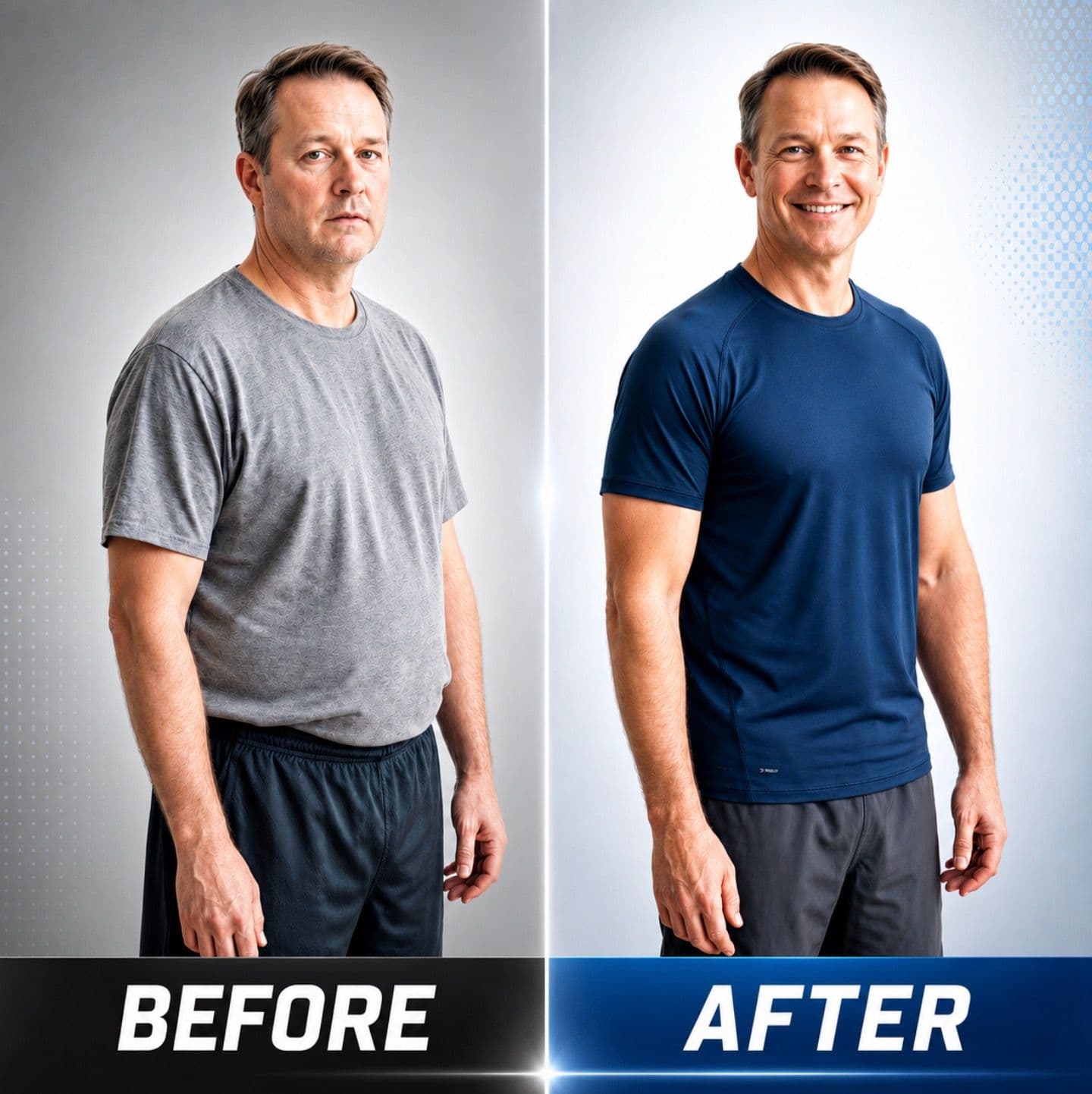
TRT can change how your face looks, mostly through your skin, your fat, and your hair rather than your bones. Oilier skin and acne tend to come first, fat and facial hair shift over months, and some men lose scalp hair over years. Testosterone does raise bone density, but the trials measured that at the spine and hip, not as a new jawline.
The changes are gradual. Knowing the usual timeline helps you set realistic expectations and spot what is worth raising with your provider.
Why your face changes on TRT
TRT affects several tissues that shape how your face looks:
- Skin: the testosterone cypionate label lists acne, seborrhea (oily skin), and male pattern baldness among its skin effects (DEPO-Testosterone label).
- Fat: in men treated for low testosterone, changes in fat mass and lean mass appear within 12 to 16 weeks and level off at 6 to 12 months, according to a review of published studies (Saad et al., Eur J Endocrinol 2011). Those studies measured the whole body, not the face.
- Facial hair: in a prospective study of 20 trans men starting testosterone, facial and body hair increased steadily over the first 12 months (Wierckx et al., J Sex Med 2014).
- Bone: in a placebo-controlled trial of 211 men aged 65 and older with low testosterone, one year of testosterone gel raised trabecular bone density in the spine by 7.5% versus 0.8% on placebo (Snyder et al., JAMA Intern Med 2017). Density is how compact bone is, not its size or shape, and the trial measured the spine and hip, not the face.
Timeline of facial changes on TRT
The changes arrive in rough phases. The timeline below draws on studies of men treated for low testosterone and of trans men starting testosterone.
First few months
- Acne or oily skin may develop. In the trans men study, acne increased during the first year and peaked at 6 months (Wierckx et al., 2014).
Months 3 to 6
- Shifts in fat begin. Body fat changes start within 12 to 16 weeks (Saad et al., 2011), and a leaner face may follow, but those studies measured the whole body, not the face.
- Facial hair growth may pick up.
Months 6 to 12
- Changes in body fat tend to stabilize between 6 and 12 months (Saad et al., 2011).
- Bone density effects become detectable after about 6 months and continue for at least 3 years, measured in the skeleton, not as changes in facial shape (Saad et al., 2011).
- Facial hair keeps increasing through the first year (Wierckx et al., 2014).
One year and beyond
- Acne usually settles. After about 10 years on testosterone, 93.9% of the trans men studied had no acne or only mild acne (Wierckx et al., 2014).
- Scalp hair may thin. Only one of 20 trans men had mild frontotemporal hair loss in the first year, but after long-term treatment 32.7% had mild frontotemporal loss and 31% had moderate to severe male pattern hair loss (Wierckx et al., 2014).
For the wider picture beyond the face, see how long testosterone takes to work.
Common questions about facial changes on TRT
Will TRT dramatically change my face?
No. The changes come from skin, fat, and hair, and they build over months. You will still look like yourself.
Will I get acne?
It is common enough that the label lists it. In the trans men study, acne peaked about 6 months in and most men had little or none in the long run (Wierckx et al., 2014). This guide covers managing acne on TRT, and a dermatologist can help if it persists.
Does TRT cause hair loss?
It can in men prone to male pattern baldness, which the label lists as a skin effect (DEPO-Testosterone label). In the trans men study, hair loss was not tied to blood levels of testosterone or DHT (dihydrotestosterone, a stronger hormone made from testosterone) (Wierckx et al., 2014). Finasteride is FDA-approved for male pattern hair loss in men (PROPECIA label); this article covers preventing hair loss while taking testosterone.
Will my beard grow thicker?
It may. Facial hair increased steadily over a year of testosterone in trans men (Wierckx et al., 2014). They started from female hormone levels, so their results do not tell you how much a man with low testosterone will gain.
What science says
Most direct research on testosterone and the face comes from trans men, who start from female hormone levels and so change more than a man treated for low testosterone would. In a 2025 study using 3D facial scans of 18 trans men and transmasculine people, total facial volume rose over 12 months, most in the lower third of the face, with the biggest change in the first 3 months (Clin Oral Investig 2025). Surface scans measure the face's outline, so they cannot separate fat and muscle from bone.
In men treated for low testosterone, the evidence covers body composition and bone density at the spine and hip (Saad et al., 2011; Snyder et al., 2017). Neither measured the face.
Best practices for managing the transition
- Get baseline labs. Low testosterone is diagnosed from two early-morning total testosterone tests on separate days (AUA statement 1). Hemoglobin and hematocrit (the share of your blood made of red cells) are measured before starting (AUA statement 11, Strong, Grade A), and PSA in men over 40 (AUA statement 12) (AUA guideline). Estradiol is checked in men with breast symptoms or breast enlargement (AUA statement 9, Expert Opinion). Free testosterone helps when total testosterone is near the lower limit or binding proteins are abnormal (Endocrine Society 2018).
- Monitor progress. The Endocrine Society recommends checking testosterone and hematocrit during the first year (Endocrine Society 2018), and the AUA recommends testosterone levels every 6 to 12 months on therapy (AUA statement 30, Expert Opinion). Your provider adjusts the plan from those results.
- Look after your skin. Use gentle cleansers and see a dermatologist if acne persists.
- Watch your hairline. If you notice thinning at the crown or temples, ask your prescriber whether finasteride makes sense for you.
Bottom line
TRT can change your face over months, mainly through acne and oilier skin early on, shifts in fat, more facial hair, and in some men scalp hair loss. It raises bone density, but the trials measured that at the spine and hip, so a reshaped jaw, brow, or cheekbones is not an expected result. Most of the face data come from trans men, so a man treated for low testosterone should expect smaller changes.
If you are considering treatment, AlphaMD's testosterone replacement therapy page explains how licensed providers review your labs before prescribing.