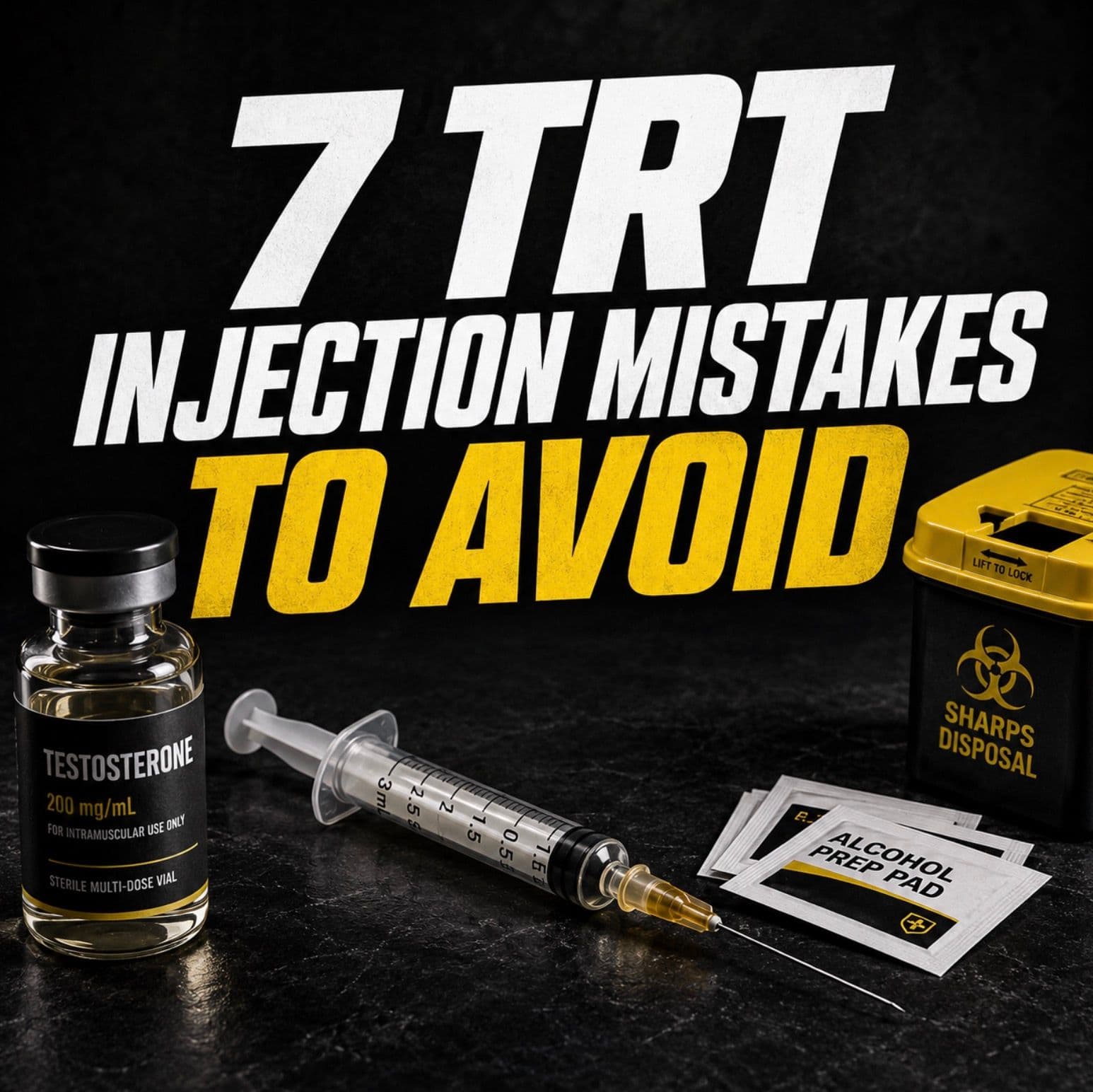
The most common TRT injection mistakes are mixing up milligrams and milliliters, skipping clean technique, injecting the same spot every time, using the wrong needle or syringe, storing the vial badly, injecting on an irregular schedule and throwing used needles in the trash. Each one is easy to prevent once you know what to check.
These mistakes can make injections of testosterone replacement therapy less comfortable, less consistent and, in some cases, unsafe.
What are the most common TRT injection mistakes?
The seven most common testosterone injection mistakes are:
- Confusing milligrams with milliliters
- Skipping proper injection preparation
- Injecting into the same location repeatedly
- Using the wrong needle or syringe
- Storing testosterone incorrectly
- Taking injections on an inconsistent schedule
- Disposing of needles improperly
Always follow the instructions from your pharmacy and licensed medical provider. Injection route, dose, frequency, needle selection and approved injection sites can differ between patients and testosterone products.
1. Confusing milligrams with milliliters
One of the easiest mistakes to make is confusing the prescribed testosterone dose with the amount of liquid that needs to be drawn into the syringe.
Testosterone is commonly prescribed in milligrams, abbreviated as mg. Syringes measure liquid volume in milliliters, abbreviated as mL. The two are related, but you cannot swap one for the other.
For example, a prescription might instruct a patient to inject 100 mg of testosterone. The amount of liquid needed depends on the concentration shown on the vial.
If the vial contains 200 mg of testosterone per mL:
100 mg ÷ 200 mg/mL = 0.5 mL
A different vial concentration would require a different volume for the same milligram dose.
How to avoid this mistake
Before drawing an injection:
- Read the concentration printed on the vial.
- Confirm the prescribed dose in milligrams.
- Confirm the corresponding volume in milliliters.
- Use the syringe markings demonstrated by your provider or pharmacy.
- Ask for clarification if the written dose and syringe instructions appear inconsistent.
Do not assume that a line on a syringe represents a certain number of milligrams. Syringe markings measure volume, so the milligrams in that volume depend on the vial's concentration.
This matters most with syringes marked in "units." Those markings still measure volume and should not be read as milligrams of testosterone without specific instructions.
2. Skipping proper injection preparation
TRT injections are often given at home, and the same hygiene rules apply there as in a clinic.
The Centers for Disease Control and Prevention's guidance for clinicians says to always use aseptic technique (steps that keep germs out of the needle, syringe and medication) when preparing and giving injections. It also says to draw up medication in a clean area away from sinks and to follow the rule "One Needle, One Syringe, Only One Time" (CDC, 2024).
A safer preparation routine
Before beginning:
- Wash your hands thoroughly with soap and water.
- Place your supplies on a clean, dry surface.
- Check the medication name, concentration and expiration date.
- Inspect the liquid for unexpected discoloration, cloudiness or particles.
- Clean the vial stopper with a fresh alcohol wipe.
- Allow the alcohol to dry before inserting the needle.
- Prepare the injection using unopened, sterile supplies.
- Clean the provider-approved injection site and allow it to dry.
Avoid touching the needle, the cleaned vial stopper or the prepared injection site. If the needle touches an unclean surface, discard it safely and use a new sterile needle.
The CDC also says the safest practice is to prepare an injection as close as possible to the time it is given, which protects the medication's sterility and stability (CDC, 2024). Do not leave a filled syringe sitting until later.
Never reuse a needle or syringe, even when you are the only person using the medication. The CDC treats a used needle and syringe as contaminated.
3. Injecting into the same location every time
Repeatedly injecting into the exact same location can lead to persistent soreness, irritation, bruising, hardened tissue or scar tissue.
Scarred or irritated tissue may also make future injections more uncomfortable. In some cases, repeatedly using one small area can make it more difficult to administer the medication consistently.
How to rotate TRT injection sites
Use only the injection sites approved for your prescribed route. Then alternate between those sites according to the instructions provided by your licensed medical provider. This guide to where to inject testosterone covers the usual intramuscular and subcutaneous sites.
A simple rotation system may involve:
- Alternating between the left and right sides
- Moving slightly within an approved injection area
- Keeping a note of the last injection location
- Avoiding any area that remains sore or irritated
Do not inject into skin that is red, swollen, bruised, tender, hardened, infected or visibly damaged.
The correct site also depends on whether the medication was prescribed for intramuscular or subcutaneous administration. Do not switch routes or select a new injection location based solely on a social media post or online diagram.
4. Using the wrong needle or syringe
The right equipment depends on several factors, including:
- The prescribed injection route
- The injection location
- The thickness of the medication
- The amount of medication being administered
- Your body composition
- The instructions for the specific testosterone product
A needle intended for drawing medication may not be the same needle recommended for administering it. Similarly, a syringe that is much larger than the prescribed injection volume can make small doses harder to measure accurately.
Why syringe size matters
A smaller-capacity syringe may provide more detailed markings for low-volume injections. Even so, use the supplies recommended by your provider or pharmacy rather than changing syringe types on your own.
Using an incorrect needle can result in:
- Increased discomfort
- Difficulty drawing the oil-based medication
- Incorrect injection depth
- Medication being delivered through the wrong route
- Greater irritation at the injection site
Do not pick a needle based only on what another TRT patient uses. Two patients taking the same medication may have different routes, doses, injection sites and supply requirements.
When there is any uncertainty, contact the prescribing provider or dispensing pharmacy before injecting.
5. Storing testosterone incorrectly
Storage is easy to overlook, particularly when TRT supplies are kept in a bathroom, gym bag, vehicle or travel case.
Many testosterone cypionate products are stored at controlled room temperature and protected from light. Exact storage instructions can vary between products and pharmacies.
The FDA-approved label for DEPO-Testosterone (testosterone cypionate) says to store it at 68°F to 77°F (20°C to 25°C) and protect it from light (DEPO-Testosterone label). Other testosterone products may have different instructions.
Common storage mistakes
- Leaving the vial in a hot vehicle
- Exposing it to direct sunlight
- Storing it near a heater
- Refrigerating it without instructions
- Allowing children or pets to access it
- Using medication after the expiration date
- Using medication that looks cloudy or contains unexpected particles
Cold matters too. The same label notes that crystals may form when the vial is stored colder than recommended, and that warming and shaking the vial should redissolve them (DEPO-Testosterone label).
Follow the storage instructions printed on your specific medication label.
Keep testosterone in its original packaging whenever possible. Store it in a secure, dry location with a stable temperature. Bathrooms are often less suitable because heat and humidity can fluctuate.
If the medication has been exposed to extreme heat or cold, or its appearance has changed, contact the pharmacy before using it.
6. Taking injections on an inconsistent schedule
Your injection schedule is part of the prescription.
Injecting on inconsistent days, repeatedly delaying doses or taking injections too close together may produce unnecessary swings in testosterone levels. That can make it harder to tell whether the prescribed protocol is working.
Inconsistency also complicates bloodwork. A 2026 practical review for clinicians advises recording the injection interval, the timing of the last injection and the timing of the blood draw, because without that context testosterone results can be misleading (Cureus, 2026). It is an expert review, not a trial.
How to stay consistent
Use a simple system:
- Choose regular injection days.
- Inject at approximately the same time when practical.
- Add recurring reminders to your phone.
- Record completed injections.
- Plan ahead for travel (see this guide to staying on track with TRT while traveling).
- Refill supplies before they run out.
- Keep your schedule consistent before follow-up bloodwork.
Do not double the next injection because you missed one. Contact your licensed medical provider or pharmacist for instructions, especially when several days have passed or your next scheduled injection is approaching.
Also avoid changing the dose or injection frequency based on a few days of symptoms. TRT adjustments should be based on the complete clinical picture, including symptoms, bloodwork, side effects and the timing of laboratory testing.
7. Throwing used needles in the trash
Used needles should never be left loose in a trash bag, bathroom bin, travel bag or recycling container.
Loose needles can injure family members, children, pets, housekeepers, sanitation workers and anyone else who handles the waste.
The FDA says to place used needles and syringes in a sharps disposal container immediately after use. FDA-cleared containers are made of puncture-resistant plastic with leak-resistant sides and bottom and a tight-fitting, puncture-resistant lid (FDA, 2021).
Safe sharps disposal basics
After completing an injection:
- Place the used needle and syringe directly into the sharps container.
- Do not leave the needle on a table or counter.
- Do not place loose sharps in household trash or recycling.
- Do not flush needles down the toilet.
- Keep the container away from children and pets.
- Do not overfill the container.
- Follow state or local rules for final disposal.
Having the sharps container next to you during the injection reduces the temptation to recap, carry or temporarily set down the used needle.
FDA-cleared sharps containers are available through pharmacies, medical supply companies, health care providers and online. If one is not available, the FDA says a heavy-duty plastic household container, such as a laundry detergent bottle, can be used instead (FDA, 2021). The FDA's checklist says any sharps container should close with a tight-fitting, puncture-proof lid, stay upright and stable, resist leaks and be properly labeled, and that you should follow your community's guidelines for getting rid of it (FDA sharps checklist).
A simple TRT injection checklist
Before every testosterone injection, confirm that:
- You have the correct medication.
- You checked the vial concentration.
- You confirmed your prescribed dose and injection volume.
- You are using the correct syringe and needle.
- Your hands and preparation area are clean.
- You cleaned the vial stopper.
- You inspected the medication.
- You are using an approved injection site.
- You are rotating away from the previous location.
- You are following your prescribed injection schedule.
- Your sharps container is within reach.
When should you contact a medical provider after an injection?
Minor soreness or a small amount of redness can occur after an injection. Contact a licensed medical provider when an injection site becomes increasingly painful, swollen, warm, hard or red, particularly when symptoms continue to worsen.
Seek medical guidance for:
- Spreading redness
- Significant swelling
- Drainage or pus
- Fever or chills
- Severe or increasing pain
- Persistent bleeding
- A growing lump
- Numbness or weakness
- A rash or signs of an allergic reaction
- Questions about whether the correct dose was injected
The DEPO-Testosterone label also tells clinicians to check for a blood clot in the leg (deep vein thrombosis) when a patient reports pain, swelling, warmth or redness in the lower leg, and for a clot in the lung (pulmonary embolism) with sudden shortness of breath (DEPO-Testosterone label). Report those symptoms promptly.
Seek immediate medical attention for difficulty breathing, chest pain, fainting, facial or throat swelling or other signs of a severe reaction.
Do not give an extra injection to make up for medication that may have leaked from the site. Contact your provider if you believe a substantial portion of a dose was lost.
Frequently asked questions about TRT injections
Can you reuse a TRT needle if it still looks clean?
No. Needles and syringes are single-use supplies. A used needle is no longer sterile and should go directly into a sharps container.
Can you use the same needle to draw and inject testosterone?
This depends on the supplies and instructions provided with your treatment. Some protocols use separate drawing and injection needles. Others use a single sterile needle. Follow the instructions from your provider or pharmacy rather than changing the process yourself.
Should testosterone be kept in the refrigerator?
Not unless the label or dispensing pharmacy specifically tells you to. Many testosterone cypionate products are stored at controlled room temperature and protected from light.
Can you switch between intramuscular and subcutaneous injections?
Only under the direction of the licensed medical provider overseeing your treatment. Injection route affects needle selection, injection site and how the medication should be given.
What happens if you miss a TRT injection?
Do not automatically double the next dose. Testosterone cypionate injected into muscle has a half-life of about 8 days (DEPO-Testosterone label), so levels fall gradually after a late dose rather than dropping all at once. Contact your provider or pharmacy for instructions based on how late the dose is and when the next injection is scheduled.
Why does my TRT injection site hurt?
Temporary soreness can come from needle movement, injection location, repeated use of the same site, equipment selection or local irritation. Pain that becomes severe, spreads or comes with warmth, swelling, drainage or fever should be medically evaluated.
Bottom line
Most TRT injection mistakes come down to a few checks: match the milligram dose to the right volume, use sterile supplies once, rotate approved sites, use the equipment your pharmacy recommends, store the vial as the label says, keep to the prescribed schedule and put every needle in a sharps container.
When something is unclear, ask before injecting. Your licensed medical provider or dispensing pharmacist can confirm the correct dose, route, equipment and injection process for your prescription.