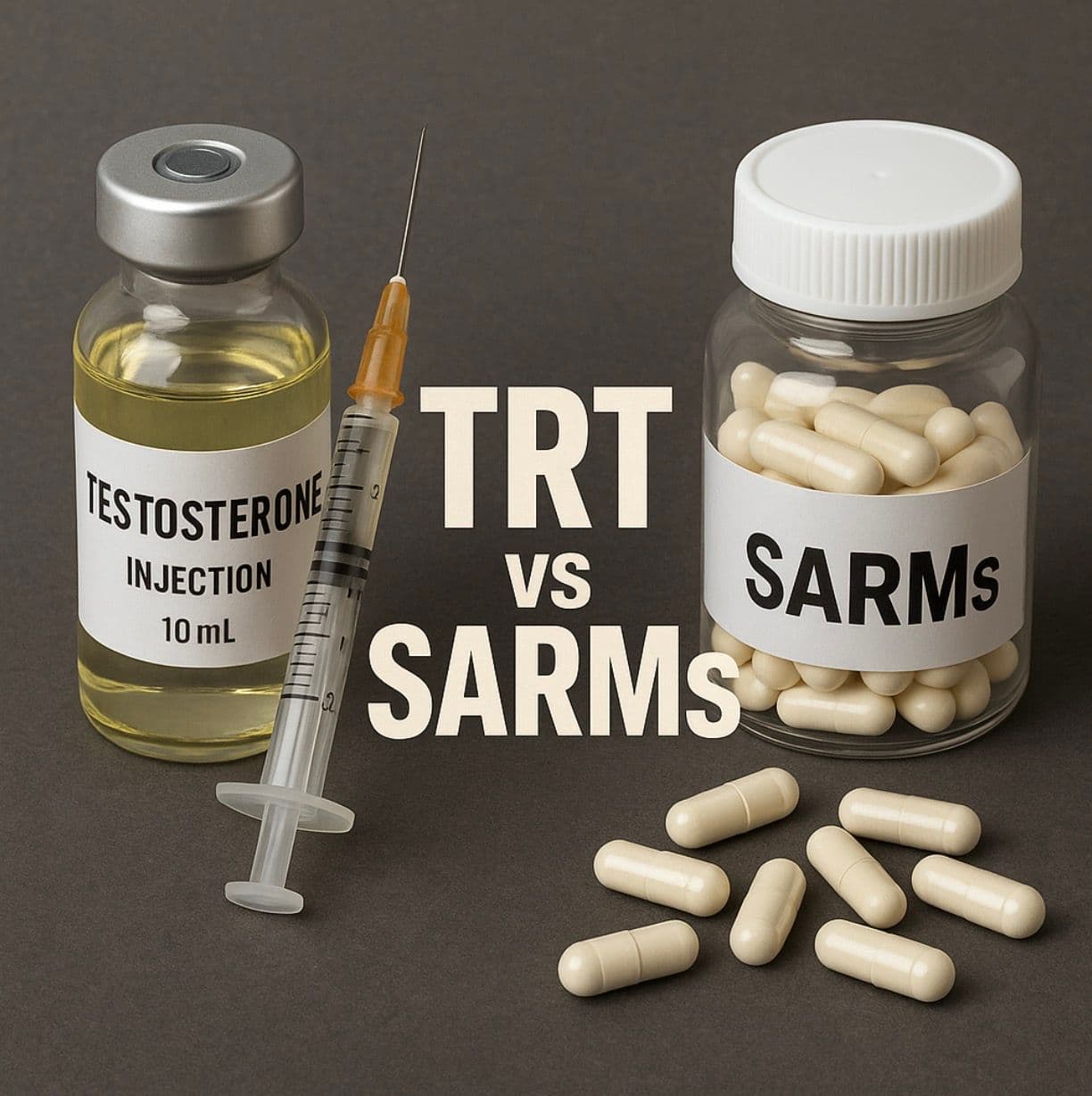
TRT (testosterone replacement therapy) is an FDA-approved treatment for men with diagnosed low testosterone, prescribed and monitored with blood tests. SARMs (selective androgen receptor modulators) are unapproved drugs, usually bought online, that the FDA has linked to liver injury and other serious harms. They are often discussed in fitness forums as if they were cousins, but they differ in approval, supervision, product quality, and how much is known about their safety.
What are SARMs?
SARMs are synthetic chemicals that mimic the effects of testosterone and anabolic steroids (FDA, 2025). Each one binds the androgen receptor in a slightly different way, and the aim was anabolic (muscle-building) activity without many of the side effects of anabolic steroids (Solomon et al., Sex Med Rev 2019).
Researchers have studied SARMs for muscle wasting from cancer (cachexia), breast cancer, and other conditions. None has an FDA-approved use (Solomon et al., 2019), so SARMs are not prescribed for low testosterone.
Despite this, SARMs are marketed to people who want more muscle, often as dietary supplements. The FDA says they are not supplements but unapproved drugs it has not reviewed for safety or effectiveness (FDA, 2025).
What about TRT?
Testosterone is FDA-approved only for men who have low testosterone along with an associated medical condition (FDA, 2025). The American Urological Association (AUA) guideline sets out how that diagnosis is made: total testosterone under 300 ng/dL on two separate early-morning tests, together with symptoms or signs (AUA statements 1–3; statement 2 is Strong, Grade A) (AUA).
Treatment is prescribed by a licensed clinician who checks labs before and during therapy. The AUA says to measure hemoglobin and hematocrit (the share of your blood made of red cells) before starting, and to recheck testosterone every 6–12 months on treatment (statements 11 and 30) (AUA).
The goal of TRT is to bring a deficient testosterone level back into the normal range in a man with symptoms. It is not a muscle-building program.
How do TRT and SARMs compare?
- Approval: testosterone products are FDA-approved for diagnosed low testosterone; SARMs have no approved use.
- Supervision: TRT is prescribed and monitored by a clinician; SARMs are usually bought online without a prescription.
- Lab testing: TRT includes baseline and follow-up blood work; SARM use usually has none.
- Product quality: TRT is filled by a licensed pharmacy; many products sold online as SARMs do not contain what the label says (details below).
- Human research: TRAVERSE alone followed 5,246 men on testosterone or placebo for about 3 years (Lincoff et al., NEJM 2023). SARM trials in humans have been small and short, such as a 21-day study of LGD-4033 in 76 healthy men (Basaria et al., 2013).
What are the risks of SARMs?
SARMs are often promoted as side-effect free, and the evidence says otherwise.
SARMs can suppress your own testosterone production. In the LGD-4033 trial, 21 days of the drug lowered total testosterone, SHBG (the protein that carries testosterone in the blood), and HDL ("good") cholesterol in a dose-dependent way. At the highest dose, FSH and free testosterone also fell. Levels returned to baseline after the drug was stopped, but the study was only three weeks long (Basaria et al., 2013).
The FDA reports life-threatening reactions in people taking SARM products, including liver injuries that required hospitalization. It lists these potential harms (FDA, 2025):
- Increased risk of heart attack or stroke
- Liver injury and acute liver failure
- Testicular shrinkage
- Infertility
- Sexual dysfunction
- Psychosis or hallucinations
- Sleep disturbances
SARMs are often sold "for research purposes" or "not for human consumption" while coming with dosing instructions (FDA, 2025). When researchers bought 44 such products online and tested them, only 52% contained a SARM, 39% contained a different unapproved drug, 25% contained substances not on the label, and only 41% had the labeled amount of the active compound (Van Wagoner et al., JAMA 2017).
Is TRT risk-free?
No. TRT is better studied than SARMs, but it has real risks, and it is meant for men with a confirmed deficiency.
- Heart: in TRAVERSE (men aged 45–80 with, or at high risk of, heart disease), testosterone gel was noninferior to placebo for major cardiac events (7.0% vs 7.3%). Atrial fibrillation, acute kidney injury, and pulmonary embolism were more common with testosterone (Lincoff et al., NEJM 2023).
- Blood pressure: in 2025 the FDA required an increased blood pressure warning on every testosterone product (FDA, 2025).
- Red blood cells: testosterone raises the risk of polycythemia (too many red cells), which is why hematocrit is checked before and during treatment (AUA). AlphaMD's guide to lowering high hematocrit covers what happens when it climbs.
- Fertility: testosterone can suppress sperm production, particularly at large doses or with prolonged use (DEPO-Testosterone label). The AUA says testosterone should not be prescribed to men who are currently trying to conceive (statement 23, Strong, Grade A) (AUA). More on testosterone and fertility.
These risks have been measured in trials, are listed on the label, and are watched for with regular blood work.
Bottom line
If you have symptoms of low testosterone, the evidence-based route is diagnosis with two morning blood tests, then treatment under a clinician who monitors your labs. SARMs are unapproved, often mislabeled, and linked by the FDA to liver injury, heart attack and stroke risk, and testicular shrinkage. TRT has its own risks, including blood pressure and red blood cell changes and reduced sperm production, so it is for men with confirmed low testosterone.
If you want to find out whether you are a candidate, AlphaMD's testosterone replacement therapy page explains how evaluation works.