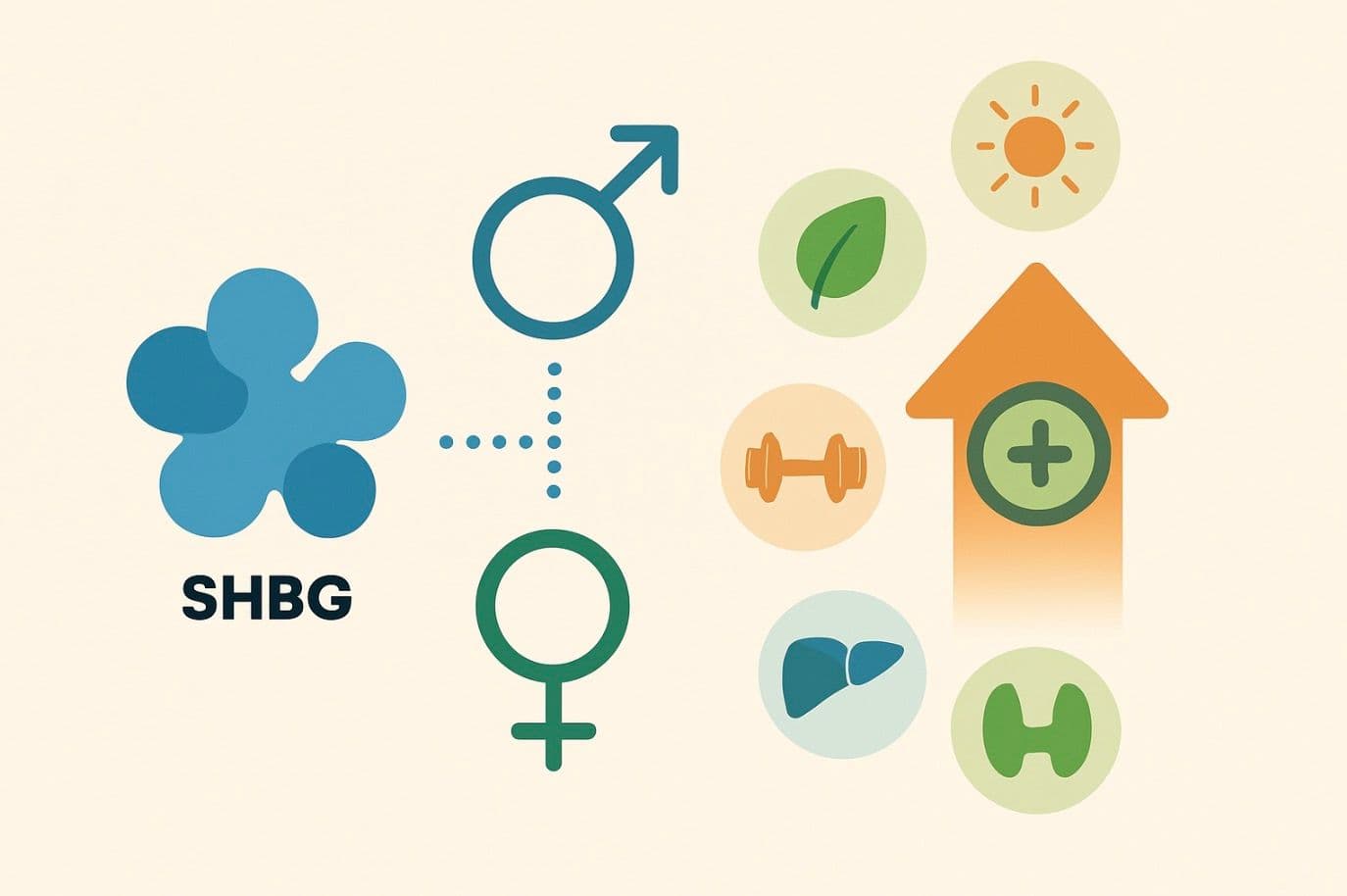
Common causes of high SHBG (sex hormone-binding globulin) are aging, an overactive thyroid, liver disease, estrogen-containing medicines, eating disorders such as anorexia, and genetics. It matters because SHBG holds testosterone tightly, so a high level can leave you with low free testosterone even when your total testosterone looks normal (MedlinePlus).
What is SHBG?
SHBG is a protein made mainly in the liver (Mayo Clinic Laboratories). It carries testosterone and estradiol through the blood. According to the AUA guideline, about 44% of a man's testosterone is tightly bound to SHBG, about 50% is loosely bound to albumin, and about 2% circulates free. The free and albumin-bound fractions together are called bioavailable testosterone; testosterone held by SHBG cannot act on your tissues (MedlinePlus).
When SHBG is high, more testosterone is locked up. Bioavailable testosterone can then be much lower than the total testosterone result suggests (Mayo Clinic Laboratories). For more on how the two numbers differ, see free vs. total testosterone.
Common causes of high SHBG
Some causes can be treated or changed, such as an overactive thyroid or an estrogen-containing medicine. Others, such as genetics, cannot.
Aging
SHBG rises with age in men. The Massachusetts Male Aging Study enrolled 1,709 men aged 40–70 and retested 1,156 of them 7–10 years later. Across ages, SHBG was about 1.6% higher per year of age, while free testosterone was about 2% lower per year and total testosterone only 0.8% lower (Feldman et al., JCEM 2002). That gap is why an older man's total testosterone can look normal while his free testosterone is low.
Liver disease
Because the liver makes SHBG, liver disease can raise it (MedlinePlus). Chronic hepatitis C is linked to high SHBG, and in one cohort of 327 men the elevated SHBG could mask low testosterone during active infection (Chaudhury et al., Clin Infect Dis 2019).
Fatty liver disease runs the other way. In 530 men in the Multicenter AIDS Cohort Study, higher SHBG was linked to lower odds of nonalcoholic fatty liver disease (Price et al., Open Forum Infect Dis 2019). That was an observational study, so it shows an association, not a cause.
Overactive thyroid
Hyperthyroidism (an overactive thyroid) raises SHBG. Thyroid hormone, whether your own or from medication, increases SHBG levels (Mayo Clinic Laboratories).
Estrogen and hormonal medications
Estrogen raises SHBG, whether the body makes it or it comes from a medicine (Mayo Clinic Laboratories). Birth control pills and menopause hormone therapy are the common examples, and SHBG is also high during pregnancy (MedlinePlus).
Diet and body weight
In 1,552 men aged 40–70, higher fiber intake went with higher SHBG and higher protein intake with lower SHBG (Longcope et al., JCEM 2000). Calories, fat, and carbohydrate intake were not related to SHBG in that study. It was cross-sectional, so it cannot show that changing your diet changes your SHBG.
Body weight and insulin also matter. Higher body mass index went with lower SHBG in the same study, and a low SHBG often signals insulin resistance (Mayo Clinic Laboratories).
Genetics
Some people carry a gene variant (Asp327Asn) that slows the breakdown of SHBG. It is found in 10–20% of the population, and carriers tend to have higher SHBG for any given set of other factors (Mayo Clinic Laboratories).
Other health conditions
- Anorexia nervosa: SHBG is high and starts to fall as nutrition improves (Mayo Clinic Laboratories).
- HIV: in 94 men with HIV and sexual symptoms, SHBG was elevated in about one in three, and testing total testosterone alone would have missed about half of the low-testosterone diagnoses (Pezzaioli et al., Infection 2021).
- Low testosterone production in men: decreased sex hormone production in men is one cause of high SHBG (MedlinePlus). High androgen levels go with low SHBG, and the age-related rise in SHBG may partly follow the age-related fall in testosterone, which lowers free testosterone further (Mayo Clinic Laboratories).
Symptoms of high SHBG (and low free testosterone)
When high SHBG leaves too little free testosterone for your tissues, men can notice the signs of low testosterone (MedlinePlus):
- Low sex drive
- Difficulty getting an erection
- Fatigue or loss of muscle mass
- Fertility problems
These symptoms are not specific. The AUA notes they can also come from chronic fatigue, chronic stress, or depression (AUA guideline), which is why labs decide the question.
How SHBG is tested
SHBG is measured with a blood test, usually alongside total testosterone (MedlinePlus). On its own it does not tell you much. The workup usually includes:
- Total testosterone, measured early in the morning on two separate days. The AUA uses under 300 ng/dL as the cut-off for low testosterone (AUA guideline).
- Free testosterone. The Endocrine Society recommends measuring it when total testosterone is near the lower limit or a condition alters SHBG, either by equilibrium dialysis or with an accurate formula (Bhasin et al., JCEM 2018). Free testosterone calculated from total testosterone and SHBG closely matched equilibrium dialysis in one validation study; the simpler free androgen index did not (Vermeulen et al., JCEM 1999).
- Albumin, in some calculations. It is the other carrier protein, though it binds testosterone about 100 times more weakly than SHBG does (Mayo Clinic Laboratories).
- Thyroid or liver tests when the history points to one of those causes.
Estradiol is not a routine part of this workup. The AUA recommends measuring it in men with breast symptoms or gynecomastia (breast tissue growth) before starting testosterone (AUA guideline).
Managing high SHBG
Treatment depends on the cause:
- Treating the liver disease or overactive thyroid behind it
- Reviewing hormone-containing medicines with the prescriber; don't stop any medicine on your own (MedlinePlus)
- Treating an eating disorder; in anorexia, SHBG starts to fall as nutrition improves (Mayo Clinic Laboratories)
Testosterone therapy is a separate decision. The AUA makes the diagnosis only when symptoms or signs come with low total testosterone confirmed on two early-morning tests (Moderate Recommendation, Grade B) (AUA guideline). When SHBG is abnormal, free testosterone helps settle borderline results (Bhasin et al., JCEM 2018). If testosterone is prescribed, it tends to lower SHBG (Mayo Clinic Laboratories), so a clinician follows total and free testosterone on treatment. For ways the underlying causes can be addressed, see how to lower SHBG.
Bottom line
High SHBG can come from aging, an overactive thyroid, liver disease, estrogen, an eating disorder, or genetics. It can hide low free testosterone behind a normal total testosterone, so the useful step is a full lab picture: repeat morning total testosterone, SHBG, and free testosterone. Finding and treating the cause comes first; testosterone therapy is only for men with symptoms and confirmed low levels.
AlphaMD providers review labs before prescribing testosterone replacement therapy.