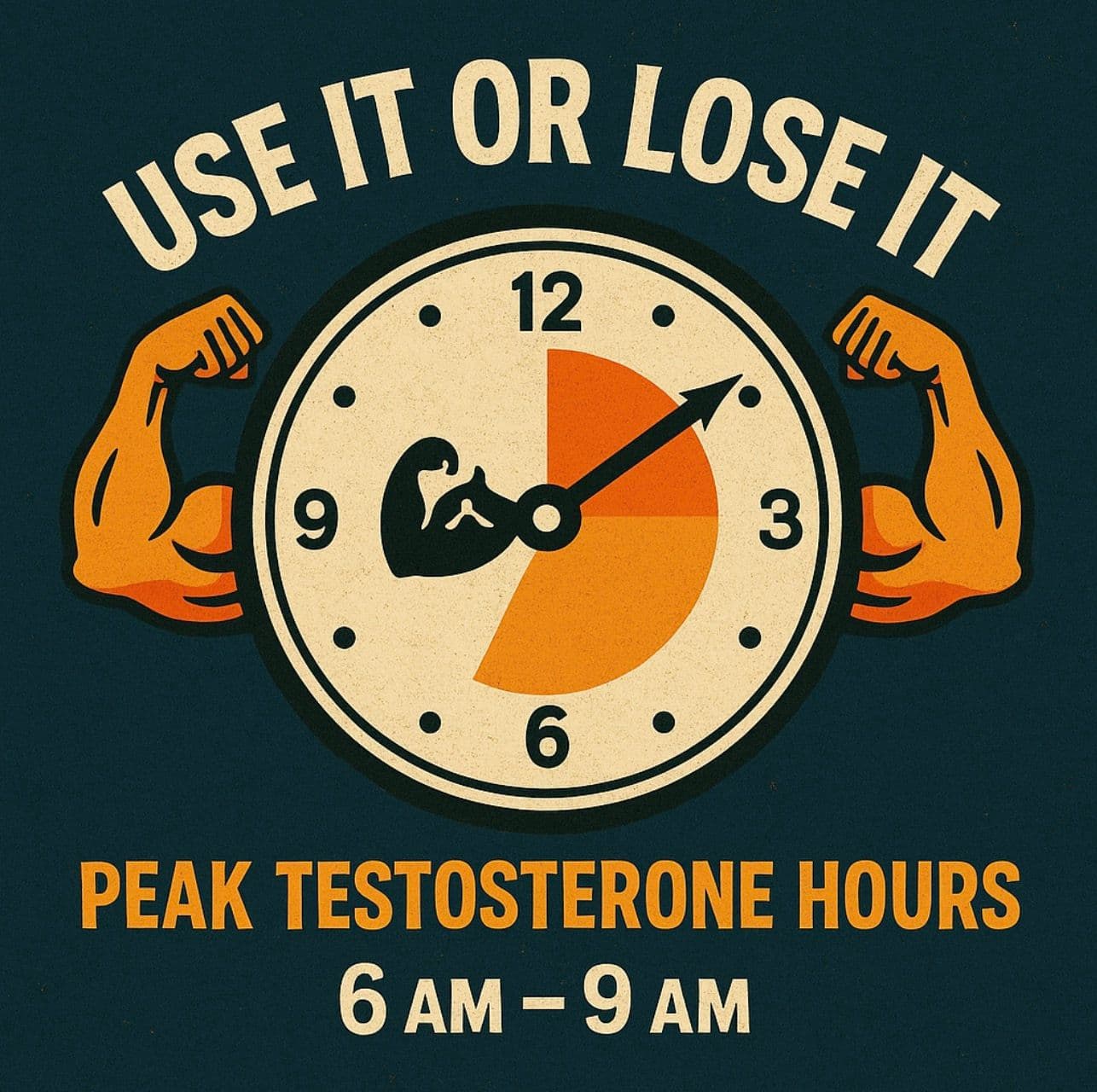
In men who sleep at night, testosterone is highest in the early morning and falls through the day, by 20% to 25% between 8 AM and 4 PM in men in their 30s. That peak is why testosterone is tested in the morning. It is not a three-hour window you need to fill with workouts, a special breakfast, or your hardest work.
Those numbers come from a study of 66 Boston men aged 30 to 80 who gave blood at three morning and three afternoon visits (Brambilla et al., JCEM 2009). The gap shrank with age, to about 10% at age 70.
Why does testosterone peak in the morning?
Mostly because you have just slept. In a sleep-lab study of seven men aged 22 to 32, testosterone climbed during sleep and fell during waking hours, and it did so whether the men slept at night or from 7 AM to 3 PM (Axelsson et al., JCEM 2005). The authors found only a weak clock-driven (circadian) effect, peaking somewhere between about 6:50 and 9:25 AM, and large differences between individuals.
So the standard advice to test in the early morning assumes you sleep at night. That study was small and lasted only days, and it did not include long-term night-shift workers. If you work nights, tell the clinician ordering your test when you usually sleep.
How much does testosterone drop by the afternoon?
In the Brambilla study, levels at 4 PM were 20% to 25% lower than at 8 AM in men aged 30 to 40, and about 10% lower at age 70.
That dip is large enough to change a diagnosis. Seventeen men in the study had at least one result under 300 ng/dL after noon, which is the cutoff the American Urological Association uses, yet every one of their results before noon was normal. Their afternoon lows reflected the daily dip.
The rhythm flattens with age. When researchers drew blood every hour for 24 hours, the early morning rise seen in 17 young men (average age 25) was blunted or missing in 12 healthy men averaging 71 (Bremner et al., JCEM 1983). Brambilla's group still recommended morning testing for young and older men alike.
If my morning result was normal, could the afternoon drop explain how I feel?
No study has shown that it does. Every man with a daily rhythm has lower testosterone in the afternoon, so a lower afternoon level by itself is expected. The diagnostic cutoffs in both major guidelines assume a morning draw, which leaves an afternoon number with nothing reliable to be compared against.
If you have symptoms such as low libido, fatigue, or slow recovery and a normal morning result, the useful next steps are a repeat morning test, a free testosterone level if your total is borderline or your SHBG is abnormal (both explained below), and a search for other causes. AlphaMD's article on whether you can start TRT at a level of 450 covers what a normal-range result means for treatment.
Why do the guidelines ask for two morning tests?
Because a single result can mislead. The American Urological Association says "the diagnosis of low testosterone should be made only after two total testosterone measurements are taken on separate occasions with both conducted in an early morning fashion," and it uses a total testosterone below 300 ng/dL as "a reasonable cut-off" (AUA guideline). The diagnosis also needs symptoms or signs (Moderate Recommendation, Grade B).
The Endocrine Society recommends diagnosing low testosterone only with symptoms and "unequivocally and consistently low" levels, measured as fasting morning total testosterone and confirmed with a repeat fasting morning test (Endocrine Society 2018).
For a sense of scale, a harmonized analysis of 9,054 men put the normal range for healthy, nonobese men aged 19 to 39 at 264 to 916 ng/dL (Travison et al., JCEM 2017).
Total testosterone, free testosterone, and SHBG
Most lab reports show total testosterone, which counts the hormone bound to proteins in the blood as well as the small free fraction. Sex hormone-binding globulin (SHBG, a protein that holds testosterone tightly) varies between men, so two men with the same total can have different amounts of free testosterone. The Endocrine Society recommends measuring free testosterone when total testosterone is near the lower limit of normal or when a condition alters SHBG. AlphaMD's guide to what causes high SHBG lists those conditions.
Do you need to fast before a testosterone test?
For a test meant to diagnose low testosterone, yes. Eating lowers the reading within minutes, and in most men it is still lower two hours later.
In 60 healthy men with normal testosterone, total testosterone fell by an average of 100 ng/dL at its lowest point after a glucose drink and 123 ng/dL after a mixed meal (Gagliano-Jucá et al., Endocrine 2019). The fall started about 20 minutes after eating and was largest at about 60 minutes. About 11% of the men in the glucose group and 56% in the meal group briefly dropped below 300 ng/dL, and most were still below their starting level at two hours.
An earlier study of 74 men found a 25% average drop after a glucose drink and concluded that "men found to have low nonfasting T levels should be re-evaluated in the fasting state" (Caronia et al., Clin Endocrinol 2013).
These studies measured a short-lived change in a blood reading. Neither looked at whether breakfast affects testosterone over weeks or months, so they support fasting before the test and say nothing about eating breakfast on other days. Follow the fasting instructions from your lab or clinician.
What lowers testosterone, whatever the time of day?
Poor sleep, stress, dieting, and drinking are often blamed for a steeper afternoon decline. The studies below show some of these factors lowering testosterone in general, which also lowers what a morning test captures. None of them measured whether the afternoon drop gets steeper.
- One week of 5-hour nights lowered daytime testosterone by 10% to 15% in 10 healthy young men (Leproult and Van Cauter, JAMA 2011).
- In a meta-analysis of 24 studies, weight loss by diet or bariatric surgery raised total testosterone, and the rise was larger in men who lost more weight (Corona et al., Eur J Endocrinol 2013).
- In the Massachusetts Male Aging Study, men with no chronic illness, prescription medication, obesity, or excessive drinking had androgen levels 10% to 15% higher (Feldman et al., JCEM 2002). In the same study of men aged 40 to 70, total testosterone fell about 1.6% a year within each man followed over 7 to 10 years.
- The AUA guideline advises considering a testosterone test in men with chronic narcotic (opioid) use or chronic corticosteroid use, even without symptoms.
Should you schedule workouts or hard work around the morning peak?
The evidence gives no reason to. A meta-analysis of 11 resistance-training studies that matched training volume found similar gains in muscle size and strength whether people trained in the morning or the evening (Grgic et al., Chronobiol Int 2019). Train at the time you can keep doing consistently.
No study has tied the normal hour-to-hour rise and fall of testosterone to focus or decision-making. In the Testosterone Trials, 788 men aged 65 and older with levels under 275 ng/dL got testosterone gel or placebo, and the gel did not improve memory or other cognitive function (Resnick et al., JAMA 2017).
Does TRT keep the morning peak?
On injectable testosterone, blood levels follow the injection schedule more than the sleep cycle. Testosterone cypionate injected into muscle has a half-life of about eight days (DEPO-Testosterone label), so levels rise after a shot and fall gradually until the next one. An early trial of testosterone enanthate found that levels fluctuated across every schedule tested (Snyder and Lawrence, JCEM 1980).
That makes the timing of a blood draw relative to the last injection more important than the clock time. A 2026 practical review advises clinicians to record "timing of the last injection, and timing of bloodwork," because without that context "testosterone results can be misleading" (Cureus 2026). That review is expert opinion, not a trial. The clinician managing your therapy decides when your labs are drawn; AlphaMD's article on when testosterone peaks after an injection goes into the curve.
Questions readers ask
What time should I book my blood draw?
Early morning, before you eat, if you sleep at night. In the Brambilla study, men whose afternoon results were low had normal results at every visit before noon, so an early slot with fasting is the safest choice. Follow the instructions from your lab.
Does one bad night of sleep change my result?
No study here tested a single night. The Leproult study used a full week of 5-hour nights and found a 10% to 15% drop. If you slept very badly or were ill before the test, mention it to the clinician reading the result.
Is an afternoon home-test result useful?
It can be read only with caution. An afternoon value can sit below 300 ng/dL in men whose morning values are normal, so a low afternoon number calls for a repeat fasting morning test before anyone draws conclusions.
Bottom line
Testosterone is highest in the early morning in men who sleep at night, and it can fall 20% to 25% by 4 PM in men in their 30s, less with age. That is why guidelines ask for two fasting early-morning tests before diagnosing low testosterone. The morning peak does not make morning workouts build more muscle, and no study shows it sharpens your thinking. If you are on injectable TRT, your blood draw should be timed to your injection schedule as your prescriber directs.
If you have symptoms and want a proper morning workup, AlphaMD's testosterone replacement therapy page explains how its providers review labs before prescribing.