
Your Stress Level Has a Testosterone Number. Here's How to Calculate the Cost.
People are asking...
Two questions. First, I find my testosterone significantly tanks when I've been extra busy, especially physically. When I first tanked (270 total or ...
For your first question, this can impact your Testosterone levels if you're not resting properly. I'll barrow from one of our earlier replies: "The majority of your Testosterone is produced and releas... See Full Answer
One thing I can't find on your site is how do you handle labs and how often you require them. Are they part of the $129 a month, or do you require the...
Our initial consultation price pays for a Testosterone testing kit to be shipped to you. It's fairly cheap considering it's paying for both that & the time with a licensed provider for 20-45 minutes. ... See Full Answer
With T fluctuations being so drastic from any given hour, day, week, how can you really know if someone has a hormonal imbalance?...
That is why symptoms are king, and numbers should be used as a guide post for what treatment is appropriate and how responsive someone is. Your 500 and my 500 will feel completely different to each of... See Full Answer
Have a question? Ask us.
At AlphaMD, we're here to help. Feel free to ask us any question you would like about TRT, medical weightloss, ED, or other topics related to men's health. Or take a moment to browse through our past questions.
Most men don't connect their exhaustion, low drive, and expanding waistline to the thing sitting on their desk every Monday morning. Chronic stress doesn't just wear you down mentally - it runs a quiet, systematic campaign against your hormonal health that shows up in your bloodwork long before you feel ready to talk to a doctor.
The Physiology Behind the Problem
Your body runs a tightly coordinated hormonal command chain called the hypothalamic-pituitary-gonadal (HPG) axis. The hypothalamus signals the pituitary, the pituitary signals the testes, and the testes produce testosterone. This system is elegant when it's working well. When you're under chronic stress, it gets overridden.
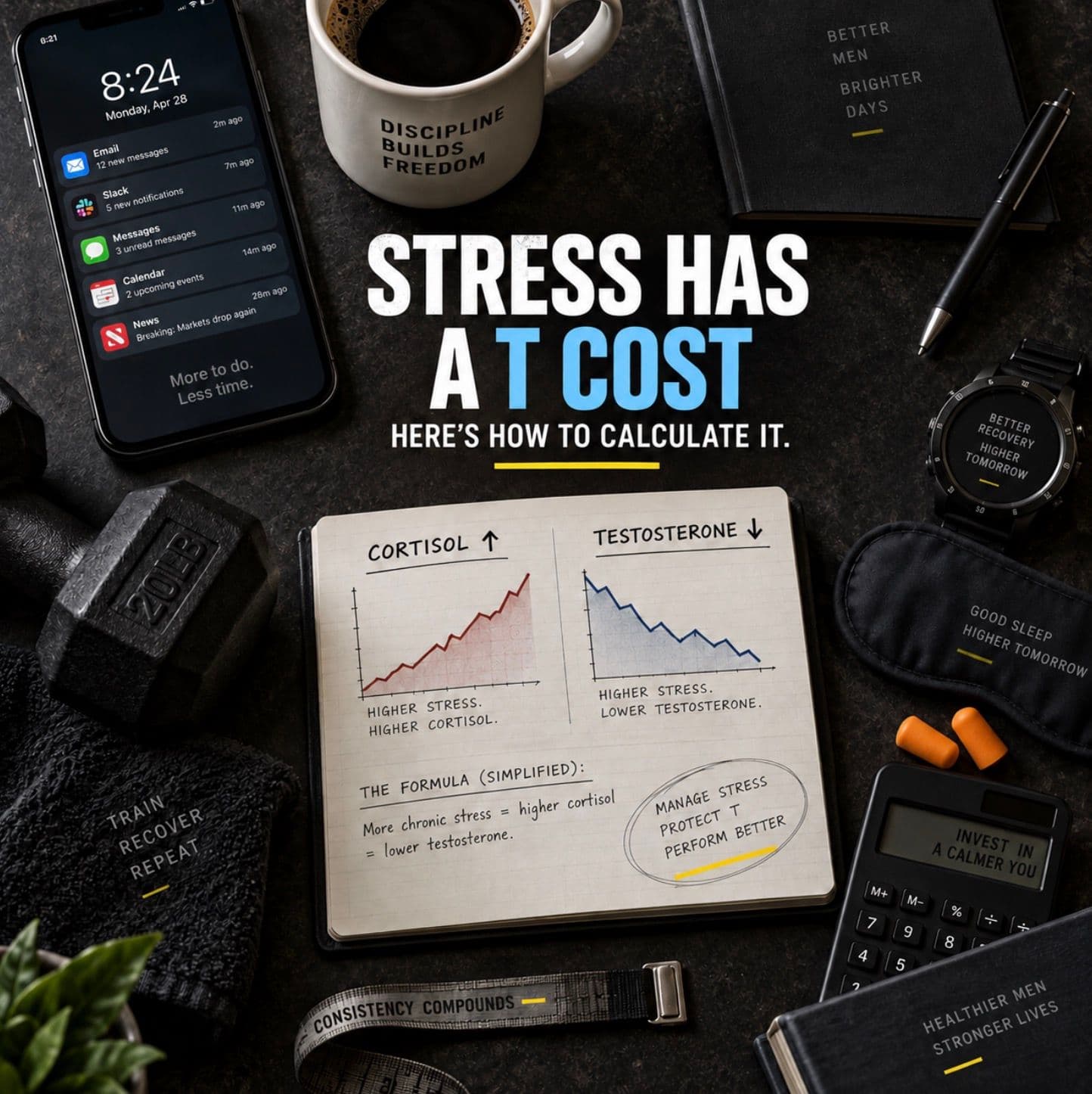
The villain here is cortisol - your primary stress hormone. In the short term, cortisol is useful. It mobilizes energy, sharpens focus, and helps you respond to threats. But sustained elevation of cortisol tells your body something important: survival is currently the priority, reproduction is not. The hypothalamus pulls back on gonadotropin-releasing hormone (GnRH), the pituitary produces less luteinizing hormone (LH), and the testes receive a quieter signal to produce testosterone. Less signal, less output.
Research published through the National Institutes of Health has confirmed that psychosocial stress and elevated cortisol are meaningfully associated with suppressed testosterone levels in men. This isn't a fringe finding - it's a well-documented interaction that most men have never been told about.
The cortisol-testosterone relationship also works through another mechanism: cortisol and testosterone compete for the same biochemical precursors. When your body is churning through cortisol to manage stress, fewer raw materials are available for testosterone synthesis. Think of it as two departments competing for the same budget - when crisis management takes everything, production gets nothing.
What "Your Testosterone Number" Actually Means in Daily Life
When people talk about testosterone, the conversation usually jumps straight to libido. That's real, but it's only one piece of what testosterone actually governs in a man's body.
Testosterone influences your energy levels and how you recover from both physical and emotional demands. It shapes your motivation - not just sexual motivation, but the drive to pursue goals, compete, and engage with life. It affects body composition, specifically how readily your body holds onto muscle versus storing fat. It modulates mood and emotional resilience. It plays a role in sleep quality, bone density, and even cardiovascular function.
So when stress suppresses testosterone production, the effects spread across all of those systems. You feel it as fatigue that sleep doesn't fully fix. You notice it as a gradual loss of enthusiasm for things that used to matter. Workouts feel harder and recovery takes longer. Body fat accumulates, particularly around the midsection, even when diet hasn't changed much. Mood becomes flatter or more irritable. Sleep gets shallower.
The "testosterone number" isn't just a lab value - it's the sum of those daily lived experiences. And chronic stress has a measurable cost against every one of them.
Calculating Your Personal Stress Cost: A Self-Audit Framework
You don't need a blood draw to start understanding your risk. This self-audit maps the most common stress inputs that research has linked to testosterone suppression. Go through each category honestly and assign yourself the point value that best matches your current reality.
Sleep Quality and QuantityConsistently getting fewer than 7 hours of sleep, or sleeping 7-8 hours but waking unrefreshed, is one of the most potent testosterone suppressors known. Studies have shown that restricting sleep to 5 hours per night for one week reduced testosterone levels in young healthy men by 10-15%. Score yourself: 0 points if sleep is consistently solid, 1 point if it's inconsistent, 2 points if it's regularly poor or insufficient.
Psychological and Work StressRate your current baseline stress from work, finances, relationships, or major life events. 0 points if stress feels manageable and temporary, 1 point if it's moderate and ongoing, 2 points if it's high, persistent, and feels outside your control.
Training Load and Recovery BalanceExercise supports testosterone - but too much without adequate recovery suppresses it. Overtraining raises cortisol chronically and creates the same hormonal suppression pattern as psychological stress. 0 points if training is consistent and recovery feels adequate, 1 point if you're training hard but recovery is occasionally compromised, 2 points if you're training very heavily with little recovery or you're largely sedentary (both extremes carry risk).
Alcohol IntakeAlcohol directly suppresses testosterone production and disrupts sleep architecture. 0 points for minimal or no regular alcohol use, 1 point for moderate regular use, 2 points for frequent or heavy use.
Nutrition QualityChronic undereating, very low fat diets, and significant micronutrient deficiencies all impair testosterone synthesis. 0 points if your diet is reasonably balanced and sufficient in calories and fat, 1 point if it's inconsistent, 2 points if it's regularly restrictive, high in processed food, or low in dietary fat.
Recovery PracticesThis covers active stress management: time outdoors, social connection, time away from screens, hobbies, downtime. 0 points if you have consistent recovery built into your week, 1 point if it's occasional, 2 points if it's essentially absent.
Scoring Your RiskAdd your points. A total of 0-2 suggests low risk of significant stress-related testosterone suppression. A score of 3-5 puts you in moderate risk territory - your hormonal environment is likely under meaningful pressure. A score of 6 or above suggests high risk, and persistent symptoms alongside that score are a reasonable trigger for a clinical evaluation.
This isn't a diagnostic tool. It's a mirror.
What Clinicians Look at - and Why the Pattern Matters
If your self-audit score is elevated and you're experiencing symptoms, a thorough hormone panel can tell a much more complete story than a single testosterone number.
Clinicians evaluating men for stress-related hormonal disruption typically look at total testosterone alongside free testosterone. The distinction matters because a significant portion of testosterone in the blood is bound to a protein called sex hormone-binding globulin (SHBG), which renders it biologically inactive. Stress and poor sleep can alter SHBG levels, meaning your total testosterone number can look acceptable while the fraction your body can actually use is suppressed.
Estradiol, the primary estrogen in men, is also informative. Testosterone and estradiol exist in a relationship, and stress-driven changes in body composition (particularly increased body fat) can shift that balance in ways that amplify symptoms. Elevated prolactin can suppress the HPG axis and is worth ruling out. Thyroid markers matter because thyroid dysfunction overlaps significantly with stress-related fatigue and mood symptoms. Cortisol patterns - whether measured in blood, saliva, or urine - can reveal whether your stress response system is running hot and whether it's affecting your adrenal and gonadal function.
The goal isn't chasing a single number into a target range. The goal is understanding the pattern - what your body is doing, why it's doing it, and what's driving the symptoms you're experiencing.
Strategies That Actually Move the Needle
The good news is that many of the stress inputs that suppress testosterone are modifiable, and the evidence base for lifestyle interventions in this area is substantial.
Prioritize sleep above almost everything else. Not just duration, but quality. If you snore heavily, wake frequently, or feel unrefreshed despite adequate time in bed, screening for sleep apnea is important - obstructive sleep apnea is strongly associated with testosterone suppression and is often underdiagnosed in men. Treating it can meaningfully improve hormonal status without any other intervention.
Resistance training is one of the most reliable testosterone supports available - but volume and recovery have to be balanced. If you're already training intensely and under high psychological stress, adding more training volume often makes hormonal status worse, not better. Scaling back intensity temporarily while stress is high is frequently the smarter move.
Dietary fat is not optional for testosterone production. Cholesterol is the direct precursor to all steroid hormones, including testosterone. Men eating very low-fat diets chronically often show lower testosterone levels. This doesn't mean eating recklessly - it means ensuring adequate dietary fat from quality sources as part of a varied, sufficient-calorie diet.
Alcohol moderation is often underestimated as a lever. Even moderate regular alcohol consumption disrupts sleep architecture, elevates cortisol, and directly impairs testicular testosterone production. Cutting back significantly often produces noticeable improvements in energy and sleep quality within weeks.
Mindfulness-based stress reduction and cognitive behavioral therapy (CBT) have legitimate evidence behind them for lowering cortisol and improving psychological stress burden. These aren't soft suggestions - they're clinically studied interventions. If your stress load is driven by thought patterns, anxiety, or relationship dynamics, addressing those upstream causes is more effective than any supplement.
Sunlight exposure in the morning supports circadian rhythm regulation, which governs cortisol's natural daily pattern. Cortisol should peak in the morning and decline across the day. When circadian rhythm is disrupted - by late light exposure, irregular schedules, or insufficient morning light - cortisol patterns flatten or invert, and testosterone often follows.
Schedule recovery the way you schedule work. Most men are good at filling their calendars with demands and obligations. Very few deliberately schedule decompression. Recovery doesn't happen by accident when you're under pressure - it has to be protected.
When to Seek Medical Evaluation
Lifestyle intervention is the right starting point for most men with moderate stress loads and mild-to-moderate symptoms. But there are situations where waiting and adjusting habits is not the appropriate first move.
If symptoms are severe - particularly significant depression, persistent fatigue that impairs daily function, or anxiety that's affecting your quality of life - a clinical evaluation should happen sooner rather than later. If you're experiencing fertility concerns, hormonal evaluation is important because some causes of suppressed testosterone also affect sperm production. If there's any suspicion of sleep apnea, that should be evaluated promptly given its broad health implications.
For men whose lifestyle factors are reasonably addressed but symptoms and labs remain significantly abnormal, options like testosterone replacement therapy may become part of the clinical conversation. That's a decision made with a qualified clinician based on a full picture - symptoms, history, and labs - not on a self-audit score alone.
Some men who want to support their own testosterone production rather than replace it may be candidates for approaches like Sermorelin, a growth hormone secretagogue that can support recovery, body composition, and sleep quality in ways that may indirectly support the hormonal environment. Again, these are clinical conversations, not self-prescriptions.
Stress Is a Hormone Problem - Treat It Like One
The mistake most men make is treating stress as a mental or emotional issue that's separate from their physical health. It isn't. Chronic stress is a physiological event with measurable hormonal consequences, and those consequences compound over months and years in ways that erode quality of life gradually enough that many men adapt to them without recognizing how much ground they've lost.
The self-audit in this article won't tell you your testosterone level. What it can do is give you an honest look at the inputs you're feeding your hormonal system every day - and a concrete starting point for addressing the ones that are working against you.
At AlphaMD, the approach to men's hormone health starts with exactly this kind of full-picture evaluation: understanding what's driving symptoms, what lifestyle factors are contributing, and what - if anything - clinical intervention can add. If your score from this audit gave you pause, that's worth paying attention to.
Have a question? Ask us.
At AlphaMD, we're here to help. Feel free to ask us any question you would like about TRT, medical weightloss, ED, or other topics related to men's health. Or take a moment to browse through our past questions.
People are asking...
Two questions. First, I find my testosterone significantly tanks when I've been extra busy, especially physically. When I first tanked (270 total or ...
For your first question, this can impact your Testosterone levels if you're not resting properly. I'll barrow from one of our earlier replies: "The majority of your Testosterone is produced and releas... See Full Answer
One thing I can't find on your site is how do you handle labs and how often you require them. Are they part of the $129 a month, or do you require the...
Our initial consultation price pays for a Testosterone testing kit to be shipped to you. It's fairly cheap considering it's paying for both that & the time with a licensed provider for 20-45 minutes. ... See Full Answer
With T fluctuations being so drastic from any given hour, day, week, how can you really know if someone has a hormonal imbalance?...
That is why symptoms are king, and numbers should be used as a guide post for what treatment is appropriate and how responsive someone is. Your 500 and my 500 will feel completely different to each of... See Full Answer
Get $30 off your first month’s order
Enter your email address now to receive $30 off your first month’s cost, other discounts, and additional information about TRT.
Legal Disclaimer
This website is a repository of publicly available information and is not intended to form a physician-patient relationship with any individual. The content of this website is for informational purposes only. The information presented on this website is not intended to take the place of your personal physician's advice and is not intended to diagnose, treat, cure, or prevent any disease. Discuss this information with your own physician or healthcare provider to determine what is right for you. All information is intended for your general knowledge only and is not a substitute for medical advice or treatment for specific medical conditions. The information contained herein is presented in summary form only and intended to provide broad consumer understanding and knowledge. The information should not be considered complete and should not be used in place of a visit, phone or telemedicine call, consultation or advice of your physician or other healthcare provider. Only a qualified physician in your state can determine if you qualify for and should undertake treatment.