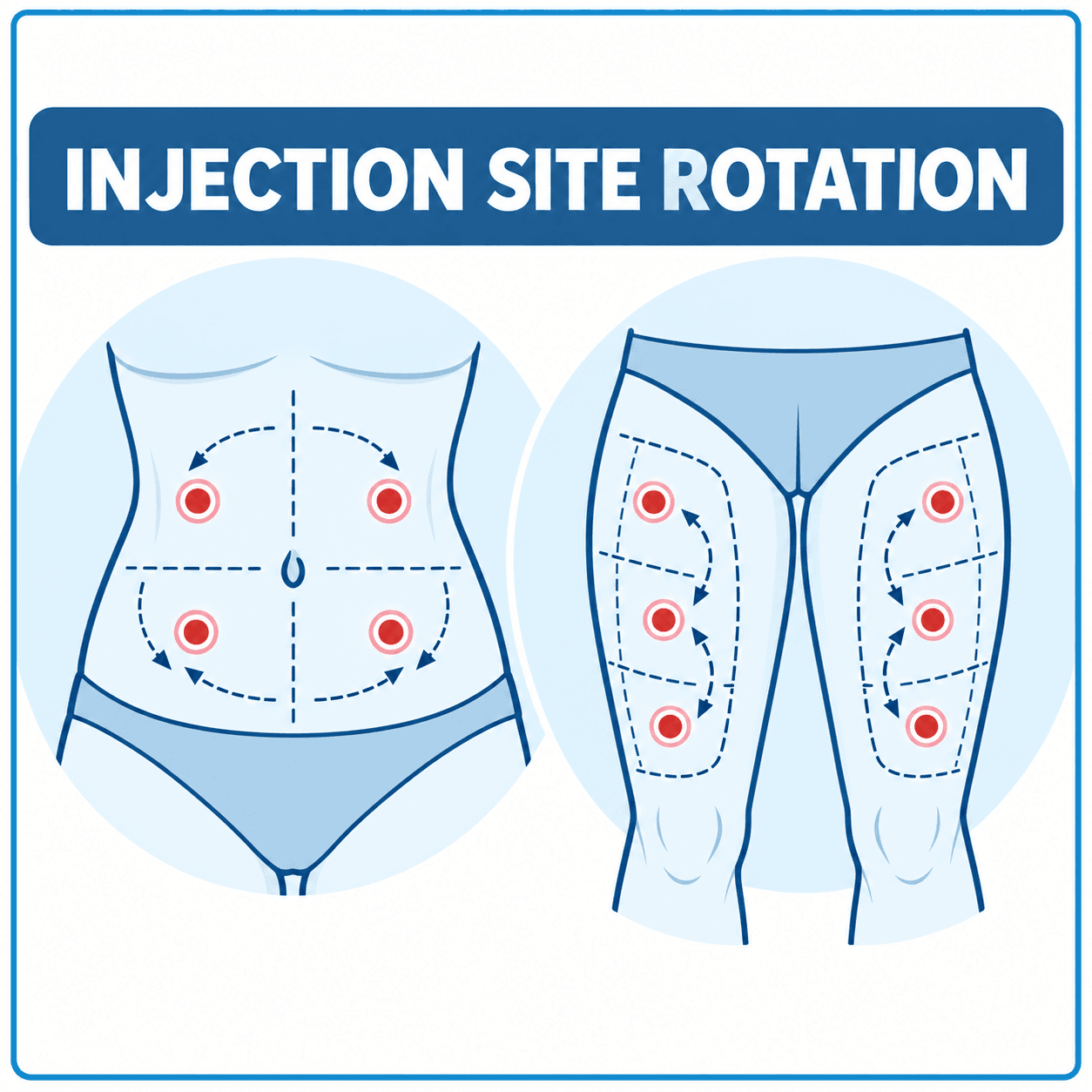
Injection site rotation means moving each testosterone replacement therapy injection away from recently used tissue. The goal is to reduce repeated needle trauma, local irritation, and the chance of injecting into an existing lump or hardened area.
The safest rotation plan depends on the prescribed route, the product, needle length, body composition, and the sites a clinician has approved. Intramuscular and subcutaneous injections are not interchangeable techniques. Follow the label and your prescribing clinician's instructions for the medication you actually use.
Why Repeatedly Using One Spot Can Cause Problems
Every injection creates a small local injury. Most sites settle without difficulty. Repeatedly puncturing the same small area gives the tissue less time to recover and can make tenderness, bruising, bleeding, or a palpable lump more likely.
The strongest research on poor rotation comes from insulin therapy. In that setting, repeated injections into the same area are associated with lipohypertrophy, a thickened or rubbery change in subcutaneous fat that can alter insulin absorption. A 2023 review of insulin-related lipohypertrophy identifies inadequate rotation as a major contributor.
That evidence is useful for the basic principle of avoiding damaged tissue. It is not direct proof that men injecting testosterone have the same complication rate or the same effect on hormone absorption. Testosterone preparations differ from insulin in formulation, volume, dosing schedule, and target tissue.
A Lump Is Not Automatically Scar Tissue
The phrase “scar tissue” is often used for any firm or tender injection site. Several different reactions can feel similar:
- A small bruise or hematoma from bleeding under the skin
- Temporary inflammation from the needle or medication
- A subcutaneous depot of oil that has not fully dispersed
- Lipohypertrophy, meaning thickened subcutaneous fat after repeated injections
- A sterile inflammatory nodule
- Fibrosis, which is denser connective tissue formed after repeated injury
- An abscess or another infection
These are not interchangeable diagnoses. A new bump that appeared after an injection is more likely to be temporary inflammation or a small depot than mature fibrosis, but persistent or worsening changes should be examined.
Do not inject through a lump, hard area, bruise, red patch, open skin, or suspected infection. The FDA-approved subcutaneous testosterone enanthate label, for example, directs patients to avoid skin that is tender, bruised, red, hard, scarred, or affected by stretch marks.
Start With the Prescribed Route
Intramuscular injections
An intramuscular injection is intended to pass through the skin and subcutaneous fat into muscle. Approved sites vary by product and clinical instruction. Commonly discussed locations include the vastus lateralis in the thigh and gluteal sites.
Do not choose a site solely because it appears in a general online guide. The product label, needle length, dose volume, and individual anatomy matter. AlphaMD's guide to where to inject testosterone covers site selection in more detail.
Subcutaneous injections
A subcutaneous injection is delivered into fatty tissue rather than muscle. The abdomen is used for some products, including the testosterone enanthate autoinjector in its approved label. Other clinician-directed regimens may use additional areas, but instructions are not universal across formulations.
The correct rotation map for a prescribed subcutaneous product should come from its instructions and the clinician or pharmacist teaching the technique.
A Practical Rotation System
A useful system is simple enough to follow every time.
1. Define the approved zones
List only the sites approved for your route and medication. If you are unsure whether a site is appropriate, ask before adding it to the rotation.
2. Divide each zone into sections
Treat a broad site such as the abdomen or thigh as several smaller sections. Move to a different section each time instead of shifting only a few millimeters.
3. Alternate sides when possible
Moving between left and right sides helps avoid repeated trauma in one area. Alternating sides is not a substitute for changing the exact point within each side.
4. Record the injection
A phone note, calendar, or simple body map can track the date, side, site, dose, and any reaction. This is especially helpful when injections are frequent or more than one medication is involved.
5. Skip any site that has not recovered
Do not return to an area simply because it is next in the sequence. If it remains tender, bruised, hard, red, swollen, or irritated, choose another approved location and discuss persistent changes with a clinician.
There is no universal rule that every site must rest for exactly five or seven days. The interval depends on the number of approved locations, injection frequency, reaction history, and treatment plan.
Technique Factors That Affect Local Reactions
Rotation is only one part of a good injection process. Local reactions can also be influenced by:
- Using the wrong needle length for the intended route
- Reusing a needle or syringe
- Touching a cleaned needle or injection site
- Injecting through clothing
- Using medication that is cold, contaminated, expired, or stored incorrectly
- Moving the needle while it is in the tissue
- Injecting a product at a site or by a route not supported by its instructions
- Repeatedly injecting through irritated tissue
AlphaMD's review of common TRT injection mistakes addresses preparation, handling, and technique without turning a rotation guide into a full injection tutorial.
Do not change needle length, route, injection volume, or site because of an online rule. A clinician or pharmacist should match those variables to the medication and the patient's anatomy.
Should You Massage a Testosterone Injection Site?
Routine massage is not a universal requirement. Product instructions differ, and aggressive rubbing can worsen tenderness or bruising. Unless the medication instructions or a clinician specifically recommend massage, leave the site alone after applying gentle pressure for minor bleeding.
Avoid improvised topical treatments on a fresh puncture. If itching, swelling, or pain is recurrent, the cause may be technique, an ingredient sensitivity, or another reaction that deserves review.
When a Reaction Is Usually Minor
Mild soreness, a small bruise, or brief redness can occur after an injection. A small, non-worsening lump may also resolve as local inflammation settles or a depot disperses.
Track the reaction instead of repeatedly checking or pressing it. Note whether it is shrinking, stable, or becoming more painful. Recurring reactions in the same type of site are a reason to review technique and formulation with the prescribing team.
When to Contact a Clinician Promptly
Seek medical guidance for:
- Redness, warmth, swelling, or pain that is spreading or worsening
- Drainage, pus, skin breakdown, or red streaks
- Fever, chills, or feeling acutely unwell
- A hard area or lump that persists or enlarges
- Significant bleeding or a rapidly expanding bruise
- Hives, facial swelling, wheezing, or another possible allergic reaction
- Severe pain, numbness, weakness, or an electric-shock sensation during or after the injection
Urgent symptoms such as trouble breathing, facial swelling, fainting, or rapidly progressive neurologic changes require emergency care.
If You Keep Getting Lumps Despite Rotating
Rotation may not solve a problem caused by route, needle length, medication formulation, injection volume, or an individual reaction. A licensed clinician may need to review:
- Whether the intended tissue is actually being reached
- Whether the site is approved for that product
- Whether the medication or carrier oil may be contributing
- Whether the dose volume should be discussed
- Whether a persistent lump needs examination or imaging
- Whether an alternative formulation or route is appropriate
Do not keep testing the same painful area with another injection.
Frequently Asked Questions
How far should I move from the last injection?
There is no single spacing rule for every testosterone product and route. The key is to use a different point within an approved zone and avoid any tissue that remains irritated. Product instructions or a clinician may provide a specific spacing recommendation.
Can I rotate between intramuscular and subcutaneous injections?
Not unless the medication and treatment plan support both routes. Changing route can change absorption and tolerability. Ask the prescriber before switching.
Does a lump mean I injected incorrectly?
Not necessarily. A small lump can reflect temporary inflammation, bruising, or a medication depot. Recurrent, painful, enlarging, hot, or persistent lumps need clinical review.
Does injecting into scar tissue reduce testosterone absorption?
Direct evidence for testosterone is limited. Insulin research shows that injecting into lipohypertrophic tissue can make insulin absorption less predictable, but that finding should not be presented as a measured testosterone effect. Avoid altered tissue because placement and tolerability may be less reliable.
What is the best TRT injection site?
There is no best site for everyone. The correct choice depends on the product, prescribed route, needle length, volume, and anatomy. Use the sites taught for your regimen.
The Bottom Line
Good rotation protects tissue by avoiding repeated trauma to one small area. It does not require a complicated calendar or a universal rest period.
Use only approved sites for the prescribed route, move to a genuinely different point each time, record reactions, and do not inject into tissue that is bruised, hard, red, painful, or otherwise abnormal. Most research on lipohypertrophy comes from insulin therapy, so its exact rates and absorption effects should not be transferred to TRT without evidence.
This article is for educational purposes and is not medical advice. Injection technique should be taught and reviewed by an appropriately licensed clinician or pharmacist using the instructions for the prescribed product.