
Is 1 mL of Testosterone a Week Enough? Dose vs. Volume Explained
Published on:
People are asking...
• 2y ago Is there a way to estimate peak testosterone by dosage and 7 day trough numbers ? Do levels linearly decline from the peak after the shot u...
For the average man, 1mg of testosterone cypionate translates to approximately 5-6 ng/dL of total testosterone. This means that 100mg/wk should get most men to a level of 500-600 ng/dL, and 200mg/wk w... See Full Answer
Hi, do you know if hair thinning is less likely with a more natural dose of test cypionate every 3 days vs a large dose once a month or every 2 weeks?...
So, the easiest way to answer this is that the higher the dose, the more conversion that occurs, like an overflowing cup of water.What I mean by that: Your body only has a certain number of androgen ... See Full Answer
I take 100mgs every Friday night. Should I switch to 50mgs every 4 days?...
Once weekly injections are still “standard of care” in that is what medical textbooks suggest as far as injection frequency. However, with the half-life of testosterone cypionate being 8 days, many pa... See Full Answer
Have a question? Ask us.
At AlphaMD, we're here to help. Feel free to ask us any question you would like about TRT, medical weightloss, ED, or other topics related to men's health. Or take a moment to browse through our past questions.
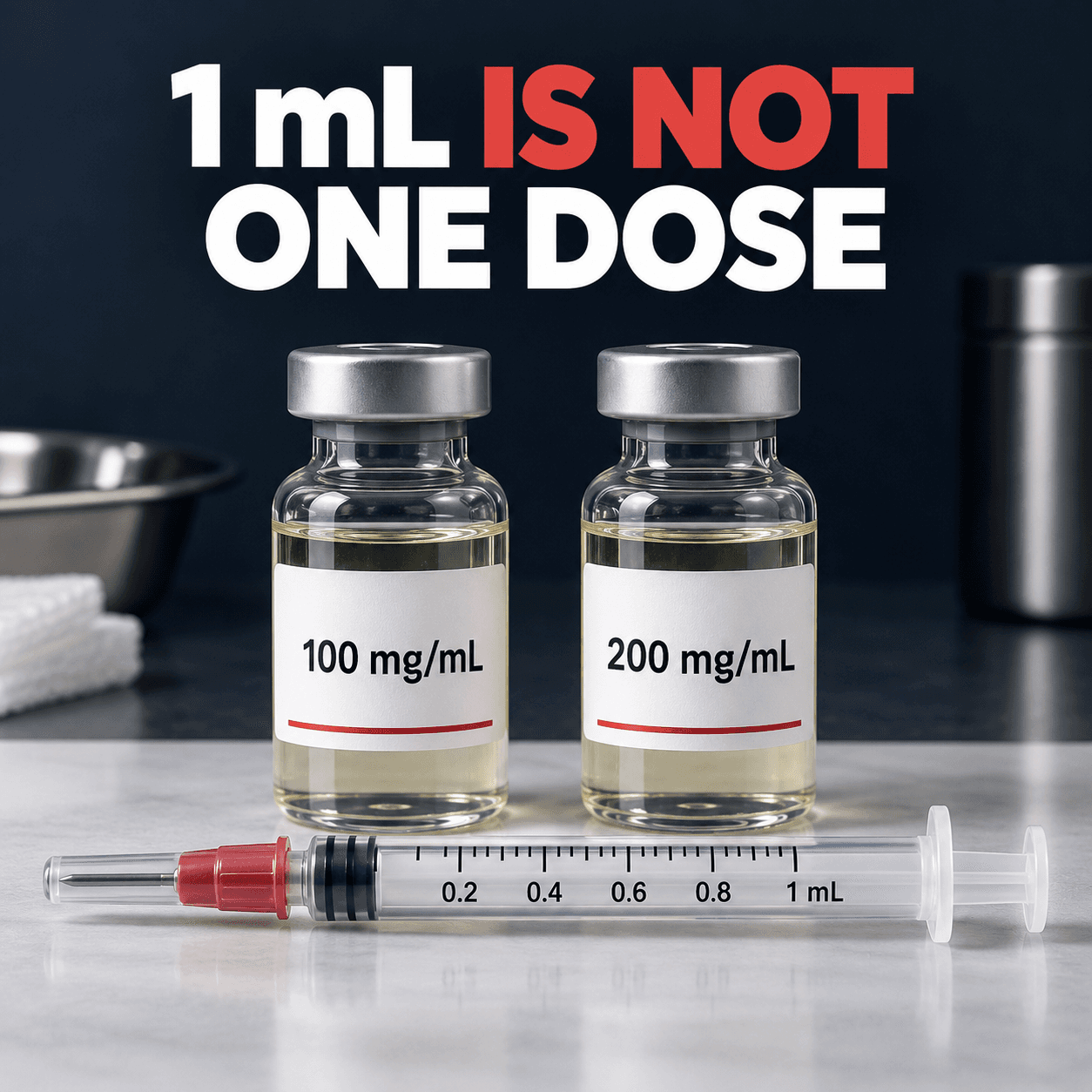
One milliliter of testosterone is a volume, not a dose. The medication label states the concentration in milligrams per milliliter (mg/mL). One milliliter of a 100 mg/mL product contains 100 mg, while 1 mL of a 200 mg/mL product contains 200 mg.
Whether either amount is appropriate depends on the exact medication, diagnosis, prescription, symptoms, laboratory results, treatment goals, safety monitoring, and the licensed clinician's instructions. Do not start, stop, or change testosterone replacement therapy (TRT) based on syringe volume alone.
Quick answer: Is 1 mL of testosterone a week enough?
There is no safe universal yes-or-no answer. Convert the prescribed volume to milligrams using the concentration on the actual medication label:
Dose in mg = volume in mL x concentration in mg/mL
- 1 mL x 100 mg/mL = 100 mg
- 1 mL x 200 mg/mL = 200 mg
- 0.5 mL x 200 mg/mL = 100 mg
These examples explain the math. They are not dosing recommendations.
Current testosterone cypionate labeling lists 100 mg/mL and 200 mg/mL presentations. Other testosterone medications may use different formulations, strengths, routes, devices, or instructions. Read the label on the medication that was dispensed to you.
Why 1 mL does not identify a testosterone dose
Milliliters measure liquid volume. Milligrams measure the amount of medication in that liquid. The concentration connects them.
A bottle can contain 1 mL, 5 mL, or 10 mL without telling you how much to inject. The total package volume is also different from the prescribed volume for one injection.
The prescription should state the dose, volume, route, and schedule. If the label and instructions do not clearly match, pause and contact the prescribing clinician or pharmacist before injecting.
What do syringe "units" mean?
Syringe markings describe volume according to that syringe's scale. They do not independently tell you how many milligrams of testosterone you are drawing.
On a U-100 insulin syringe, 100 marked units equal 1 mL of syringe volume, and 50 marked units equal 0.5 mL. That conversion applies only to the syringe scale. The medication dose still depends on the concentration in mg/mL.
Do not assume that every syringe uses the same markings or that an insulin syringe is appropriate for the prescribed product and route. Use only the syringe and needle specified or demonstrated by the prescribing clinician or pharmacist. Ask for the prescription to be written in both milligrams and milliliters when the instructions are unclear.
Does a 1 mL vial mean you should inject the entire vial?
No. A vial containing 1 mL does not establish the prescribed dose. Check whether the vial is labeled single-dose or multidose and follow the prescription.
An important safety distinction applies after the vial has been punctured:
- A single-dose vial is intended for one patient and one injection or procedure. CDC single-dose vial guidance says not to save leftover medication for later use, even for the same patient. Current FDA-approved testosterone cypionate labeling for a 1 mL single-dose presentation also instructs users to discard the unused portion.
- A multidose vial is labeled for repeated withdrawals. Follow the product's storage, beyond-use, and handling instructions, and use a new sterile needle and syringe for every entry.
Vial size does not determine vial type. Read the exact package label rather than judging by appearance.
Why formulation and route matter
Testosterone products are not interchangeable simply because they contain the same hormone. The ester, concentration, carrier oil, route, injection device, and manufacturer instructions may differ.
The DailyMed product cited above is labeled for intramuscular use. A different dispensed product may have different instructions. Follow the label and the route prescribed for that exact medication. AlphaMD's testosterone cypionate and enanthate comparison explains why formulation details matter.
How is an appropriate regimen determined?
A regimen is not appropriate because the syringe reaches the 1 mL line. A licensed clinician considers whether testosterone is indicated, how symptoms and laboratory measurements respond, and whether safety markers remain acceptable.
The Endocrine Society's 2026 statement on testosterone therapy says diagnosis requires relevant symptoms plus consistently low, accurately measured testosterone, generally confirmed with at least two early-morning fasting tests. Symptoms alone do not diagnose testosterone deficiency.
Once treatment begins, clinicians may review:
- Symptoms and treatment response
- Appropriately timed total and free testosterone when indicated
- Hemoglobin and hematocrit
- Blood pressure
- Adverse effects and changes in sleep
- Fertility plans
- Prostate risk and monitoring when appropriate
The American Urological Association testosterone-deficiency guideline recommends baseline hemoglobin and hematocrit testing and follow-up monitoring during testosterone therapy.
Why laboratory timing matters
The time between an injection and a blood draw can affect the measured testosterone concentration. Record the date and time of the last injection and follow the clinician's instructions for laboratory timing.
A result collected at an unexpected point in the dosing interval may be difficult to compare with earlier results. Changing the injection schedule before laboratory testing can make interpretation harder.
What should you check before an injection?
Confirm the following each time a new vial, concentration, or syringe is supplied:
- Medication name and ester
- Concentration in mg/mL
- Prescribed dose in mg
- Corresponding prescribed volume in mL
- Route and schedule
- Syringe type and markings
- Whether the vial is single-dose or multidose
- Storage and discard instructions
Do not estimate the amount, rely on a previous vial's concentration, or copy another person's regimen. Contact the prescribing clinician or pharmacist when any detail conflicts with the prescription.
What are signs that a regimen needs review?
Fatigue, libido changes, mood changes, acne, sleep problems, blood-pressure changes, fertility concerns, or abnormal laboratory results can have many causes. They do not prove that a testosterone dose is too low or too high.
If symptoms began after a dose or schedule change, contact the licensed clinician managing your care. AlphaMD's guide to working with a clinician on TRT adjustments explains what information is useful to track. The guide to possible signs of excessive testosterone exposure provides additional context.
Frequently asked questions
Is 200 mg always the same as 1 mL?
No. Two hundred milligrams equals 1 mL only when the concentration is 200 mg/mL. At 100 mg/mL, 1 mL contains 100 mg.
Is 0.5 mL always a low dose?
No. The milligram amount depends on the concentration. Half a milliliter contains 50 mg at 100 mg/mL and 100 mg at 200 mg/mL. Whether either amount is appropriate is a clinical decision.
Can you save the rest of a single-dose vial?
CDC guidance says an accessed single-dose vial should not be retained for later use, even for the same patient. Follow the exact product label and ask the pharmacist if the vial type or discard instruction is unclear.
Should you increase the volume if symptoms continue?
No. Persistent symptoms can have causes unrelated to testosterone. Changing the dose without clinical guidance can increase risk and make laboratory results harder to interpret. Contact the prescribing clinician for a structured review.
Bottom line
One milliliter cannot tell you whether a weekly testosterone regimen is appropriate. Check the concentration, convert the prescribed volume to milligrams, confirm the vial type and syringe scale, and follow the plan created by a licensed clinician.
If the medication label, syringe, route, schedule, or discard instructions are unclear, contact the prescribing clinician or pharmacist before injecting.
This article is educational and is not a substitute for individualized medical advice.
Have a question? Ask us.
At AlphaMD, we're here to help. Feel free to ask us any question you would like about TRT, medical weightloss, ED, or other topics related to men's health. Or take a moment to browse through our past questions.
People are asking...
• 2y ago Is there a way to estimate peak testosterone by dosage and 7 day trough numbers ? Do levels linearly decline from the peak after the shot u...
For the average man, 1mg of testosterone cypionate translates to approximately 5-6 ng/dL of total testosterone. This means that 100mg/wk should get most men to a level of 500-600 ng/dL, and 200mg/wk w... See Full Answer
Hi, do you know if hair thinning is less likely with a more natural dose of test cypionate every 3 days vs a large dose once a month or every 2 weeks?...
So, the easiest way to answer this is that the higher the dose, the more conversion that occurs, like an overflowing cup of water.What I mean by that: Your body only has a certain number of androgen ... See Full Answer
I take 100mgs every Friday night. Should I switch to 50mgs every 4 days?...
Once weekly injections are still “standard of care” in that is what medical textbooks suggest as far as injection frequency. However, with the half-life of testosterone cypionate being 8 days, many pa... See Full Answer
Get $30 off your first month’s order
Enter your email address now to receive $30 off your first month’s cost, other discounts, and additional information about TRT.
Legal Disclaimer
This website is a repository of publicly available information and is not intended to form a physician-patient relationship with any individual. The content of this website is for informational purposes only. The information presented on this website is not intended to take the place of your personal physician's advice and is not intended to diagnose, treat, cure, or prevent any disease. Discuss this information with your own physician or healthcare provider to determine what is right for you. All information is intended for your general knowledge only and is not a substitute for medical advice or treatment for specific medical conditions. The information contained herein is presented in summary form only and intended to provide broad consumer understanding and knowledge. The information should not be considered complete and should not be used in place of a visit, phone or telemedicine call, consultation or advice of your physician or other healthcare provider. Only a qualified physician in your state can determine if you qualify for and should undertake treatment.