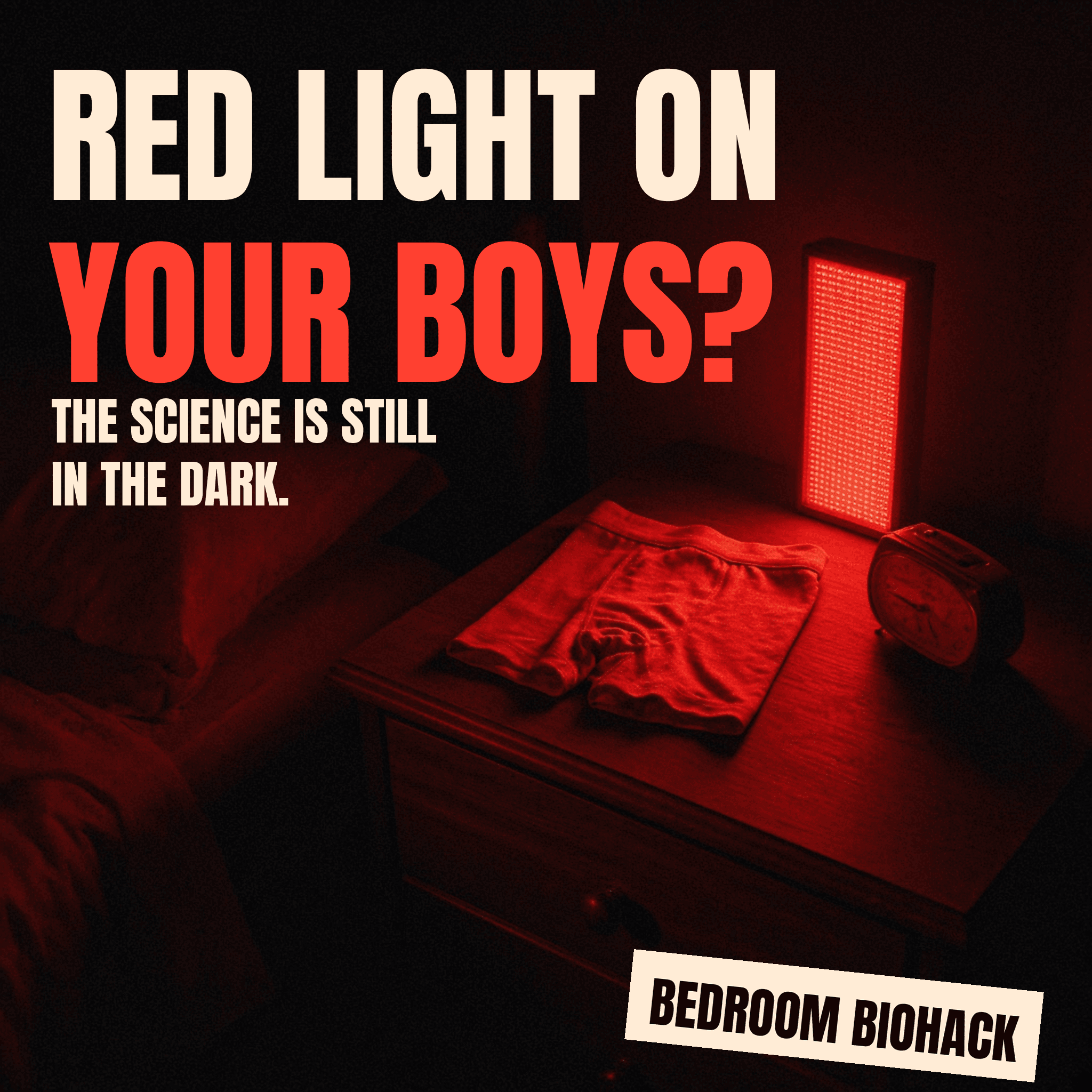
Picture a guy at his standing desk with his pants around his ankles, answering emails while a red light panel nearly five feet tall glows at his crotch. That scene comes straight from a 2017 Men's Health first-person piece with a headline that promised a lot: "I Put a Giant Red Light on My Balls to Triple My Testosterone Levels." Years later, the idea is still making the rounds, and a 2025 urology review listed that article among the media claims it set out to check.
The appeal makes sense. Sessions take a few minutes, panels are sold for home use, and the promise is more testosterone with no needles and no prescription. If you've been dealing with low energy or a flagging sex drive, a gadget that claims to fix it from your living room is tempting. For all the talk of tripling testosterone, though, the Men's Health piece describes how the writer felt. It doesn't report a single lab result.
So we went looking for the science behind it, and it's thinner than the hype. The testosterone claims come almost entirely from rat and ram studies, and those results are mixed, with some light settings damaging the testicles. The few human trials that aimed light at the testicular area were testing pain relief, and their published results don't include testosterone. Here's what each study found, and what it means if you're on testosterone replacement therapy (TRT) or thinking about it.
What red light therapy is supposed to do
Red light therapy goes by a few names: photobiomodulation, low-level light therapy, or low-level laser therapy (LLLT). It uses red or near-infrared light at low power, usually from LED panels or small lasers. The pitch is that the light energizes the mitochondria in your cells.
That idea has some lab support. The open question for this trend is whether it does anything useful when the target is your testicles, and whether it's safe.
What happens when researchers test it in men
A 2025 scoping review in the Canadian Urological Association Journal looked at popular men's health trends, light therapy among them. Across the light therapy studies it found, most showed non-significant or marginal changes in testosterone. Some studies showed improvements in sexual satisfaction or hair regrowth, but those weren't testicular red light panels. The authors concluded there's a gap between what the media claims and what the research shows.
The closest human trials we found come from one research group in Iran. In two small randomized, placebo-controlled trials, each with 60 men split among red light, infrared and placebo groups, red (650 nm) and infrared (820 nm) lasers aimed at the testicular area eased chronic testicular pain, including pain after varicocele surgery, and men reported better sexual satisfaction. Neither trial reported testosterone results, so they can't tell us whether the light does anything for your levels.
The animal studies behind the hype
This is where the testosterone claims come from, and the results don't line up neatly.
In a 2013 rat study, a 670 nm red laser on the testes raised testosterone on one day of measurement (day 4), though overall levels weren't significantly higher than in untreated rats. An 808 nm near-infrared laser at the same dose didn't raise testosterone at all, and it damaged the testicular tissue, shrinking the tubes where sperm are made.
Rams didn't fare much better. In a 2016 study of rams whose testicles had already been damaged by heat, an 808 nm laser seemed to limit some of the tissue damage, but it didn't improve testosterone, and it lowered sperm motility and sperm membrane integrity. When researchers pulled the animal research together in a 2021 systematic review, they found only five eligible studies. Most pointed to some benefit for sperm-producing cells, but light settings varied widely, and the authors said more research is needed before applying this to people. A 2025 review from Chinese urologists described some promising animal findings but also said rigorous preclinical and clinical studies are still needed.
So the animal data cut both ways. Some settings seemed harmless and some caused damage, and the wavelength made a difference. Consumer panels vary in wavelength, power, and distance, and none of that has been tested on human testicles.
Don't forget about heat
It's the part people tend to overlook. Sperm production runs best a little below core body temperature, which is why the testicles sit outside the body. Anything that warms the scrotum for long stretches is worth thinking about if fertility matters to you. We covered heat and sperm in detail in our look at saunas and male fertility, so we won't repeat it here.
If you're already on TRT
Here's a wrinkle most red light fans skip. Testosterone from TRT signals your brain to cut back on luteinizing hormone (LH), the hormone that tells your testicles to make their own testosterone. The FDA label for injectable testosterone notes that outside testosterone suppresses your body's own production through this feedback loop, and that at higher doses it can also suppress sperm production.
That means a device aimed at boosting your testicles' own output is working against the same signal your treatment turns down. If you're on TRT and care about fertility or testicular size, that's a conversation to have with your clinician. Some clinicians add hCG alongside TRT for this reason, which is an off-label use, and whether it fits you is a clinical decision. Our guide to fertility and testosterone covers the basics.
So, should you try it?
We found no studies testing consumer red light panels on human testicles for safety, so there's no honest way to call it safe or unsafe. The animal studies give two reasons for caution: the 808 nm rat group showed tissue damage, and the rams had worse sperm motility after treatment. If you're trying to conceive, that's worth weighing.
If you're curious anyway, a licensed clinician can check your testosterone and other labs first so you know where you're actually starting.
Frequently asked questions
What about sunlight on the testicles?
It's a popular idea online, but we found no clinical trials testing it. The 2025 urology review noted that testosterone may shift with the seasons, but that isn't the same as showing that direct sun exposure raises it.
Is near-infrared better than red light for this?
No study shows either one raises testosterone in men. In the one rat study that compared them directly, the near-infrared laser was the one that damaged testicular tissue.
Can red light therapy replace TRT?
No. Low testosterone is diagnosed with blood tests and symptoms, and treatment decisions belong with a licensed clinician. AlphaMD's TRT assessment is one place to start that conversation.
The bottom line
Red light on the testicles is a trend built on animal studies and a magazine headline. Human trials in this area tested pain, not testosterone, and the animal results include some real warning signs. If your goal is higher testosterone or better fertility, getting your labs checked and talking with a licensed clinician will tell you far more than a light panel.
Sources
- Qaoud et al., Canadian Urological Association Journal (2025): a systematic appraisal of alternative therapies in men's health
- Ahn et al., Biomedical Research (2013): low-level laser therapy on the testis and serum testosterone in rats
- Alves et al., Lasers in Medical Science (2016): low-level laser therapy and testicular degeneration in rams
- Façanha et al., Lasers in Medical Science (2021): systematic review of low-level laser therapy on seminiferous epithelium
- Momenzadeh et al., Journal of Lasers in Medical Sciences (2024): red and infrared laser for chronic testicular pain
- Momenzadeh et al., Journal of Lasers in Medical Sciences (2024): low-level laser therapy for pain after varicocelectomy
- Niu et al., Journal of Peking University Health Sciences (2025, in Chinese): low-level laser therapy for male infertility and erectile dysfunction
- DEPO-Testosterone (testosterone cypionate) prescribing information, DailyMed
- Greenfield, Men's Health (2017): I Put a Giant Red Light on My Balls to Triple My Testosterone Levels
This article is educational and is not medical advice. Decisions about testosterone, fertility, and any device use should be made with an appropriately licensed clinician.