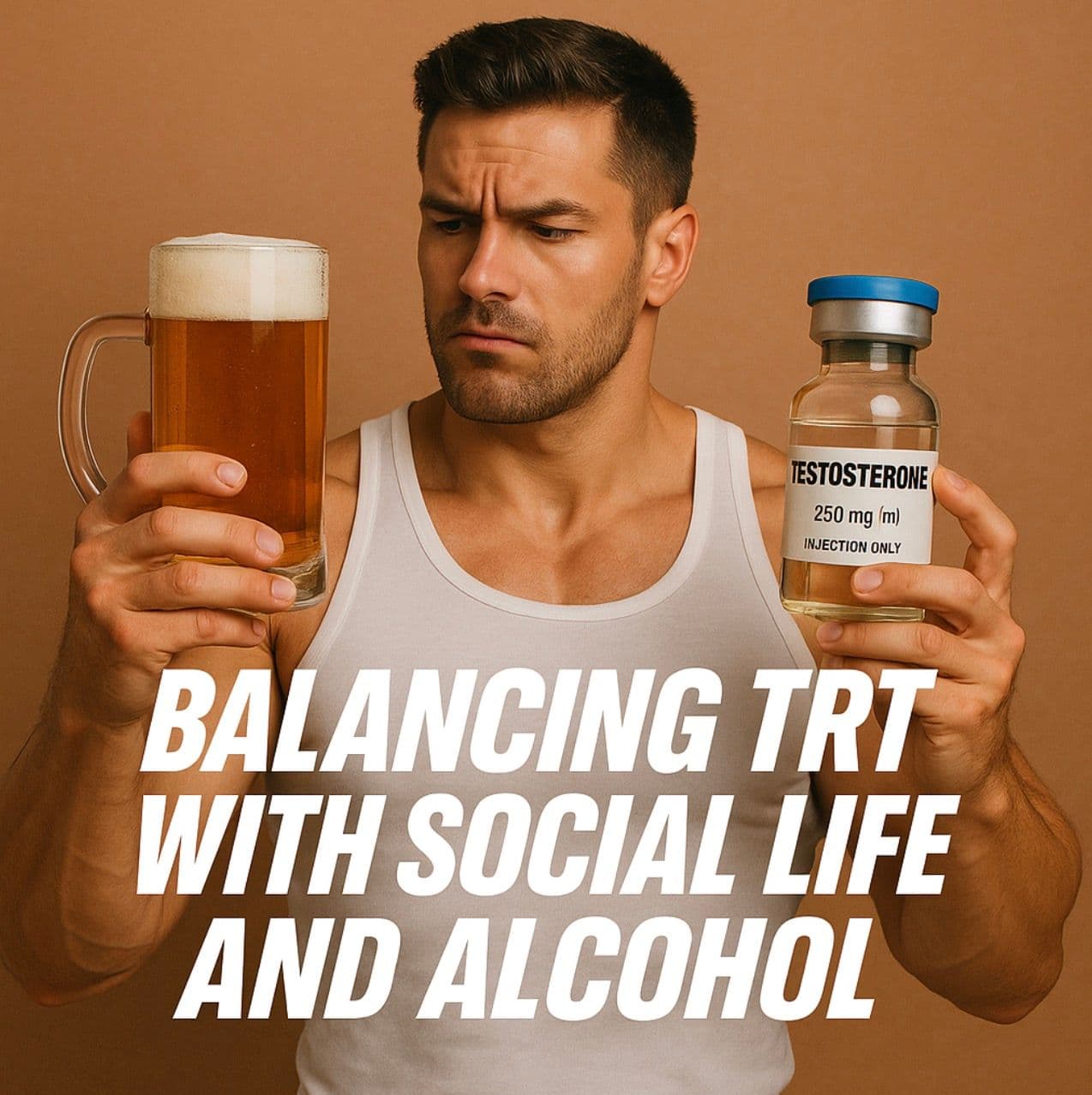
You can drink on TRT, but keep it to two standard drinks or fewer in a day, because testosterone and alcohol both push blood pressure up. Being on testosterone does not make alcohol off-limits, and it doesn't make you immune to alcohol's effects either. The American Heart Association recommends that men who drink have no more than two drinks a day (AHA, 2024), and the current federal Dietary Guidelines put it more simply: "Consume less alcohol for better overall health" (Dietary Guidelines 2025-2030).
Where the two-drink limit comes from
The two-drink figure comes from general public health guidance for men. The 2020-2025 Dietary Guidelines defined drinking in moderation as "2 drinks or less in a day for men," and added that "drinking less is better for health than drinking more" (Dietary Guidelines 2020-2025). The 2025-2030 edition dropped the number and now says to consume less. The AHA still uses two a day for men.
It is a daily ceiling, not a weekly average. Saving up seven days of drinks for Saturday night counts as heavy drinking. The National Institute on Alcohol Abuse and Alcoholism (NIAAA) defines heavy drinking for men as five or more drinks on any day or 15 or more in a week, and binge drinking as five or more drinks in about two hours (NIAAA).
A standard drink holds about 14 grams of alcohol. That is a 12-ounce beer at 5% alcohol, a 5-ounce glass of wine at 12%, or a 1.5-ounce shot of 40% spirits (NIAAA). A strong craft beer or a heavy pour of wine can be closer to two.
Does alcohol lower testosterone?
In men who make their own testosterone, the answer depends on how much and how often. A summary of the research is in does alcohol lower testosterone; the main studies are these:
- In a placebo-controlled crossover trial of 13 men, a single low dose of 0.5 g of alcohol per kilogram of body weight briefly raised blood testosterone, from 13.5 to 16.0 nmol/L (Sarkola and Eriksson, 2003).
- Men brought to an emergency department visibly drunk had lower testosterone and lower luteinizing hormone (the pituitary signal that tells the testes to make testosterone) than sober controls (Frias et al., 2002).
- In a randomized crossover study of 10 middle-aged men, 40 g of alcohol a day (about three standard drinks) with dinner for three weeks lowered testosterone by 6.8% compared with alcohol-free beer (Sierksma et al., 2004).
- A 2024 meta-analysis of controlled studies found lower total and free testosterone with chronic drinking in healthy men, but not after a single bout of drinking (Santi et al., Andrology 2024). A separate 2024 meta-analysis of 17 observational studies found no overall difference in testosterone between drinkers and non-drinkers (Moosazadeh et al., 2024).
The evidence is mixed and the trials are small. None of these studies included men on TRT, so how much drinking changes testosterone levels during treatment is not known. For a man on TRT, the better-documented concerns are blood pressure, sleep, and mood.
Why blood pressure is the main concern
Testosterone raises blood pressure. After blood pressure monitoring studies, the FDA said in 2025 that results "confirmed an increase in blood pressure with use of all testosterone products, class-wide," and required a blood pressure warning on every testosterone product (FDA, 2025). The testosterone cypionate label says testosterone "can increase blood pressure which can increase cardiovascular (CV) risk over time" (DEPO-Testosterone label).
Alcohol raises it too, with no clear safe floor. A 2023 meta-analysis of seven cohort studies (19,548 adults followed for a median of 5.3 years) found systolic pressure was 1.25 mm Hg higher at 12 g of alcohol a day and 4.90 mm Hg higher at 48 g a day than in non-drinkers, with no threshold below which the link disappeared (Di Federico et al., Hypertension 2023). These were observational studies, so they show an association rather than proof of cause.
No study has tested alcohol and testosterone together for blood pressure. Both effects point the same way, though, and the AHA's 2025 scientific statement says that even 1 to 2 drinks a day "may worsen high blood pressure for people who already have high blood pressure" (AHA, 2025). If your blood pressure has crept up on treatment, alcohol is one of the first things to look at, along with the steps in how to lower blood pressure while on testosterone.
Heart rhythm is the other overlap. In TRAVERSE (NEJM 2023, 5,246 men aged 45 to 80 with or at high risk of heart disease), testosterone gel was noninferior to placebo for heart attack, stroke, and cardiovascular death (7.0% vs 7.3%), but atrial fibrillation, acute kidney injury, and pulmonary embolism were more common with testosterone (TRAVERSE, 2023). Noninferior means testosterone did not raise major cardiac events; it does not mean it protected against them. The AHA links heavy and binge drinking with arrhythmias (irregular heartbeat), and says people with atrial fibrillation may need to cut back or stop drinking (AHA, 2025).
What alcohol does to sleep
Alcohol's clearest effect on sleep is on REM (rapid eye movement) sleep. A 2025 meta-analysis of 27 studies in healthy adults found that REM sleep was delayed and shortened after as little as about two standard drinks, and the disruption grew with larger doses. Falling asleep faster showed up only at about five drinks (Gardiner et al., Sleep Med Rev 2025).
If you feel worse the morning after drinking than you did before TRT, why testosterone changes your hangovers covers that question.
Mood, and when drinking is a red flag
Testosterone itself can affect mood. The cypionate label lists anxiety and depression among its nervous system side effects, along with increased or decreased libido (DEPO-Testosterone label). Alcohol can blur that picture, because it is hard to tell whether a low week comes from the treatment or the weekend.
Tell the clinician managing your TRT if any of these apply:
- You regularly pass the heavy-drinking line: five or more drinks in a day, or 15 or more in a week (NIAAA).
- You find it hard to stop once you start, or you drink more than you planned.
- You drink to manage anxiety, stress, or low mood.
- You are drinking more than you did before you started treatment.
- Your blood pressure readings have gone up.
NIAAA notes that "harms may be associated with any amount of drinking," with more harm as the amount rises (NIAAA). Be specific about how much you drink. Your clinician can only weigh it if they know.
Who should not drink at all
The Dietary Guidelines say these groups should avoid alcohol completely: people recovering from alcohol use disorder or unable to control how much they drink, and people taking medications or with medical conditions that interact with alcohol (Dietary Guidelines 2025-2030). For people with high blood pressure or atrial fibrillation, the AHA says reducing or eliminating alcohol may be important to manage the condition (AHA, 2025).
Planning around a big weekend
A wedding or a bachelor party is where the daily limit usually breaks. A few things keep the numbers honest:
- Count standard drinks, not glasses. A double pour or a 12-ounce beer at 9% is about two.
- Spacing helps you stay under the binge line of five or more drinks in about two hours.
- Alcohol-free drinks between rounds slow the count without leaving you empty-handed.
- You don't owe anyone a medical explanation. "I'm driving" or "early morning tomorrow" ends most conversations.
Common questions
Should I avoid drinking on injection day?
No study has tested drinking on injection day versus other days, so there is no evidence-based rule. Keep your injection schedule the same whether or not you plan to drink, and ask your prescriber if you have a specific concern.
Will one heavy weekend undo my progress on TRT?
No study has measured that in men on TRT. What the evidence does show is that heavy and binge drinking are tied to high blood pressure and irregular heart rhythms (AHA, 2025), which is a reason to keep heavy weekends rare.
Is beer worse than liquor?
The alcohol content is what counts. A 12-ounce beer at 5%, 5 ounces of wine at 12%, and a 1.5-ounce shot of 40% spirits each hold about the same 14 grams (NIAAA).
Do I need to tell my provider how much I drink?
Yes. Alcohol affects blood pressure and sleep, both of which your clinician weighs when reviewing how treatment is going. A rough weekly count is more useful than "socially."
Bottom line
You can drink on TRT. If you do, two standard drinks or fewer in a day is the limit the AHA recommends for men, and the current Dietary Guidelines say less is better. Blood pressure is the main reason to stay there, since testosterone and alcohol both raise it. Whether alcohol changes testosterone levels in men on treatment has not been studied. If you have questions about starting treatment, see testosterone replacement therapy at AlphaMD.