
The Before-and-After Photo Problem: What TRT Transformations Leave Out
People are asking...
Do you have any theories as to why some people experience a honeymoon phase for a few weeks then lose the benefits of TRT?...
The most common reason for this in men tends to be a need for a simple dose adjustment. There's a general 8 week uptake period where injected levels increase week over week & then natural production ... See Full Answer
What are the most common side effects and symptoms you see in patients, that may eventually lead them to stop?...
The primary reasons men stop TRT, which providers on the platform rarely see (less than 5%), are desire to maximize chances of fertility, weight gain (TRT increases hunger because of anabolism), and w... See Full Answer
How prevalent is “moon face” in the guys you treat? And what can be done about it?...
Nearly zero men on standard therapeutic doses of TRT report this as an issue. This is more prevalent at higher doses, say something a bodybuilder might use from an UGL combined with steroids, than at ... See Full Answer
Have a question? Ask us.
At AlphaMD, we're here to help. Feel free to ask us any question you would like about TRT, medical weightloss, ED, or other topics related to men's health. Or take a moment to browse through our past questions.
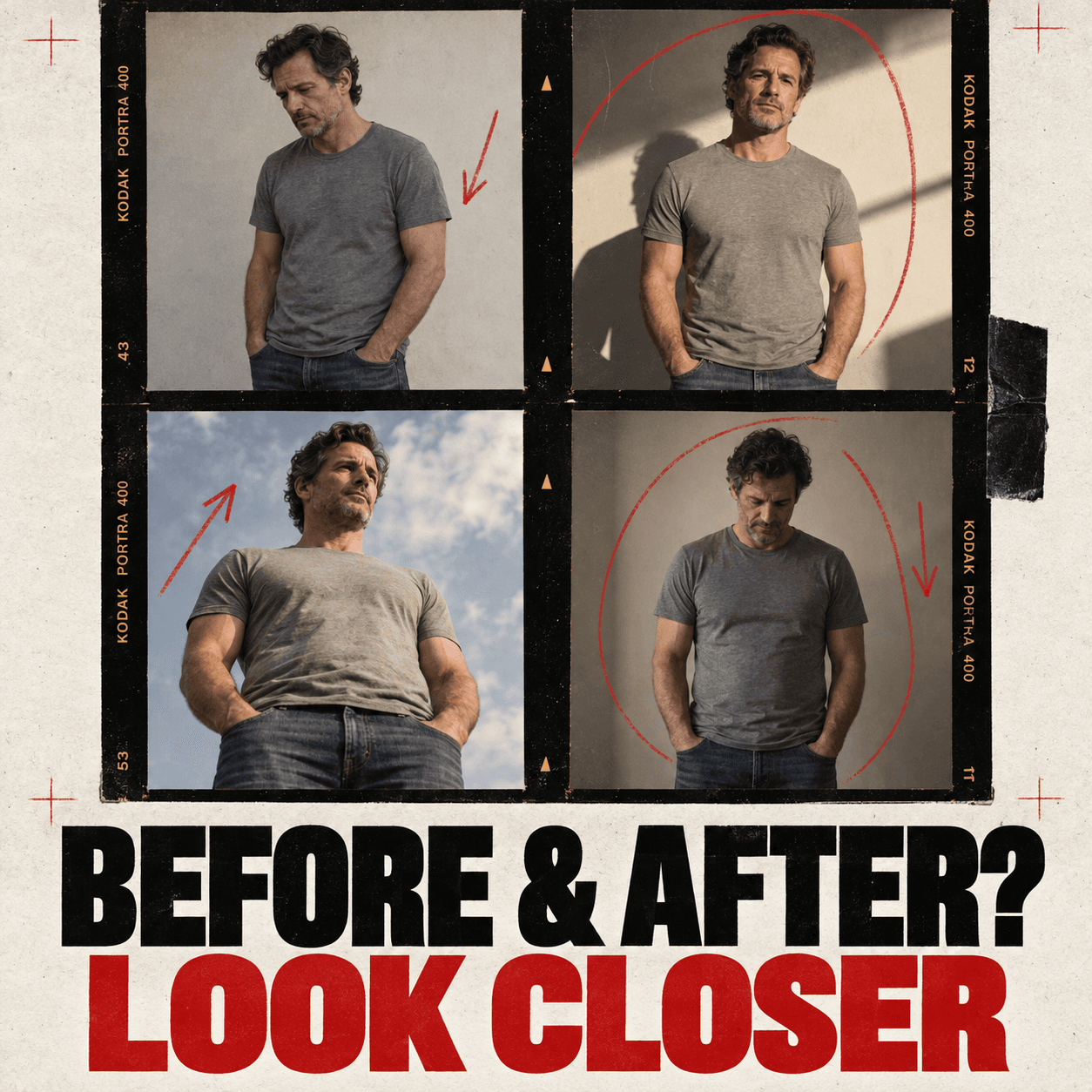
A before-and-after photo can show that someone's appearance changed. It cannot prove that TRT caused the change, reveal every intervention used, or predict another man's result.
That distinction matters because transformation photos compress months of treatment, training, dieting, sleep, posing, lighting, and image selection into two frames. The viewer sees a simple story: testosterone went in, a new body came out. Biology is rarely that clean.
Why transformation photos feel like strong evidence
Images are immediate. A laboratory trend requires explanation, while a smaller waist and broader shoulders appear self-evident. The side-by-side format also creates a built-in claim of causation. Whatever happened between the first and second photo seems responsible for the difference.
The photograph does not show the counterfactual. We cannot see what would have happened with the same training, nutrition, sleep, and weight loss without treatment. We also cannot see the dozens of unused photos that made the chosen pair look less dramatic.
Before-and-after images can be useful documentation. They are weak evidence for attributing a result to one treatment.
What the photo usually leaves out
Lighting and camera position
Overhead or side lighting makes muscle separation and abdominal contours more visible. Flat front lighting softens them. A camera placed lower can make the torso appear larger. Distance and lens choice can change proportions, especially near the edges of the frame.
Posing and posture
Shoulders pulled back, the rib cage lifted, the pelvis repositioned, and the abdomen braced can change the silhouette within seconds. A relaxed "before" beside a flexed "after" is not a controlled comparison.
A workout pump
Training shortly before the second photo increases blood flow and temporarily enlarges the trained muscles. The effect is real, but it is not the same as permanent tissue growth.
Food, fluid, sodium, and carbohydrate intake
Short-term changes in gastrointestinal contents, water balance, and muscle glycogen can change scale weight and appearance. A depleted, unpumped body and a full, pumped body can look surprisingly different without a major change in body fat.
Selection and editing
One person can take a large set of photos and publish the most flattering "after." Cropping, contrast, sharpening, skin smoothing, and filters can increase the gap further. Generative tools can now alter the body itself.
Everything else that changed
The caption may credit TRT while leaving out a calorie deficit, higher protein intake, structured resistance training, reduced alcohol, improved sleep, a new coach, other therapies, or months of consistent behavior. Those variables are part of the result.
What clinical trials actually show about body composition
Testosterone therapy can improve body composition in appropriately selected men with confirmed hypogonadism. The average changes reported in controlled studies are more restrained than the most dramatic social-media transformations.
In a six-month randomized placebo-controlled trial of men aged 50 to 80 with low to low-normal testosterone and symptoms, testosterone gel increased lean body mass by an average of 1.28 kg and reduced fat mass by 1.16 kg. Those are group averages from a specific population and formulation. They do not guarantee an individual's visual result.
A 2026 systematic review of randomized trials in men with obesity, metabolic disease, and functional secondary hypogonadism found that the most consistent signal was increased lean mass and reduced fat mass. Effects on insulin resistance varied across studies.
The evidence supports possible changes in body composition. It does not support the idea that TRT automatically produces a lean, muscular physique without training, nutrition, recovery, time, and an appropriate diagnosis.
A dramatic transformation may still be real
A staged image and a genuine physical change can exist at the same time. Better lighting does not prove the person made no progress. It means the size of the visual difference cannot be read as a clinical effect.
The same applies when the person is truthful about treatment. He may have worked hard, lost substantial fat, gained muscle, and improved his health. The photo still cannot isolate how much change came from TRT, training, diet, previous detraining, or ordinary individual response.
Good media literacy does not require cynicism. It requires separating documentation from proof.
Seven questions to ask before believing a TRT transformation
- Was testosterone deficiency confirmed before treatment?
- Is the timeline stated clearly?
- Are the pose, lighting, distance, lens, clothing, and level of flexion comparable?
- Were diet, training, sleep, alcohol intake, and starting fitness disclosed?
- Were other medications, therapies, or supplements used?
- Are objective measurements provided, such as waist circumference, body weight trend, or a consistent body-composition method?
- Is the image educational, a personal post, or an advertisement with a financial incentive?
If most answers are missing, the photo is a story prompt, not a result you can generalize.
When the photo is also an advertisement
Commercial context changes how a transformation should be read. A testimonial can imply that the depicted result is typical, even when the caption never says so directly.
The Federal Trade Commission's guidance on endorsements says advertisers need adequate support that an endorser's result reflects what consumers generally achieve or must clearly communicate the generally expected result. A vague "results may vary" disclaimer is not automatically enough.
Readers should look for financial relationships, affiliate links, free treatment, paid coaching, sponsorship, and selective disclosure. The absence of an obvious #ad label does not prove there was no material connection.
How to take progress photos that are worth comparing
Personal progress photos become more useful when the method stays consistent. Treat them like a simple measurement protocol:
- Use the same room and lighting.
- Place the camera at the same height and distance.
- Use the same lens or phone setting.
- Photograph the same front, side, and back positions.
- Choose either relaxed or flexed poses and keep that choice consistent.
- Take photos at a similar time of day under similar conditions.
- Avoid taking the comparison photo immediately after training.
- Use similar clothing and framing.
- Keep the unedited originals.
Standardization will make the change look less cinematic. That is the point.
Track outcomes that a photograph cannot show
Appearance is only one part of treatment response. A better review combines photos with measures that are harder to manipulate:
- Waist circumference measured at the same location
- Body-weight trend rather than a single weigh-in
- Strength and performance in selected movements
- Training consistency
- Sleep duration and quality
- Sexual function, mood, energy, and daily function
- Clinician-selected laboratory and safety markers
AlphaMD's guide to TRT before-and-after changes explains which outcomes may change and the broad timelines involved. The article on five metrics to track besides scale weight provides a wider measurement framework.
The body-image cost of constant transformations
Repeated exposure to optimized physiques can change the standard men use to judge themselves. A 2025 study of 1,553 boys and men found that more frequent viewing of muscular bodies, muscle-building supplements, and muscle-building drug content on social media was associated with probable muscle dysmorphia. The study was cross-sectional, so it cannot prove which came first.
A 2025 systematic review also found preliminary evidence connecting fitness-focused social-media content with muscle-dysmorphia symptoms. Much of the research is observational and involves younger populations, which limits how confidently it can be applied to men in their 40s and 50s.
The practical warning still stands. If every legitimate improvement feels inadequate beside a curated feed, the feed may be distorting the goal.
When progress photos start driving bad decisions
Step back when images are pushing you to:
- Increase a prescribed dose without clinical guidance
- Crash diet or dehydrate yourself for a sharper look
- Train through persistent pain or injury
- Add several unverified products at once
- Check or photograph your body compulsively
- Avoid social situations because you feel insufficiently lean or muscular
- Dismiss better health, function, or laboratory results because the mirror has not changed enough
AlphaMD's article on male body image and muscle dysmorphia explains when an appearance goal may be turning into something more disruptive.
Common questions about TRT before-and-after photos
Are TRT transformation photos fake?
Some may be edited or misleading, while others document real changes. A photo alone cannot establish authenticity, disclose every intervention, or show what result is typical.
Can TRT visibly change body composition?
Yes, conditionally. Controlled trials show average increases in lean mass and reductions in fat mass in some men with confirmed hypogonadism. Response varies, and lifestyle remains important.
How often should I take progress photos?
There is no medically required schedule. Monthly photos may be enough for many people because daily or weekly comparison magnifies normal fluctuations and encourages overanalysis.
Is a body-composition scan better than photos?
A consistent measurement method can provide useful information, but every method has error. Trends measured under similar conditions are more informative than switching between devices or treating one reading as exact.
Should I change my TRT protocol if I do not look different?
Do not change prescribed treatment based on appearance alone. The clinician overseeing care should review the diagnosis, symptoms, adherence, laboratory timing, safety markers, and realistic treatment goals.
Bottom line
TRT transformation photos can document change and motivate consistent work. They cannot establish causation, show a typical result, or replace clinical measurements.
Look for standardized conditions, a complete timeline, disclosure of other interventions, and objective tracking. A useful treatment result is measured across symptoms, function, safety, and health. The best photograph in the camera roll is only one data point.
Have a question? Ask us.
At AlphaMD, we're here to help. Feel free to ask us any question you would like about TRT, medical weightloss, ED, or other topics related to men's health. Or take a moment to browse through our past questions.
People are asking...
Do you have any theories as to why some people experience a honeymoon phase for a few weeks then lose the benefits of TRT?...
The most common reason for this in men tends to be a need for a simple dose adjustment. There's a general 8 week uptake period where injected levels increase week over week & then natural production ... See Full Answer
What are the most common side effects and symptoms you see in patients, that may eventually lead them to stop?...
The primary reasons men stop TRT, which providers on the platform rarely see (less than 5%), are desire to maximize chances of fertility, weight gain (TRT increases hunger because of anabolism), and w... See Full Answer
How prevalent is “moon face” in the guys you treat? And what can be done about it?...
Nearly zero men on standard therapeutic doses of TRT report this as an issue. This is more prevalent at higher doses, say something a bodybuilder might use from an UGL combined with steroids, than at ... See Full Answer
Get $30 off your first month’s order
Enter your email address now to receive $30 off your first month’s cost, other discounts, and additional information about TRT.
Legal Disclaimer
This website is a repository of publicly available information and is not intended to form a physician-patient relationship with any individual. The content of this website is for informational purposes only. The information presented on this website is not intended to take the place of your personal physician's advice and is not intended to diagnose, treat, cure, or prevent any disease. Discuss this information with your own physician or healthcare provider to determine what is right for you. All information is intended for your general knowledge only and is not a substitute for medical advice or treatment for specific medical conditions. The information contained herein is presented in summary form only and intended to provide broad consumer understanding and knowledge. The information should not be considered complete and should not be used in place of a visit, phone or telemedicine call, consultation or advice of your physician or other healthcare provider. Only a qualified physician in your state can determine if you qualify for and should undertake treatment.