
Your Fitness Tracker Now Sells a 77-Biomarker Lab Panel. Should It Interpret Your Testosterone?
Published on:
Updated on:
People are asking...
Do you guys only require a at home test? What about other stuff like lipids ? I have a blood panel from last week. Could you take that for step 1?...
Yes, providers on the platform work with at-home tests, & AlphaMD sends the kits out when needed. Extra markers like lipids are not as important when starting TRT as they would be if you encountered a... See Full Answer
Have been zeroing on some health issues and I recently got a Testosterone test of 301 ng/dl. As a very healthy male ( train 6x a week, track every cal...
Based on your symptoms, a licensed provider would likely consider you a candidate for TRT. A provider would want to talk with you to dive a bit deeper into them, but at a glance, yes.Men who are very ... See Full Answer
Estradiol 20.4 T 175.8 FSH 3.9 LH 1.0 Prolactin 5.8 Thsr 1.59 Xt wbc 5.3 35m 170lb 16 % bf decent sleep , clean eating no alcohol Fatigue sex drive ha...
Your LH is low and your FSH is on the lower end as well. This suggests you may have secondary hypogonadism. You would expect a rather drastic improvement in quality of life with the addition of TRT. W... See Full Answer
Have a question? Ask us.
At AlphaMD, we're here to help. Feel free to ask us any question you would like about TRT, medical weightloss, ED, or other topics related to men's health. Or take a moment to browse through our past questions.
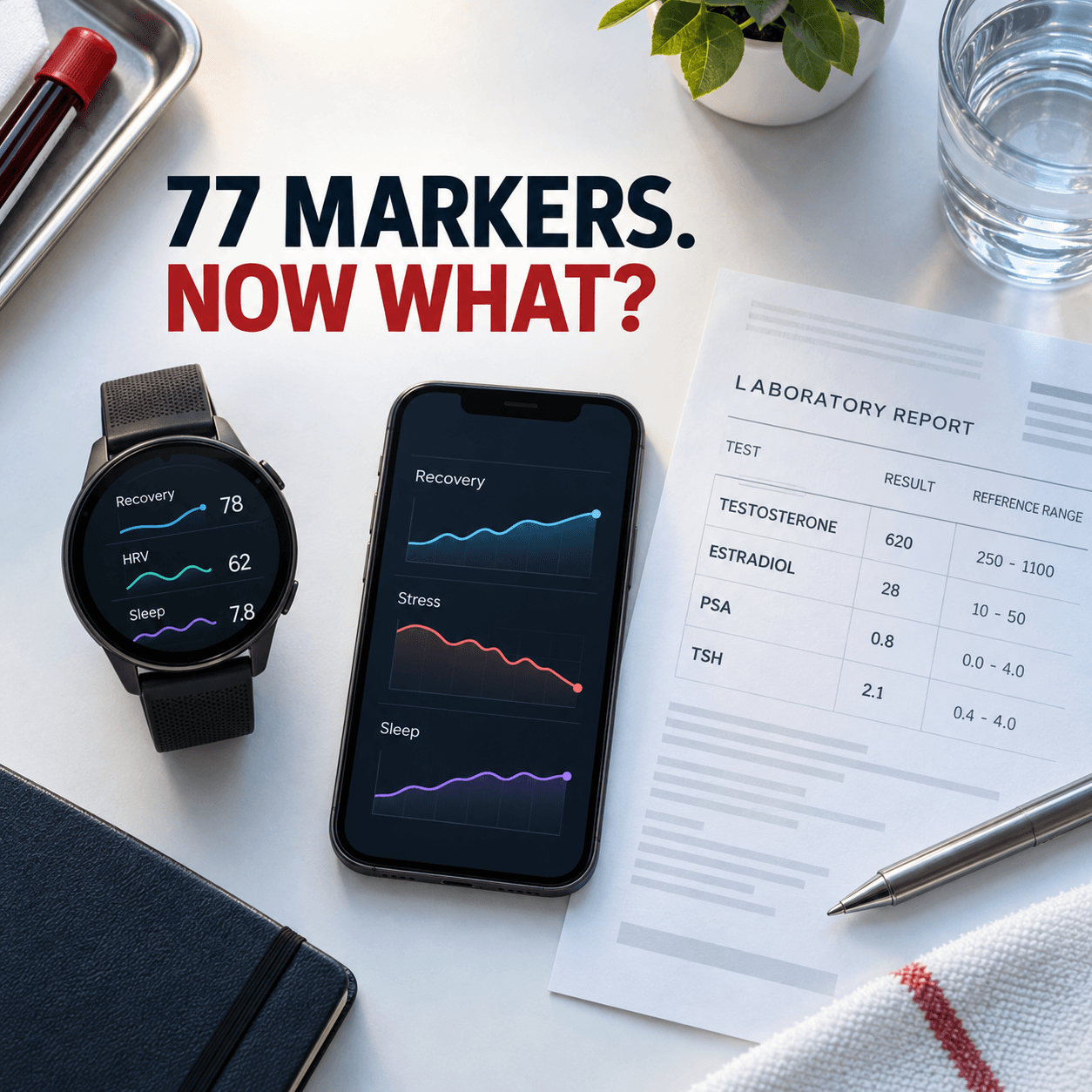
A fitness tracker can organize blood results beside sleep, strain, heart rate, and recovery data. It cannot diagnose testosterone deficiency from an app score. Hormone interpretation still depends on symptoms, collection conditions, repeat testing, medical history, and clinical judgment.
The line between wearable wellness and medical evaluation is getting thinner. WHOOP now markets a men's health panel with 77 biomarkers, including total and free testosterone, estradiol, prostate-specific antigen, thyroid markers, lipids, glucose measures, and blood counts. That creates useful possibilities and several ways to overread the data.
What Can a Wearable-Linked Lab Panel Add?
The main advantage is organization. A person can view laboratory results near patterns in sleep duration, resting heart rate, heart-rate variability, training load, and recovery.
That context may help generate better questions. A man with fatigue and low testosterone may also notice restricted sleep, high training strain, or sustained weight gain. Someone using testosterone replacement therapy may find it easier to track whether symptoms, laboratory values, and recovery patterns move together over time.
The dashboard can also reduce the problem of scattered results across laboratories and portals. Convenience is real. Diagnostic authority is separate.
Why Is Testosterone Harder to Interpret Than a Recovery Score?
Testosterone varies with time of day, sleep, illness, energy intake, medications, obesity, and the testing method. One result can be misleading when it was collected late, during acute illness, after major sleep disruption, or under conditions that differ from earlier tests.
Diagnosis typically requires relevant symptoms plus consistently low testosterone measured under appropriate conditions. Free testosterone may add context when sex hormone-binding globulin is altered, but the calculation or assay also matters.
An app can flag a value against a reference interval. It cannot reliably decide whether the result represents primary hypogonadism, secondary hypogonadism, temporary suppression, an assay problem, or normal variation for that person.
Does More Biomarker Data Mean Better Care?
Only when the data answer a defined question. Large panels increase the chance of finding a value outside its reference interval in a healthy person. Some flagged results are important. Others reflect expected statistical variation, temporary physiology, or a range that does not fit the individual's context.
Testing without a plan can create cascades of repeat tests, supplements, anxiety, and self-directed protocol changes. A useful panel should begin with a reason for testing and end with a clear interpretation pathway.
Which Markers Need Special Caution?
Testosterone and free testosterone
Collection timing, confirmation, symptoms, SHBG, and the measurement method affect interpretation. A single low result is not a complete diagnosis.
Estradiol
Standard immunoassays may perform poorly at the lower concentrations common in men. Symptoms, assay type, and the wider hormone picture matter.
PSA
PSA is prostate-specific, not cancer-specific. Age, prostate size, infection, ejaculation, instrumentation, and trends can affect the result. A flagged PSA deserves clinical review, not an automated cancer conclusion.
Hematocrit and hemoglobin
Hydration and altitude can affect these values. Persistent elevation during TRT requires appropriate review rather than an app-directed blood donation.
Thyroid markers
TSH, free thyroid hormones, symptoms, medications, and thyroid antibodies can tell different parts of the story. One marker rarely supports a complete thyroid diagnosis.
Can Wearable Data Explain a Hormone Result?
Wearable data can suggest context, but it cannot establish causation. A week of poor sleep and a low testosterone result may be related. The dashboard cannot prove that sleep caused the result or that improving a sleep score will correct it.
Heart-rate variability creates similar problems. HRV is influenced by training, alcohol, illness, sleep, measurement conditions, and individual baseline. A change after starting TRT does not automatically mean the medication improved or harmed cardiovascular function.
What Is the Best Way to Use These Panels?
Treat the dashboard as a structured record. Bring the original laboratory report, collection time, symptoms, medications, supplements, and relevant wearable trends to a licensed clinician.
Avoid changing prescribed medication because an automated explanation labels a value high, low, optimal, or suboptimal. Consumer-defined “optimal” ranges may not match validated diagnostic thresholds or the needs of a particular patient.
Frequently Asked Questions
Can a wearable diagnose low testosterone?
No. A wearable may display laboratory data, but diagnosis requires appropriate clinical evaluation and confirmation.
Are 77 biomarkers better than a smaller panel?
Not automatically. The better panel is the one that answers a clinical question without adding low-value testing.
Can wearable trends help during TRT?
They may help track sleep, activity, resting heart rate, and subjective patterns. They should complement symptoms, validated laboratory testing, and clinician follow-up.
Should I use an app's optimal testosterone range?
Use the laboratory method, validated clinical guidance, symptoms, and clinician interpretation. A proprietary score should not determine treatment.
Key Takeaway
Wearable-linked laboratory panels can make health data easier to follow. They do not turn a fitness platform into a diagnostic system. Testosterone, PSA, estradiol, hematocrit, and thyroid results still require method-aware interpretation by a licensed clinician.
This article is educational and is not medical advice. Testing and treatment decisions should be made with an appropriately licensed clinician.
Have a question? Ask us.
At AlphaMD, we're here to help. Feel free to ask us any question you would like about TRT, medical weightloss, ED, or other topics related to men's health. Or take a moment to browse through our past questions.
People are asking...
Do you guys only require a at home test? What about other stuff like lipids ? I have a blood panel from last week. Could you take that for step 1?...
Yes, providers on the platform work with at-home tests, & AlphaMD sends the kits out when needed. Extra markers like lipids are not as important when starting TRT as they would be if you encountered a... See Full Answer
Have been zeroing on some health issues and I recently got a Testosterone test of 301 ng/dl. As a very healthy male ( train 6x a week, track every cal...
Based on your symptoms, a licensed provider would likely consider you a candidate for TRT. A provider would want to talk with you to dive a bit deeper into them, but at a glance, yes.Men who are very ... See Full Answer
Estradiol 20.4 T 175.8 FSH 3.9 LH 1.0 Prolactin 5.8 Thsr 1.59 Xt wbc 5.3 35m 170lb 16 % bf decent sleep , clean eating no alcohol Fatigue sex drive ha...
Your LH is low and your FSH is on the lower end as well. This suggests you may have secondary hypogonadism. You would expect a rather drastic improvement in quality of life with the addition of TRT. W... See Full Answer
Get $30 off your first month’s order
Enter your email address now to receive $30 off your first month’s cost, other discounts, and additional information about TRT.
Legal Disclaimer
This website is a repository of publicly available information and is not intended to form a physician-patient relationship with any individual. The content of this website is for informational purposes only. The information presented on this website is not intended to take the place of your personal physician's advice and is not intended to diagnose, treat, cure, or prevent any disease. Discuss this information with your own physician or healthcare provider to determine what is right for you. All information is intended for your general knowledge only and is not a substitute for medical advice or treatment for specific medical conditions. The information contained herein is presented in summary form only and intended to provide broad consumer understanding and knowledge. The information should not be considered complete and should not be used in place of a visit, phone or telemedicine call, consultation or advice of your physician or other healthcare provider. Only a qualified physician in your state can determine if you qualify for and should undertake treatment.