
Can I Start TRT at 450? What the Guidelines Say About "Normal" Testosterone
People are asking...
180 being a bit high for a start would you recommend lower dosing? Without looking at my labs, are you saying it’s more common to start off around 150...
Without getting too specific, or try to guide your treatment, I will just say that the majority of men on TRT in the US average between 100-140mg/wk. The medical textbook standard is currently to star... See Full Answer
What levels do you consider low enough that the person will see a benefit from TRT?...
In general, it's a lot more about how someone feels than about the numbers themselves. The range for "acceptable" Testosterone in men can go from 250-1000. That's honestly crazy for any other hormone ... See Full Answer
At what levels of Total Testosterone and Free Testosterone in your opinion would someone benefit from starting TRT?...
The level at which they are feeling low Testosterone symptoms. I know that's kind of a non-answer, but it's also the best answer. The cornerstone of good TRT should be based on following symptoms & du... See Full Answer
Have a question? Ask us.
At AlphaMD, we're here to help. Feel free to ask us any question you would like about TRT, medical weightloss, ED, or other topics related to men's health. Or take a moment to browse through our past questions.
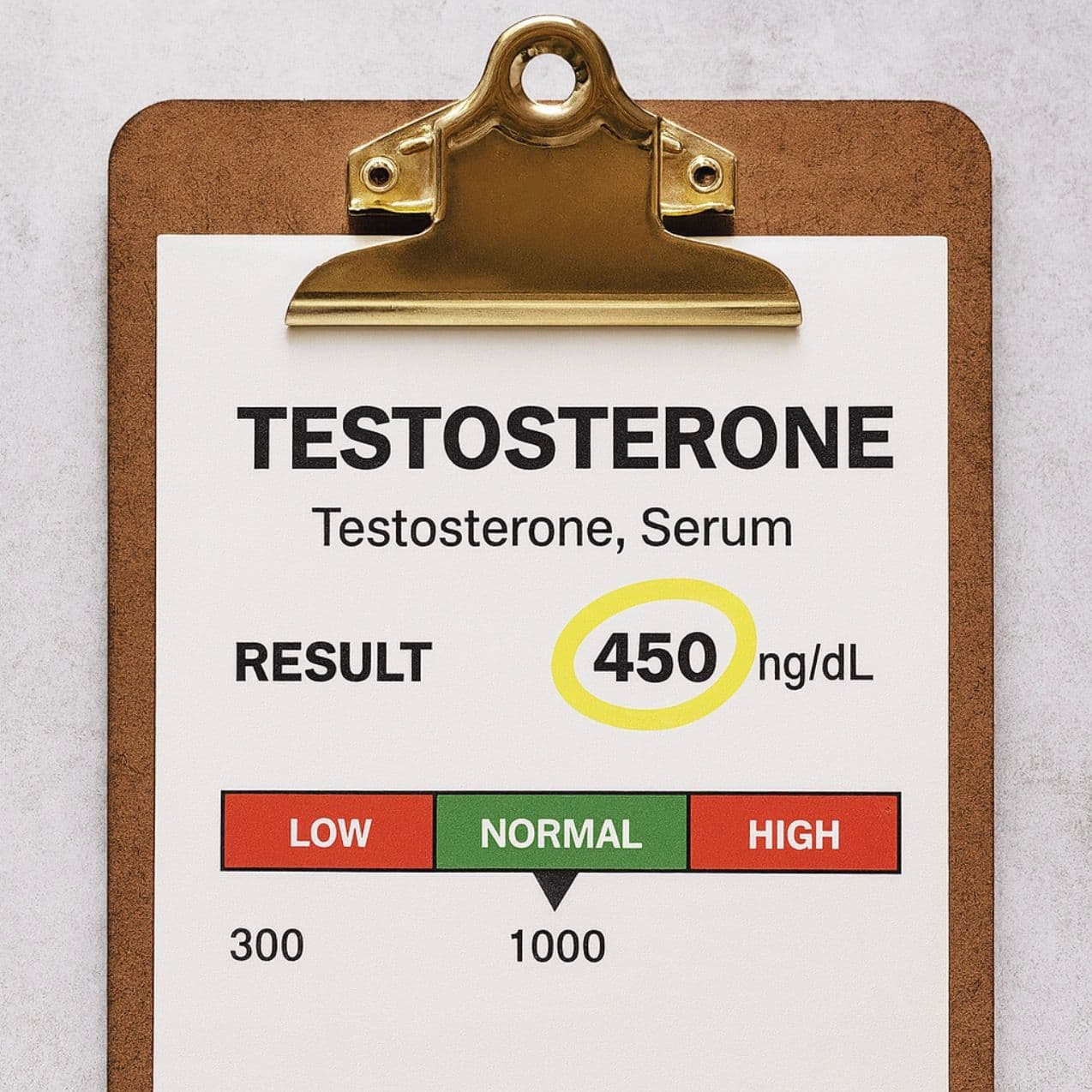
Usually not. A total testosterone of 450 ng/dL on repeat morning tests does not meet the definition of low testosterone in either major US guideline, so it is not a standard reason to start TRT. If you still have symptoms, the next step is finding their cause, and in some men that means checking free testosterone.
A common belief online is that the normal range is an insurance construct and "optimal" testosterone is higher. The guidelines take a different view, and the reasons are worth knowing before you decide anything.
What counts as low testosterone?
The American Urological Association (AUA) guideline sets three conditions for diagnosing testosterone deficiency (AUA):
- A total testosterone below 300 ng/dL is "a reasonable cut-off in support of the diagnosis" (Moderate Recommendation, Grade B).
- The diagnosis needs "two total testosterone measurements ... taken on separate occasions with both conducted in an early morning fashion" (Strong Recommendation, Grade A).
- It is made "only ... when patients have low total testosterone levels combined with symptoms and/or signs" (Moderate Recommendation, Grade B).
The Endocrine Society guideline agrees. It recommends diagnosing hypogonadism only in men with symptoms and "unequivocally and consistently low" testosterone, confirmed by a repeat fasting morning test (Bhasin et al., 2018).
At 450 ng/dL you have the symptoms but not the lab result. Both are required.
Is 450 low for a young man?
Not by the best available reference range. A 2017 study harmonized testosterone measurements from 9,054 men in four US and European cohorts. In healthy, nonobese men aged 19 to 39, the normal range was 264 to 916 ng/dL, and the median was 531 ng/dL (Travison et al., 2017).
A value of 450 sits below that median and well above the 5th percentile of 303 ng/dL. It is a common result for a healthy young man. Claims that young men should be at 600 to 900 do not match this data.
When does free testosterone change the answer?
Most testosterone in your blood is bound to proteins, including SHBG (sex hormone-binding globulin), and only a small share circulates free. The testosterone cypionate label puts it at about 98% bound and 2% free (DailyMed).
The Endocrine Society recommends measuring free testosterone in men whose total testosterone is near the lower limit of normal, or who have a condition that changes SHBG (Bhasin et al., 2018). It should be measured by equilibrium dialysis or estimated with an accurate formula.
So a total of 450 with very high SHBG can still deserve a closer look. That is a reason to measure free testosterone properly, and to ask what is raising SHBG (see what causes high SHBG). It does not make every symptomatic man at 450 a TRT candidate.
What does the evidence on TRT benefits cover?
The large trials enrolled men with clearly low levels. The Testosterone Trials (NEJM 2016) studied 790 men aged 65 and older with testosterone under 275 ng/dL. One year of testosterone gel brought a moderate benefit in sexual function and some benefit in mood, and no benefit in vitality (energy) or walking distance (Snyder et al., 2016). TRAVERSE (NEJM 2023) enrolled 5,246 men with two fasting levels under 300 ng/dL (Lincoff et al., 2023).
No large randomized trial has tested TRT in men starting around 450 ng/dL. Whether those men would gain the same benefits is not known.
What else causes low-T symptoms?
Fatigue, low libido, poor focus, and weight gain have many causes. Two are both common and measurable:
- Short sleep. One week of 5-hour nights lowered daytime testosterone by 10% to 15% in young healthy men (Leproult & Van Cauter, 2011). Short sleep also causes fatigue on its own.
- Excess weight. In a meta-analysis of 24 studies, weight loss from diet or bariatric surgery raised total and free testosterone, and more weight lost meant a larger rise (Corona et al., 2013).
A clinician can also look for thyroid problems, depression, sleep apnea, and medications that affect energy or libido. Symptoms are where the evaluation starts. Repeat morning labs and a search for other causes decide what happens next.
What are the downsides of starting TRT?
These apply at any starting level, and they matter more when the expected benefit is uncertain:
- Fertility. External testosterone suppresses the pituitary signal (FSH) that drives sperm production, and low sperm counts can occur with prolonged use or high doses (DailyMed). The AUA says testosterone "should not be prescribed to men who are currently trying to conceive" (AUA). More in fertility and testosterone.
- Hematocrit. Testosterone raises red blood cell production. The AUA treats an on-treatment hematocrit (the share of your blood made of red cells) of 54% or higher as a level that warrants intervention (AUA).
- Blood pressure. In 2025 the FDA added an increased blood pressure warning to the labeling of all testosterone products (FDA).
- Heart and clots. In TRAVERSE, major cardiac events were similar with testosterone and placebo (7.0% vs 7.3% over about 33 months of follow-up), but atrial fibrillation, acute kidney injury, and pulmonary embolism were more common with testosterone (Lincoff et al., 2023).
- Ongoing monitoring. The Endocrine Society recommends a standardized monitoring plan that checks symptoms, side effects, testosterone, hematocrit, and prostate cancer risk (Bhasin et al., 2018).
Who should not start TRT?
The Endocrine Society recommends against starting testosterone in men who are planning fertility in the near term, or who have breast or prostate cancer, an elevated hematocrit, untreated severe obstructive sleep apnea, uncontrolled heart failure, or a heart attack or stroke within the last 6 months, among other conditions (Bhasin et al., 2018).
Questions men ask about TRT at 450
Should I retest?
Yes, if your result came from a single test, a test taken later in the day, or a period of illness or poor sleep. The guidelines require two early-morning tests on separate days, and the Endocrine Society specifies fasting.
Can a symptom questionnaire show I need TRT?
No. The AUA says validated questionnaires are not recommended "to either define which patients are candidates for testosterone therapy or to monitor symptom response" (Conditional Recommendation, Grade C) (AUA).
What if my free testosterone is low?
Ask how it was measured. If it was measured by equilibrium dialysis or a validated calculation and is low, along with high SHBG, that is a real finding to discuss with a clinician. A free testosterone result from a less accurate method may not be reliable.
Bottom line
A total testosterone of 450 ng/dL is within the normal range for healthy young men and does not meet the guideline definition of low testosterone. If you have symptoms, confirm the number with repeat morning tests, check free testosterone if your SHBG may be abnormal, and look for other causes such as short sleep or excess weight. AlphaMD providers review your labs before deciding whether TRT fits.
Have a question? Ask us.
At AlphaMD, we're here to help. Feel free to ask us any question you would like about TRT, medical weightloss, ED, or other topics related to men's health. Or take a moment to browse through our past questions.
People are asking...
180 being a bit high for a start would you recommend lower dosing? Without looking at my labs, are you saying it’s more common to start off around 150...
Without getting too specific, or try to guide your treatment, I will just say that the majority of men on TRT in the US average between 100-140mg/wk. The medical textbook standard is currently to star... See Full Answer
What levels do you consider low enough that the person will see a benefit from TRT?...
In general, it's a lot more about how someone feels than about the numbers themselves. The range for "acceptable" Testosterone in men can go from 250-1000. That's honestly crazy for any other hormone ... See Full Answer
At what levels of Total Testosterone and Free Testosterone in your opinion would someone benefit from starting TRT?...
The level at which they are feeling low Testosterone symptoms. I know that's kind of a non-answer, but it's also the best answer. The cornerstone of good TRT should be based on following symptoms & du... See Full Answer
Get $30 off your first month’s order
Enter your email address now to receive $30 off your first month’s cost, other discounts, and additional information about TRT.
Legal Disclaimer
This website is a repository of publicly available information and is not intended to form a physician-patient relationship with any individual. The content of this website is for informational purposes only. The information presented on this website is not intended to take the place of your personal physician's advice and is not intended to diagnose, treat, cure, or prevent any disease. Discuss this information with your own physician or healthcare provider to determine what is right for you. All information is intended for your general knowledge only and is not a substitute for medical advice or treatment for specific medical conditions. The information contained herein is presented in summary form only and intended to provide broad consumer understanding and knowledge. The information should not be considered complete and should not be used in place of a visit, phone or telemedicine call, consultation or advice of your physician or other healthcare provider. Only a qualified physician in your state can determine if you qualify for and should undertake treatment.