
Does TRT Raise Blood Pressure? What the FDA Labels and Trials Show
People are asking...
How dangerous is high hematorcrit?...
There are some studies that show it can increase cardiovascular issues, though you'd tend to notice some of the symptoms if it was induced from starting TRT. Brain fog & additional headaches are prett... See Full Answer
How do you guys handle increased blood pressure on trt? Normal bp off, but high when on trt....
In general, the provider overseeing your care looks to make sure the doses make sense & are not overly high to create unnecessary side effects to BP. If the dosage is right & you still have BP issues,... See Full Answer
I’m back on testosterone therapy again with my primary doc. 0.3mL twice a week (120mg) of test cypionate. My bloodwork recently was phenomenal excep...
To clarify, was your recent bloodwork with the before or after you restarted TRT? That would be odd for you to have low T levels with the dose you listed (120mg/wk). Enclomiphene, as well as its cousi... See Full Answer
Have a question? Ask us.
At AlphaMD, we're here to help. Feel free to ask us any question you would like about TRT, medical weightloss, ED, or other topics related to men's health. Or take a moment to browse through our past questions.
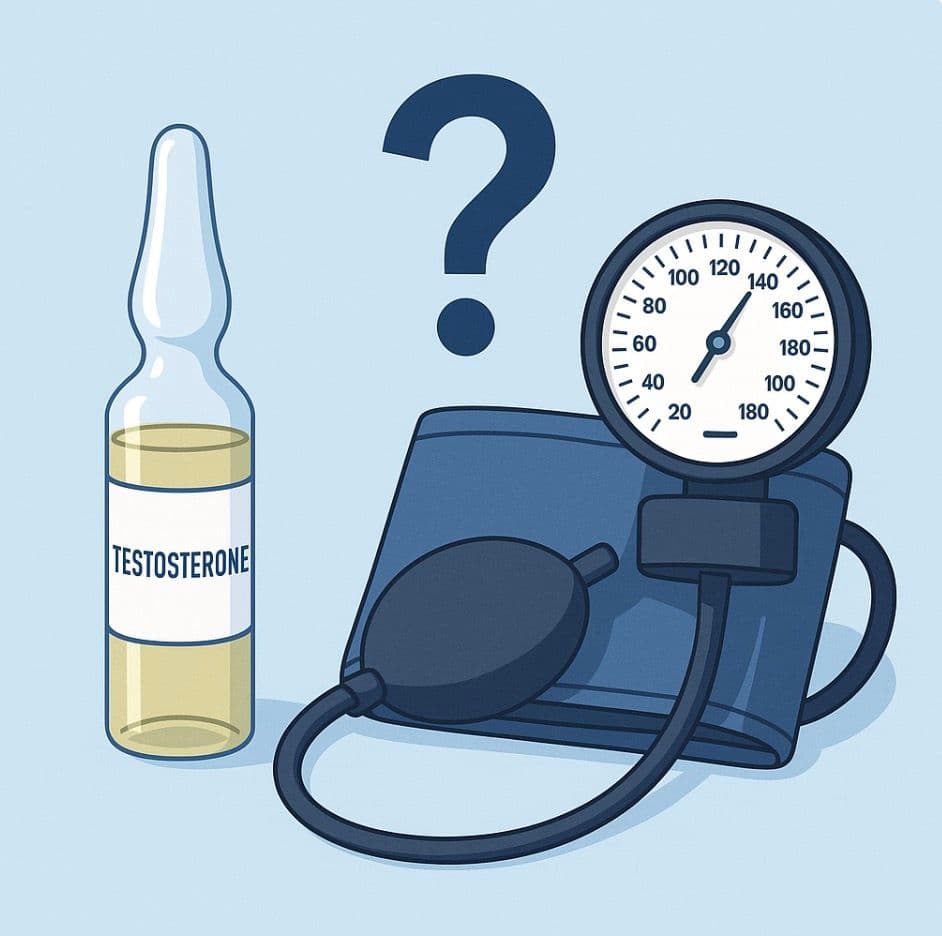
Yes. Testosterone therapy can raise blood pressure, and since 2025 the FDA requires every testosterone product to carry a warning saying so. The rise is usually a few points on average, but it shows up across injections, gels, and capsules, and some men in the label studies needed new or adjusted blood pressure medicine. The idea that TRT tends to lower blood pressure is not what the testing found.
What did the FDA change in 2025?
In February 2025 the FDA reviewed two sets of data: the TRAVERSE heart-safety trial and required studies that tracked blood pressure around the clock with ambulatory monitors (a cuff worn for 24 hours that takes readings automatically). The agency said the completed ambulatory studies "confirmed an increase in blood pressure with use of all testosterone products, class-wide," and required a blood pressure warning on every testosterone label that did not already have one (FDA 2025).
The same action removed Boxed Warning language about a higher risk of heart attack and stroke, based on TRAVERSE. Removing the old heart warning did not make testosterone neutral for blood pressure.
The testosterone cypionate injection label now reads: "Testosterone can increase blood pressure which can increase cardiovascular (CV) risk over time" (DEPO-Testosterone label).
How much does testosterone raise blood pressure?
The product labels report the average change from each man's own starting reading, measured with 24-hour monitors:
- Xyosted (testosterone enanthate injected under the skin weekly): systolic (top number) up 3.9 mm Hg and diastolic (bottom number) up 1.5 mm Hg after 12 weeks, in 62 men with usable recordings (Xyosted label).
- Jatenzo (oral testosterone undecanoate): up 4.9/2.5 mm Hg after about 4 months, in 135 men. The label adds that "average blood pressures had not plateaued at the end of the trial" (Jatenzo label).
- Aveed (long-acting testosterone undecanoate injection): up 3.1/2.0 mm Hg at week 16, in 139 men (Aveed label).
These are averages, so some men rose more and some less. The share who needed treatment gives a better sense of the spread. In the Xyosted one-year study, 10% of men started blood pressure medicine or changed their regimen, and 12.7% had hypertension reported as a side effect (Xyosted label). In the Jatenzo study, 7.2% started blood pressure medicine or had it increased (Jatenzo label).
These studies ran 12 weeks to 4 months and measured change from baseline. They were not head-to-head comparisons, so they cannot tell you which form of testosterone raises blood pressure least.
What did TRAVERSE show?
TRAVERSE (NEJM 2023) was a randomized, placebo-controlled trial of 5,246 men aged 45 to 80 with low testosterone, symptoms, and existing heart disease or a high risk of it. They used daily 1.62% testosterone gel or a placebo gel and were followed for about 33 months on average.
Heart attack, stroke, or cardiovascular death occurred in 7.0% of the testosterone group and 7.3% of the placebo group. That met the trial's test for noninferiority (testosterone was not worse than placebo). It does not show that testosterone protects the heart. Atrial fibrillation, acute kidney injury, and pulmonary embolism were more common with testosterone.
Blood pressure moved in TRAVERSE too. At 36 months, systolic pressure was up 1.0 mm Hg on testosterone and down 0.5 mm Hg on placebo, a difference of 1.5 mm Hg (Xyosted label, reporting TRAVERSE).
The American Urological Association guideline, written before TRAVERSE, tells clinicians to counsel men that "it cannot be stated definitively whether testosterone therapy increases or decreases the risk of cardiovascular events" (statement 20, Moderate Recommendation, Grade B) (AUA). TRAVERSE answered part of that question for gel in this group of men. It did not test injections.
Who should be careful?
- Men with uncontrolled high blood pressure. The Xyosted, Jatenzo, Aveed, and testosterone cypionate labels all say testosterone is "not recommended" for them (DEPO-Testosterone label). Blood pressure should be under control before therapy starts.
- Men already on blood pressure medicine. Treated hypertension did not stop the rise. Men on blood pressure medicine went up 3.9/1.3 mm Hg on Xyosted (Xyosted label) and 5.4/3.2 mm Hg on Jatenzo (Jatenzo label).
- Men with a recent heart attack or stroke. The AUA says testosterone "should not be commenced for a period of three to six months in patients with a history of cardiovascular events" (statement 24, Expert Opinion) (AUA).
- Men with heart, kidney, or liver disease. The labels warn that fluid retention (edema), with or without heart failure, can be a serious complication in these men. In the Xyosted one-year study, 2.7% of men had peripheral edema (swelling in the limbs) (Xyosted label).
How do you keep track of your blood pressure on TRT?
The labels tell prescribers to measure blood pressure periodically, especially in men with hypertension (DEPO-Testosterone label). A reading before you start gives you something to compare against later.
Home readings fill in the gaps between visits. The American Heart Association recommends an automatic upper-arm cuff that has been validated; wrist and finger monitors are not recommended. Before measuring, skip caffeine, smoking, and exercise for 30 minutes, empty your bladder, and sit quietly for at least five minutes with your arm supported at heart level and the cuff on bare skin. Take two readings one minute apart, at the same time each day, and write them down (AHA home monitoring).
The AHA categories for adults (AHA blood pressure readings):
- Normal: under 120 and under 80
- Elevated: 120 to 129 and under 80
- Stage 1 hypertension: 130 to 139 or 80 to 89
- Stage 2 hypertension: 140 or higher or 90 or higher
- Severe: higher than 180 and/or higher than 120. Call 911 if you also have chest pain, shortness of breath, back pain, numbness, weakness, a change in vision, or trouble speaking. Without those symptoms, call your healthcare professional.
If your home readings climb into a higher category after starting testosterone, send them to the clinician who prescribes it. Don't change your dose on your own. Options such as a dose change or blood pressure medicine are their call, made with your numbers in hand. Diet, exercise, and other steps are covered in how to lower blood pressure while on testosterone.
Blood pressure is separate from hematocrit (the share of your blood made of red cells), which testosterone also raises. The labels call for checking hemoglobin and hematocrit periodically on long-term therapy (DEPO-Testosterone label), so expect both on your follow-up plan. The risks and the thresholds are covered in how high hematocrit becomes dangerous.
Common questions
Is a 3 to 5 point rise worth worrying about?
The labels treat it as a real risk: testosterone "can increase blood pressure, which can increase cardiovascular risk over time" (Xyosted label). An average also hides the men who rose more. In the Xyosted one-year study, 10% of men started or changed blood pressure medicine.
Does the type of testosterone matter?
Every form tested raised blood pressure, which is why the FDA made the warning class-wide (FDA 2025). The studies differed in length, design, and the men enrolled, so their numbers can't be lined up to rank one form as safer.
Can I stay on TRT if my blood pressure goes up?
In the Xyosted and Jatenzo studies, 7% to 10% of men started or adjusted blood pressure medicine during treatment. The labels say testosterone is not recommended once blood pressure is uncontrolled, so the decision depends on whether your readings can be brought back under control. Your prescriber makes that call with you.
Does a red face on TRT mean my blood pressure is high?
Not reliably. Flushing has several possible causes, and redness alone can't tell you your blood pressure; a cuff reading can. The other causes are covered in facial redness on testosterone.
Bottom line
Testosterone therapy can raise blood pressure. Label studies measured average increases of about 3 to 5 mm Hg systolic over 12 weeks to about 4 months, and the FDA has required a blood pressure warning on every testosterone product since 2025. TRAVERSE found no increase in heart attacks, strokes, or cardiovascular deaths with testosterone gel over about three years, but it did not show protection. If you have uncontrolled high blood pressure, get it controlled before starting, and check your blood pressure regularly once you are on therapy.
AlphaMD providers review your labs before prescribing testosterone replacement therapy and follow up with repeat labs during treatment.
Have a question? Ask us.
At AlphaMD, we're here to help. Feel free to ask us any question you would like about TRT, medical weightloss, ED, or other topics related to men's health. Or take a moment to browse through our past questions.
People are asking...
How dangerous is high hematorcrit?...
There are some studies that show it can increase cardiovascular issues, though you'd tend to notice some of the symptoms if it was induced from starting TRT. Brain fog & additional headaches are prett... See Full Answer
How do you guys handle increased blood pressure on trt? Normal bp off, but high when on trt....
In general, the provider overseeing your care looks to make sure the doses make sense & are not overly high to create unnecessary side effects to BP. If the dosage is right & you still have BP issues,... See Full Answer
I’m back on testosterone therapy again with my primary doc. 0.3mL twice a week (120mg) of test cypionate. My bloodwork recently was phenomenal excep...
To clarify, was your recent bloodwork with the before or after you restarted TRT? That would be odd for you to have low T levels with the dose you listed (120mg/wk). Enclomiphene, as well as its cousi... See Full Answer
Get $30 off your first month’s order
Enter your email address now to receive $30 off your first month’s cost, other discounts, and additional information about TRT.
Legal Disclaimer
This website is a repository of publicly available information and is not intended to form a physician-patient relationship with any individual. The content of this website is for informational purposes only. The information presented on this website is not intended to take the place of your personal physician's advice and is not intended to diagnose, treat, cure, or prevent any disease. Discuss this information with your own physician or healthcare provider to determine what is right for you. All information is intended for your general knowledge only and is not a substitute for medical advice or treatment for specific medical conditions. The information contained herein is presented in summary form only and intended to provide broad consumer understanding and knowledge. The information should not be considered complete and should not be used in place of a visit, phone or telemedicine call, consultation or advice of your physician or other healthcare provider. Only a qualified physician in your state can determine if you qualify for and should undertake treatment.