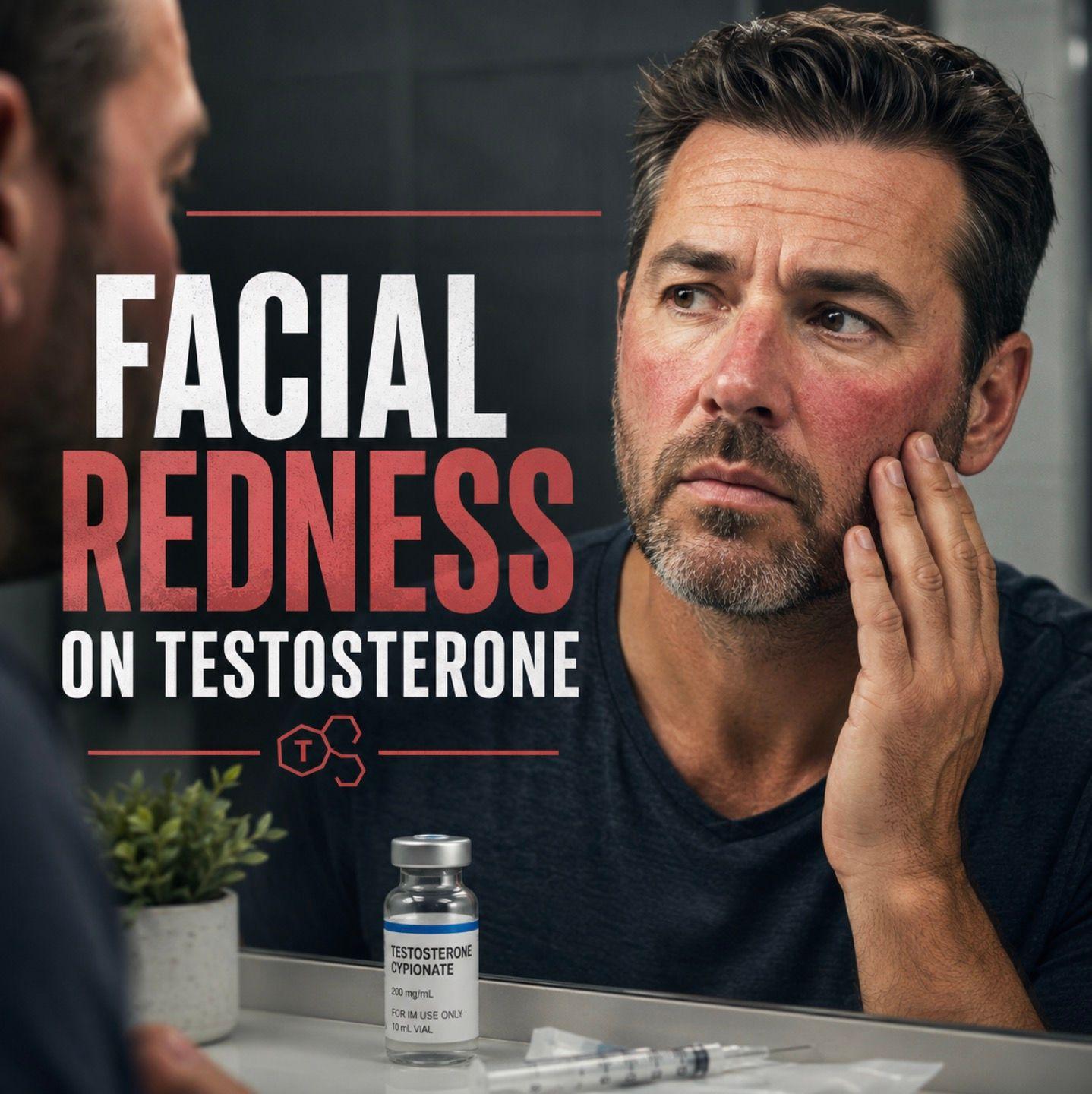
Facial redness or flushing can appear after starting testosterone replacement therapy, but it does not necessarily mean your dose is too high. It can come from a higher red blood cell count, a rise in blood pressure, rosacea, acne, everyday flushing triggers, another medication, or a condition unrelated to testosterone.
Find the actual cause before assuming a red face on TRT means "thick blood."
Quick answer: can testosterone cause facial redness?
Testosterone can contribute to facial redness, mostly indirectly. TRT can:
- Raise red blood cell production and hematocrit (the share of your blood made of red cells)
- Raise blood pressure in some men; since 2025 every testosterone product's label carries this warning (FDA, 2025)
- Cause oily skin and acne, which are listed side effects (testosterone cypionate label)
- Start around the same time as rosacea or other skin changes that have nothing to do with it
Redness alone cannot tell you whether your hematocrit, blood pressure, or testosterone level is high. Those need a blood test and a blood pressure reading.
Bring persistent or unexplained redness to the clinician managing your treatment.
Why might your face look red after starting TRT?
Several conditions look alike. When the redness appears, how long it lasts, what sets it off, and what other symptoms come with it help narrow the cause.
1. More red blood cells
Testosterone stimulates the body to make red blood cells, so hemoglobin and hematocrit usually rise somewhat on treatment. That is why the AUA guideline says to measure both before starting and to tell patients about the risk of polycythemia (too many red blood cells) (AUA guideline).
Cutoffs differ by source. One review defines erythrocytosis (a high red cell count) as a hematocrit above 52% (Jones et al., 2015). The AUA guideline says a hematocrit of 54% or higher on treatment "warrants intervention," with a dose adjustment tried first when testosterone levels are high, and that a baseline hematocrit above 50% means holding off on testosterone until the cause is explained (AUA guideline, Table 8). For what lowers it, see how to lower hematocrit.
A high hematocrit often causes no symptoms. When it does, MedlinePlus lists (hematocrit test):
- Headache
- Feeling light-headed or dizzy
- Weakness or fatigue
- Itching after a shower or bath, burning, or a red face
- Heavy sweating, especially during sleep
- Blurred or double vision
- Shortness of breath when lying down
None of these is specific, so only a complete blood count shows whether hematocrit is actually high. Testosterone labeling says hemoglobin and hematocrit "should be checked periodically" in men on long-term treatment (testosterone cypionate label).
2. Changes in blood pressure
Flushing is not a reliable sign of high blood pressure, but blood pressure is worth checking when redness appears after starting or changing TRT.
In February 2025 the FDA required every testosterone product to carry a warning that it can raise blood pressure (FDA, 2025). The current label puts it plainly: "Testosterone can increase blood pressure which can increase cardiovascular (CV) risk over time" (testosterone cypionate label). Periodic checks matter most if you already have hypertension or other cardiovascular risk factors. See how to lower blood pressure on testosterone.
A home monitor helps, but single readings mislead. The American Heart Association advises an upper-arm cuff, no smoking, caffeine, or exercise in the 30 minutes before, five minutes of quiet rest, and two readings one minute apart, recorded each time (AHA). Share the log with your provider.
Call 911 for a reading above 180/120 mm Hg with chest pain, shortness of breath, back pain, numbness, weakness, a change in vision, or difficulty speaking (AHA).
3. Rosacea
Rosacea is a long-term inflammatory skin condition. According to the NIH's skin institute (NIAMS), it can cause:
- Facial redness that starts as a tendency to flush and can become persistent
- Tingling or burning
- Red or pus-filled bumps that resemble acne
- Visible small blood vessels on the cheeks and nose
- Thickened skin, mostly on the nose and mostly in men
- Sore, red, gritty, or dry eyes
It is more common in middle-aged and older adults (NIAMS), the same age group that often starts TRT.
Common rosacea triggers (NIAMS):
- Sunlight
- Emotional stress
- Hot or cold weather and strong winds
- Strenuous exercise
- Alcohol
- Hot baths
- Spicy foods
- Hot foods or drinks
Starting TRT and developing rosacea around the same time does not mean testosterone caused it. A dermatologist can tell rosacea apart from acne, dermatitis, sun damage, and other skin conditions.
4. Temporary flushing
Flushing is a sudden reddening of the face, neck, or upper chest from increased blood flow (MedlinePlus).
MedlinePlus lists these common causes (MedlinePlus):
- Alcohol
- Exercise
- Strong emotions
- Hot or spicy foods
- Rapid temperature changes or heat exposure
- Fever
- Some medicines for diabetes and high cholesterol
All of these cause redness in men who are not on testosterone. Redness that comes briefly after a workout, a hot shower, a drink, or a spicy meal is different from a complexion that stays red all day.
5. Acne or skin irritation
Oily skin (seborrhea) and acne are listed side effects of testosterone (testosterone cypionate label).
Inflamed acne can make the whole face look red, especially when combined with:
- Harsh cleansers
- Frequent scrubbing
- Shaving irritation
- Retinoids
- Benzoyl peroxide
- Fragranced skincare products
- Excessive sun exposure
Look at whether the redness is smooth and spread out, or concentrated around pimples, shaving areas, dry patches, or irritated skin.
6. Dose and hormone swings
Facial redness does not prove a dose is too high. Higher testosterone levels on treatment are one reason hematocrit climbs, which is why the AUA guideline tries a dose adjustment first when hematocrit reaches 54% and testosterone is high (AUA guideline, Table 8). For other signs of a level that is too high, see 6 warning signs your testosterone is too high.
A clinician may review:
- Your prescribed dose
- Injection frequency
- Testosterone level and when the blood was drawn
- Hemoglobin and hematocrit
- Blood pressure
- Other medications and supplements
- Sleep apnea risk
- Smoking or nicotine use
Do not change or stop your testosterone because your face looks red. A dose change should rest on symptoms, measurements, and a clinician's evaluation.
Does a red face mean your hematocrit is too high?
No. Redness does not substitute for a blood test.
A man can have high hematocrit without looking red, and another can have obvious redness with a normal blood count.
A complete blood count reports:
- Red blood cell count
- Hemoglobin
- Hematocrit
- White blood cell count
- Platelets
The Endocrine Society guideline recommends checking hematocrit at baseline, 3 to 6 months after starting testosterone, and then yearly (Endocrine Society guideline slides).
Your provider may test sooner after a dose change or when symptoms suggest a problem.
Should you donate blood because your face is red?
No. Do not donate blood just because your face looks flushed.
Donation or therapeutic phlebotomy (a blood draw done as treatment) lowers hematocrit for a while, but it does not explain why it rose. Frequent donation also drains iron: in a study of 2,425 blood donors, 18% of men who donated often had no iron stores left by their final visit (RISE study, 2012).
When hematocrit is high, a clinician may consider:
- Repeating the test to confirm it
- Reviewing the testosterone dose and blood level
- Adjusting the dose or schedule
- Evaluating for sleep apnea
- Addressing smoking or lung disease
- Changing the testosterone formulation
- Pausing treatment when needed
- Blood donation or therapeutic phlebotomy in selected cases
The right step depends on how high the hematocrit is, your symptoms, your history, and the cause.
What to do if you develop facial redness on TRT
Note when it happens
Track whether the redness appears:
- Shortly after an injection
- During exercise
- After showering
- After alcohol or spicy food
- During stress
- In hot weather
- After applying skincare products
- All day long
Photos taken in similar lighting help document changes.
Measure your blood pressure
Check it seated and rested, following the AHA steps above. Repeated high readings should go to a healthcare professional.
Check your lab schedule
Ask whether you are due for:
- A complete blood count
- Total and free testosterone
- Other monitoring in your treatment plan
With injections, the timing of a testosterone test matters. Follow your provider's instructions on when to draw blood relative to your dose.
Review other triggers
Consider recent changes in:
- Alcohol
- Caffeine
- Pre-workout supplements
- Niacin supplements
- Blood pressure or cholesterol medication
- Skincare products
- Sun exposure
- Exercise intensity
- Hot showers or saunas
Some cholesterol and diabetes medicines cause flushing on their own (MedlinePlus).
Talk to your TRT provider
Contact your provider when redness is new, persistent, worsening, or comes with other symptoms. They can work out whether the cause looks skin-related, blood-pressure-related, blood-related, medication-related, or unrelated to TRT.
A dermatologist is the right referral when the redness comes with visible blood vessels, persistent burning, eye irritation, scaling, or acne-like bumps.
When facial redness needs urgent care
Seek urgent care when facial redness comes with:
- Chest pain
- Difficulty breathing
- Fainting
- Sudden weakness or numbness
- Confusion
- A severe or unusual headache
- Vision loss or major vision changes
- Painful swelling in one leg
- Coughing up blood
- Swelling of the lips, tongue, or throat
- Hives or signs of a severe allergic reaction
These are not routine TRT side effects.
Can facial redness be prevented?
Not always, but these habits reduce common triggers:
- Take testosterone as prescribed
- Keep up with lab monitoring
- Check your blood pressure
- Limit your known flushing triggers
- Use gentle cleansers made for sensitive skin, and daily SPF 30 or higher sunscreen on your face (NIAMS)
- Avoid very hot showers
- Treat sleep apnea if you have it
- Avoid smoking
Rosacea has no cure, but treatment can keep it under control, usually with a mix of self-care and medication (NIAMS).
Frequently asked questions
Is facial redness a common TRT side effect?
It is not one of the main listed side effects. Testosterone can contribute through a higher hematocrit, higher blood pressure, or acne, but many cases have another explanation.
Can high estrogen cause a red face?
Redness is not a reliable sign of high estradiol. The AUA guideline ties estradiol testing to breast symptoms or gynecomastia (breast tissue growth), measured before testosterone is started, as expert opinion (AUA guideline, statement 9). An aromatase inhibitor should not be started because someone looks flushed.
Will lowering my testosterone dose stop the redness?
It may help when the dose is causing high testosterone levels or a high hematocrit. It will not fix rosacea, medication-related flushing, sun damage, or skin irritation.
Can sleep apnea raise hematocrit on TRT?
Yes, it can contribute. The AUA guideline lists obstructive sleep apnea among the causes to rule out when hematocrit is high (AUA guideline, Table 8). In a review of 474 men on TRT, those with sleep apnea had about twice the odds of developing polycythemia, after accounting for age, weight, and peak testosterone. That was a retrospective study from one clinic (Lundy et al., 2020). Snoring, waking up gasping, and daytime sleepiness are reasons to ask about a sleep study.
Is facial redness dangerous?
Most brief flushing is not an emergency. Persistent redness can still point to something worth treating, such as rosacea, a high hematocrit, or uncontrolled blood pressure. The other symptoms and the test results matter more than the color.
Bottom line
The cause of facial redness on testosterone can be found with a blood count, blood pressure readings, and a look at your triggers.
TRT can raise hematocrit and blood pressure, but redness also comes from rosacea, heat, exercise, alcohol, medication, acne, or skin irritation. A red face does not prove your blood is "too thick," and it is not a reason on its own to donate blood or stop treatment.
Check your blood pressure, keep up with the recommended labs, note your triggers, and talk to the licensed provider managing your TRT.
AlphaMD providers review symptoms and lab results before and during testosterone replacement therapy.