
Is There Really a Three-Week Rule for TRT Side Effects?
People are asking...
is there a legitimate protocol to trial trt? say 3 months and re-evaluate with a go/no-go?...
Yes. Many patients are “borderline”, and it is difficult to determine if they may or may not benefit from TRT. In those cases, a 3-6 month therapeutic trial is done. If they don’t notice improvement o... See Full Answer
Do you have any theories as to why some people experience a honeymoon phase for a few weeks then lose the benefits of TRT?...
The most common reason for this in men tends to be a need for a simple dose adjustment. There's a general 8 week uptake period where injected levels increase week over week & then natural production ... See Full Answer
Is getting on TRT a lifetime commitment? Should I expect bad side effects from coming off of it? Just wondering if I’ll be a 80 year old one day on TR...
Yes & no. It's better to think of it this way: If you have low Testosterone & do not treat it, you are committing to a life-time of low Testosterone symptoms that will for a fact always worsen with ag... See Full Answer
Have a question? Ask us.
At AlphaMD, we're here to help. Feel free to ask us any question you would like about TRT, medical weightloss, ED, or other topics related to men's health. Or take a moment to browse through our past questions.
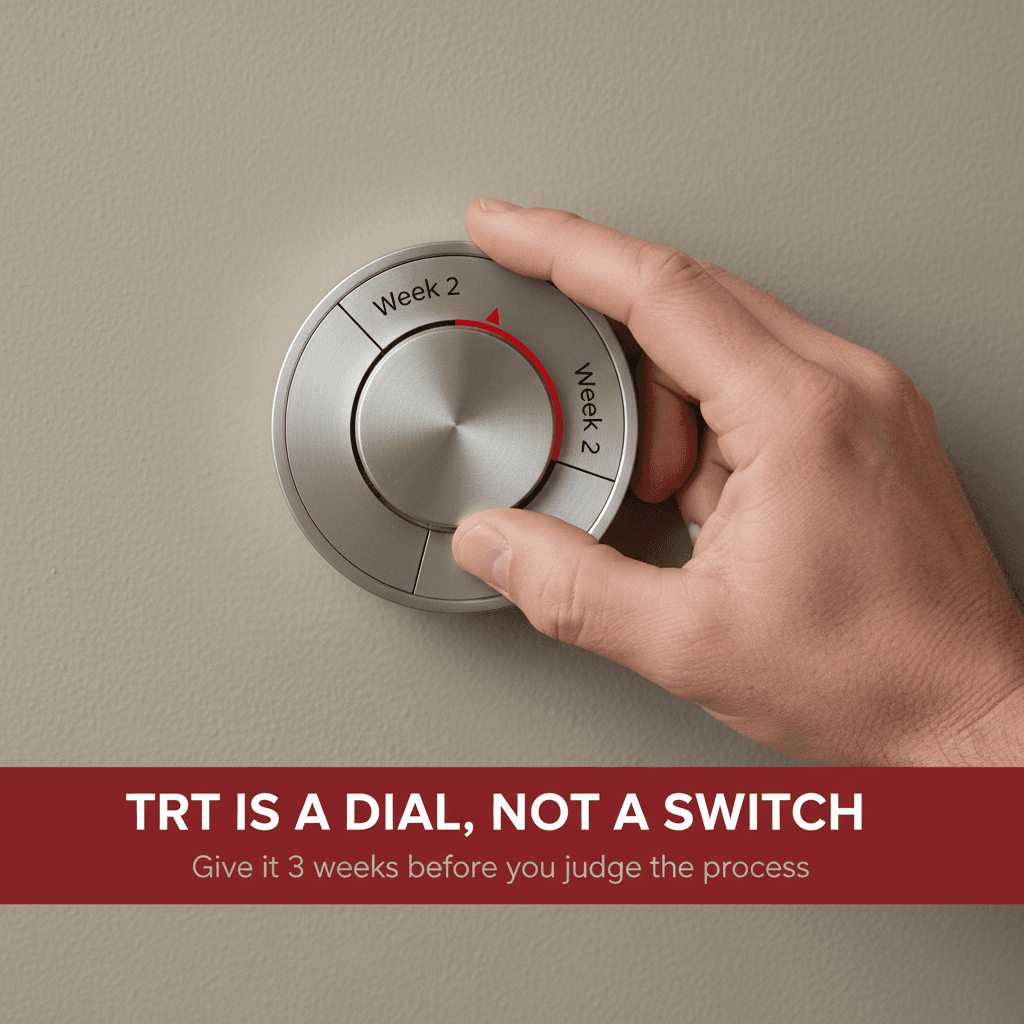
No study has tested a three-week rule for TRT side effects, so nobody can promise that early problems settle by week 3. The idea is common in TRT forums: wait three weeks before judging how treatment is going. What the research does show is narrower. Some benefits start to appear around three weeks, other effects (including some side effects) take months to show up, and guidelines judge the response to treatment at 3 to 12 months, not at three weeks.
The rule gets applied to two different things. Benefits do take weeks to months to appear, so judging treatment after a few days is too early. Chest pain, a swollen leg, or sudden shortness of breath are a different matter and need care the same day.
Where the three-week idea comes from
The closest thing to evidence is a 2011 review in the European Journal of Endocrinology that pulled together published trials to estimate when each effect of testosterone treatment first appears and when it peaks (Saad et al., 2011). It reported:
- Sexual interest: improves after about 3 weeks and plateaus at about 6 weeks.
- Quality of life: improves within 3 to 4 weeks, with the full benefit taking longer.
- Depressive mood: changes become detectable after 3 to 6 weeks and peak at 18 to 30 weeks.
- Erections and ejaculation: changes may take up to 6 months.
- Fat mass, lean mass, and strength: changes begin within 12 to 16 weeks and stabilize at 6 to 12 months.
- Red blood cell production: the effect is evident at 3 months and peaks at 9 to 12 months.
So three weeks is roughly when the earliest benefits begin. The review is about benefits, not about when side effects go away, and its authors note "considerable variation" between men and between testosterone products. It is a review of other studies, not a trial designed to answer this question.
Other timelines in circulation have even less behind them. Some say weeks 3 to 6 are the worst stretch, that men reliably feel better by week 8 or 12, or that the first 90 days are a fixed adjustment period. None of those timelines is established by published research.
What actually happens to your levels in the first weeks
Testosterone cypionate, the most common injection, has a half-life of about 8 days after an intramuscular shot (DEPO-Testosterone label). Levels rise after each injection and fall gradually over the following days, not off a cliff.
That peak-and-trough pattern is the most concrete explanation for symptoms that come and go in the first weeks. A 2026 practical review for primary care doctors describes "early peak-related symptoms and late-cycle recurrence of hypogonadal symptoms" in some men, especially with larger doses given at longer intervals (Cureus, 2026). If you feel good a day or two after a shot and worse before the next one, that pattern is covered in more detail in why some men feel worse a few days after injecting.
The same review says weekly dosing "is often a reasonable and effective schedule, and many patients do well with it," and treats more frequent, smaller injections as an optional tool rather than a default. It is expert opinion, not trial evidence. Changing your injection schedule is a decision for your prescriber.
Starting testosterone also tells your brain to stop signaling the testes, which lowers your own testosterone and sperm production. That is why the Endocrine Society recommends against starting testosterone in men who are planning to have children in the near term (Endocrine Society, 2018).
Side effects that can show up early
The Cureus review lists the complaints some men report on weekly injections: acne or oily skin, mood or sleep disturbance, breast tenderness, fluid retention, fatigue late in the dosing cycle, lower libido, and erection problems. The cypionate label adds headache, anxiety, depression, and either increased or decreased libido.
Good rates for these early effects do not exist. The label lists them without percentages, and no study has tracked how long each one lasts in the first weeks.
Mood is the one with a trial behind it, though at doses far above replacement. In a randomized trial, 56 healthy men aged 20 to 50 received testosterone cypionate rising to 600 mg a week for 6 weeks (Pope et al., 2000). Of the 50 who reached that dose, 84% had minimal psychiatric effects, 12% became mildly hypomanic (elevated, revved-up mood), and 4% became markedly hypomanic. Nothing measured at baseline predicted who would react. Replacement doses are much lower, and the trial lasted 6 weeks in men who did not have low testosterone.
Some changes are worth reporting to your prescriber even if they are mild:
- Breast tenderness or swelling. The label says gynecomastia (breast tissue growth) "may develop and occasionally persists." The AUA guideline ties estradiol testing to breast symptoms or gynecomastia (AUA statement 9), which is a reason to tell your prescriber rather than guess at an estrogen problem yourself.
- Swelling in the ankles or hands. The label warns that edema (fluid retention) can be a serious complication in men with existing heart, kidney, or liver disease.
- Higher blood pressure readings. In 2025 the FDA reported that blood pressure studies "confirmed an increase in blood pressure with use of all testosterone products," and it required a blood pressure warning on testosterone labels (FDA, 2025).
For a look at common changes that are usually harmless, see TRT side effects that usually aren't a problem.
Symptoms that need care the same day
Get emergency care for any of these, whatever week of treatment you are in:
- Pain, swelling, warmth, or redness in one leg, which can signal a blood clot (deep vein thrombosis, or DVT). The cypionate label tells clinicians to evaluate these symptoms for DVT.
- Sudden shortness of breath, which the label says should be evaluated for a clot in the lungs (pulmonary embolism, or PE).
- Chest pain or pressure.
- Thoughts of harming yourself or others.
Clots are a documented risk. In TRAVERSE, a randomized trial of 5,246 men aged 45 to 80 with or at high risk of heart disease, testosterone gel did not increase major cardiac events compared with placebo (7.0% vs 7.3%), but pulmonary embolism, atrial fibrillation, and acute kidney injury were more frequent in the testosterone group (TRAVERSE, NEJM 2023).
Some effects take months, not weeks
Hematocrit (the share of your blood made of red cells) is the clearest example. The rise in red cell production is evident at about 3 months and peaks at 9 to 12 months (Saad et al., 2011). A normal-feeling first month says nothing about it. The Endocrine Society's monitoring plan checks hematocrit at baseline, at 3 to 6 months, and then yearly (Endocrine Society plenary slides). What happens when levels or hematocrit run high is covered in warning signs your testosterone is too high.
When treatment is actually judged
Guidelines use a longer clock than three weeks:
- The Endocrine Society says to evaluate the patient "at 3-12 months after treatment initiation and then annually to assess whether symptoms have responded to treatment and whether the patient is suffering from any adverse effects," and to check testosterone levels 3 to 6 months after starting.
- The AUA says clinicians should discuss stopping therapy 3 to 6 months after starting if testosterone levels are normal but symptoms have not improved.
Between those checkpoints, the most useful thing you can bring to your prescriber is a record. Note what you feel, when it started, and how many days it was after your last injection. The Cureus review asks clinicians to document injection timing and the timing of blood draws for the same reason: a lab value or a symptom means little without knowing where it fell in the dosing cycle.
Do not change your dose, skip injections, or add other drugs on your own. An unplanned change also makes the next lab result harder to interpret.
Who should not start TRT
The Endocrine Society recommends against starting testosterone in men who:
- are planning to have children in the near term
- have breast or prostate cancer, or a prostate nodule or raised PSA that has not been evaluated
- have an elevated hematocrit
- have untreated severe obstructive sleep apnea
- have severe lower urinary tract symptoms
- have uncontrolled heart failure
- have had a heart attack or stroke in the last 6 months
- have thrombophilia (a tendency to form blood clots)
Common questions
Is it normal to feel worse in the first few weeks of TRT?
Some men report feeling worse early, often in a pattern tied to injection timing. No study gives a rate or a typical duration, so there is no standard answer for how long it should last. Tell your prescriber what you notice and when.
Should I wait three weeks before reporting a side effect?
No. Mild changes like oily skin can be mentioned at your next check-in, but there is no evidence-based reason to hold off. Leg swelling, chest pain, or sudden shortness of breath need care the same day.
When should I expect to feel better?
Based on the 2011 review, sexual interest and quality of life may begin to improve around 3 to 4 weeks, mood over 3 to 6 weeks and beyond, and body composition over 3 to 4 months. These are averages across studies, and individual men vary widely.
If I feel fine at three weeks, am I in the clear?
Not entirely. Red blood cell production peaks 9 to 12 months in, and hematocrit and blood pressure have to be measured. That is why follow-up labs at 3 to 6 months matter even when you feel well.
Bottom line
There is no tested three-week rule for TRT side effects. Three weeks is roughly when the earliest benefits begin, while red blood cell changes take months and guidelines judge treatment at 3 to 12 months. Report mild side effects to your prescriber without waiting for a deadline, get same-day care for leg swelling, chest pain, or sudden shortness of breath, and leave dose changes to the clinician managing your care. AlphaMD's testosterone replacement therapy includes provider review of labs before prescribing and follow-up labs after you start.
Have a question? Ask us.
At AlphaMD, we're here to help. Feel free to ask us any question you would like about TRT, medical weightloss, ED, or other topics related to men's health. Or take a moment to browse through our past questions.
People are asking...
is there a legitimate protocol to trial trt? say 3 months and re-evaluate with a go/no-go?...
Yes. Many patients are “borderline”, and it is difficult to determine if they may or may not benefit from TRT. In those cases, a 3-6 month therapeutic trial is done. If they don’t notice improvement o... See Full Answer
Do you have any theories as to why some people experience a honeymoon phase for a few weeks then lose the benefits of TRT?...
The most common reason for this in men tends to be a need for a simple dose adjustment. There's a general 8 week uptake period where injected levels increase week over week & then natural production ... See Full Answer
Is getting on TRT a lifetime commitment? Should I expect bad side effects from coming off of it? Just wondering if I’ll be a 80 year old one day on TR...
Yes & no. It's better to think of it this way: If you have low Testosterone & do not treat it, you are committing to a life-time of low Testosterone symptoms that will for a fact always worsen with ag... See Full Answer
Get $30 off your first month’s order
Enter your email address now to receive $30 off your first month’s cost, other discounts, and additional information about TRT.
Legal Disclaimer
This website is a repository of publicly available information and is not intended to form a physician-patient relationship with any individual. The content of this website is for informational purposes only. The information presented on this website is not intended to take the place of your personal physician's advice and is not intended to diagnose, treat, cure, or prevent any disease. Discuss this information with your own physician or healthcare provider to determine what is right for you. All information is intended for your general knowledge only and is not a substitute for medical advice or treatment for specific medical conditions. The information contained herein is presented in summary form only and intended to provide broad consumer understanding and knowledge. The information should not be considered complete and should not be used in place of a visit, phone or telemedicine call, consultation or advice of your physician or other healthcare provider. Only a qualified physician in your state can determine if you qualify for and should undertake treatment.